
BILLION-DOLLAR BLIND SPOTS IN ILLINOIS
Billion-Dollar Blind Spots
Inside Illinois’ quiet convergence of power, profit, and public money
By Staff Writer
January 13, 2026
At her kitchen table in suburban Cook County, Linda Morales, a retired public-school teacher, studies her property tax bill like a document written in a foreign language. It has climbed again—nearly 28 percent in four years—while her pension remains fixed and her energy bills rise each winter.
“I did everything right,” Morales says.
“I worked, I paid in. And it feels like the system keeps getting more expensive for people like me, while someone else always seems protected.”
Morales does not follow campaign trackers or ethics filings. But the system shaping her finances is now under renewed scrutiny—one that reaches the highest office in Illinois and tens of billions of taxpayer dollars flowing quietly through it.
When Gov. JB Pritzker took office in 2019, he pledged to separate his immense personal fortune from public decision-making by placing his assets into a blind trust. The move was meant to neutralize conflicts of interest and reassure Illinois residents that wealth and governance would not intertwine.
Six years later, that promise is facing its most serious test.
A Pattern, Not a Single Contract
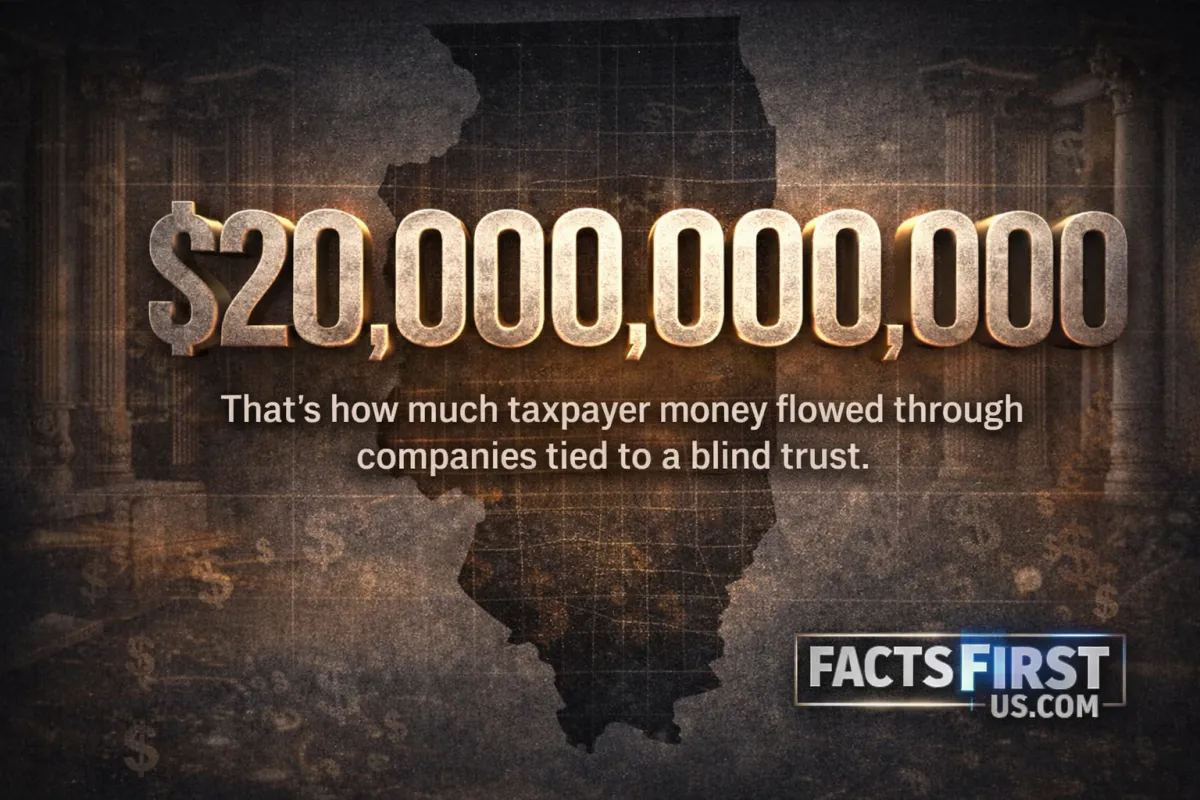
Records drawn from state procurement data, public authority approvals, and watchdog reports reveal that 12 for-profit companies held within Gov. Pritzker’s blind trust have collectively received more than $20 billion in Illinois state contracts since he became governor—all funded by taxpayers through income taxes, sales taxes, and federally matched programs such as Medicaid.
The contracts are legal. The question critics raise is whether they are sustainable for public trust.
“When financial interests repeatedly intersect with public spending at this magnitude, the concern is no longer theoretical,”
said David Ellis, an ethics professor.
“Even without direct involvement, the appearance of influence becomes unavoidable—and corrosive.”
There is no allegation that Gov. Pritzker personally directed individual contracts. Ethics experts emphasize, however, that blind trusts are designed to prevent not only wrongdoing—but doubt. And doubt, once entrenched, is difficult to dislodge.
The Centene Overlap
One of the most consequential intersections involves Centene Corporation, one of Illinois’ largest Medicaid contractors.
Through its subsidiaries, Centene has received more than $20 billion in state funding during the Pritzker administration. In 2022, the governor’s blind trust purchased Centene stock—after those contracts were already firmly in place.
The Better Government Association flagged the overlap, warning that legality alone does not resolve ethical concerns.
“The issue is not whether a rule was broken,” the organization stated,
“but whether the rules themselves are sufficient to protect public confidence.”
The Hyatt Question and Public Authorities
Scrutiny deepened with renewed attention on the Hyatt Regency McCormick Place, operated by Hyatt Corporation and controlled by the Pritzker family.
A recent investigation by FactsFirstUS.com found that more than $180 million in taxpayer funds have flowed to the hotel since 2011 through approvals by the Metropolitan Pier and Exposition Authority (MPEA)—a public body whose board Gov. Pritzker appoints nearly half of.
In December 2024, the MPEA approved a $59.5 million taxpayer-funded renovation of 1,258 hotel rooms. In Fiscal Year 2023 alone, $8.8 million was spent on Hyatt “infrastructure improvements,” funded by special hotel, food, and beverage taxes.
The full investigation is available at:
https://factsfirstus.com/post/illinois-doge
Supporters characterize the spending as routine convention-center investment. Critics argue it reflects a broader structural imbalance.
DOGE Illinois and the Fight Over Scrutiny
The debate intensified after Republican gubernatorial candidate Darren Bailey launched a Transparency Tracker as part of his proposed Department of Government Efficiency (DOGE Illinois).
Gov. Pritzker has publicly dismissed DOGE-style efforts to examine government spending. In a Facebook post, he wrote:
“DOGE is an insult to all Americans.”
He continued:
“Millions of people have been impacted by Elon Musk’s blind assault on our government.
They have lost their livelihoods, security, and healthcare.
And for what?”
Those remarks are now resurfacing as critics argue that Illinois taxpayers deserve equal scrutiny of billions flowing through their own state government—especially when those dollars intersect with the governor’s financial interests.
Is Illinois an Outlier?
Comparative analysis by ethics researchers suggests Illinois stands apart.
States such as Ohio, Indiana, and Wisconsin also permit blind trusts. But experts note it is far less common for companies tied to those trusts to receive multi-billion-dollar shares of state contracting during the same administration.
“The concentration of overlap in Illinois stands out,”
said Karen Holt, a former state inspector general.
“Other states rely more heavily on divestment requirements or mandatory recusals tied to appointment power.”
Illinois does not.
The Question That Remains
Blind trusts are legal. Public trust is not statutory.
The question confronting Illinois is not whether Gov. Pritzker followed the law—but whether the law is strong enough to protect the public when political power and private wealth repeatedly intersect.
Illinois has faced that question before. Too often, it has waited until after confidence collapsed.
As Morales folds her tax bill and reaches for a calculator, she is not thinking about blind trusts or procurement statutes. She is thinking about whether the system still works for people like her.
That answer may determine more than the next election.
It may decide whether Illinois has learned anything at all.
Sources
Illinois state budget and procurement records
Metropolitan Pier and Exposition Authority board approvals and financial disclosures
Better Government Association ethics analyses
FactsFirstUS.com, “Illinois DOGE” investigation
Public statements by Gov. JB Pritzker via Facebook