
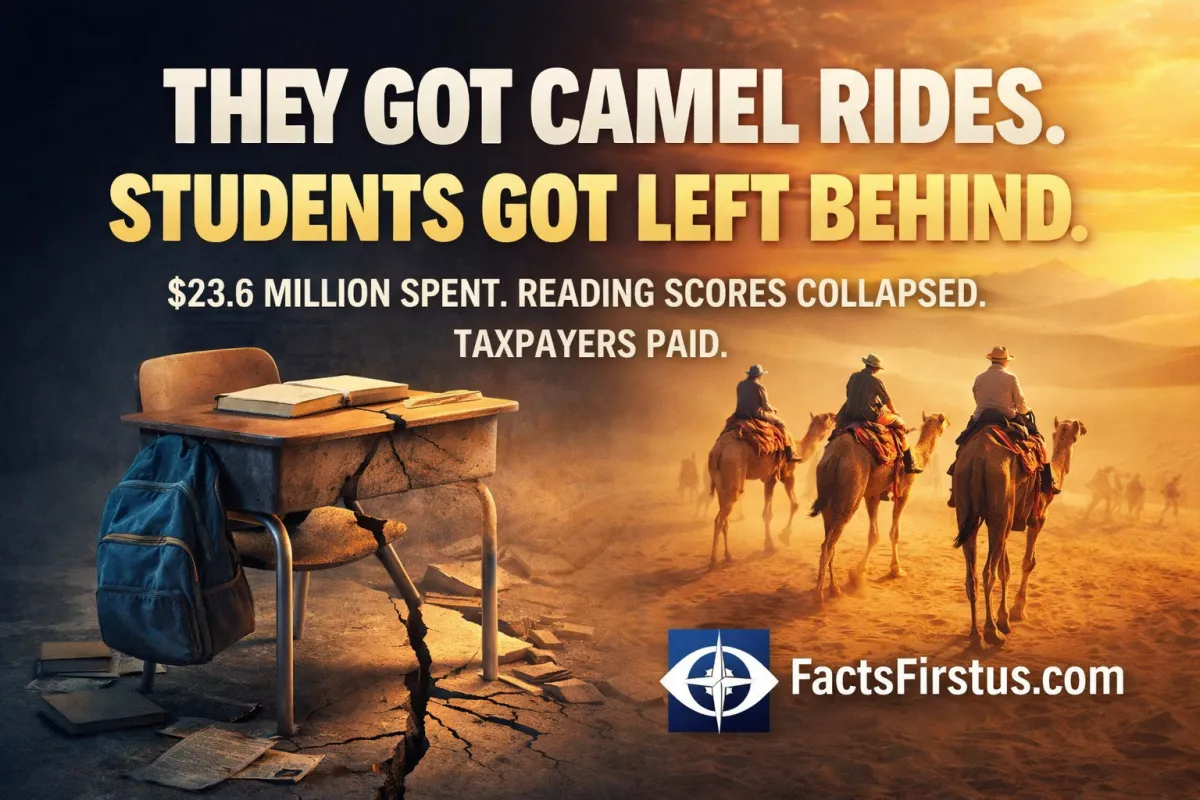
CAMEL RIDES, COLLAPSING CLASSROOMS, AND THE PRICE OF FAILURE
A Camel Ride While the Classroom Crumbles
Illinois lowered the bar, raised taxes, and still couldn’t hide the failure.
By Staff Writer
December 26, 2025
The paragraph isn’t difficult. It’s short, familiar, and written at the level most children master years earlier. But the boy can’t get through it. He pauses, guesses, starts over, and finally gives up.
His mother watches, helpless and quiet.
This is not a rare moment in Illinois. It is an ordinary one — playing out at kitchen tables and homework desks across the state. It’s what educational failure actually looks like when stripped of press releases and talking points.
And it is happening while Illinois spends more per student than nearly any state in the nation — and while Chicago Public Schools employees were boarding international flights to Finland, Egypt, South Africa, and Greece, paid for by the very taxpayers whose children are falling behind.
Safaris. Camel rides. Hot air balloon excursions.
All of it billed as “professional development.”
This isn’t rhetoric.
It’s in the receipts.
Since 2019, Chicago Public Schools staff have spent $23.6 million in taxpayer money on travel, according to the district’s own Office of Inspector General. Not on classroom supplies. Not on tutoring. Not on literacy recovery. On travel — much of it overseas, much of it lavish, and much of it approved under rules so weak the Inspector General described them as “lax, vague, inadequate and unenforced.”
Eight CPS schools alone spent more than $142,000 sending staff on 15 international trips, often through a travel agency that didn’t even have a contract with the district. Most of those trips were never properly approved. One was explicitly rejected — and staff traveled anyway.
At one elementary school, more than $20,000 went toward a single staff trip to Egypt that investigators said included “lavish staff outings.” When scrutiny finally arrived and several trips were canceled, CPS still forfeited nearly $53,000 in prepaid costs.
That money didn’t evaporate.
It was spent.
And it belonged to taxpayers.
What makes the scandal worse is that even inside CPS, the excess was impossible to ignore. As the Inspector General reviewed internal communications, one official tasked with oversight stopped and asked the obvious question — the one parents had been asking all along:
“Why can’t this be done in the United States?”
It was a moment of honesty. And it exposed the truth. If the training could be done domestically, then the overseas travel wasn’t about necessity. It wasn’t about students. It was about a system that no longer knows how to say no — and no longer feels compelled to try.
Back home, the numbers tell a far less glamorous story.
Only two out of five Chicago Public Schools students can read at grade level.
Just one in four are proficient in math.
These aren’t statistical quirks. They are life-shaping outcomes. They determine whether children can keep up, graduate, or compete in a modern economy. They determine whether parents spend evenings reteaching lessons schools failed to deliver.
Chicago is not an exception. It is a warning.
Statewide, Illinois quietly tried to soften the embarrassment. In 2025, education officials lowered proficiency standards, a calculated attempt to make results look better after years of disruption and prolonged school closures. Expectations were reduced. The bar was lowered. The curve was bent.
And even then, students still couldn’t clear it.
After the standards were loosened, just over half of Illinois students could read at grade level, and only 39% were proficient in math.
That is not improvement.
That is exposure.
When a state lowers the bar and still fails, the problem is no longer measurement. It is the system itself.
The price tag for this failure is staggering.
Illinois spends an average of $20,129 per student, placing it among the highest per-pupil spenders in the country. About two-thirds of that money comes from property taxes, and Illinois homeowners pay the highest property tax rates in America, averaging $4,584 per household.
Families are paying more than ever — not for excellence, but for excuses.
They’re told budgets are tight. That progress takes time. That classrooms need patience.
Yet when it came time to book flights, the money was there.
None of this was unforeseeable.
Chicago students were kept out of classrooms for 78 weeks during the pandemic, largely at the insistence of the Chicago Teachers Union, with the full support of city and state leadership. The learning loss that followed was predicted, warned about, and ultimately ignored.
What followed should have been an all-hands emergency — aggressive tutoring, literacy recovery, math intervention.
Instead, millions flowed into travel, conferences, and overseas “experiences” while students struggled to relearn the basics.
This wasn’t a clerical error.
It wasn’t a one-off lapse.
It spanned multiple years, multiple budgets, and multiple administrations.
Illinois is governed by a Democratic supermajority, from the General Assembly to the Governor’s Office — the same leadership that writes education policy, sets funding priorities, and controls accountability systems.
The pattern is unmistakable: spending rises, standards fall, outcomes stagnate, and leadership remains unchanged.
Failure isn’t corrected.
It’s absorbed.
Education is supposed to be the great equalizer.
In Illinois, it has become a case study in what happens when accountability disappears and political comfort replaces urgency.
Students struggle quietly.
Families pay relentlessly.
And the system keeps moving — well-funded, well-defended, and largely untouched by consequence.
Illinois didn’t just fail its students.
It charged families a premium price to do it.
The only remaining question is whether voters will continue to accept failure — or finally demand something better.
Sources
Chicago Public Schools Office of Inspector General, Staff Travel Expenditures Report
Illinois State Board of Education, 2025 Assessment Results
Illinois Department of Revenue, Property Tax Statistics
CPS Financial Oversight & Travel Policy Documents
U.S. Census Bureau, State and Local Education Spending Data