
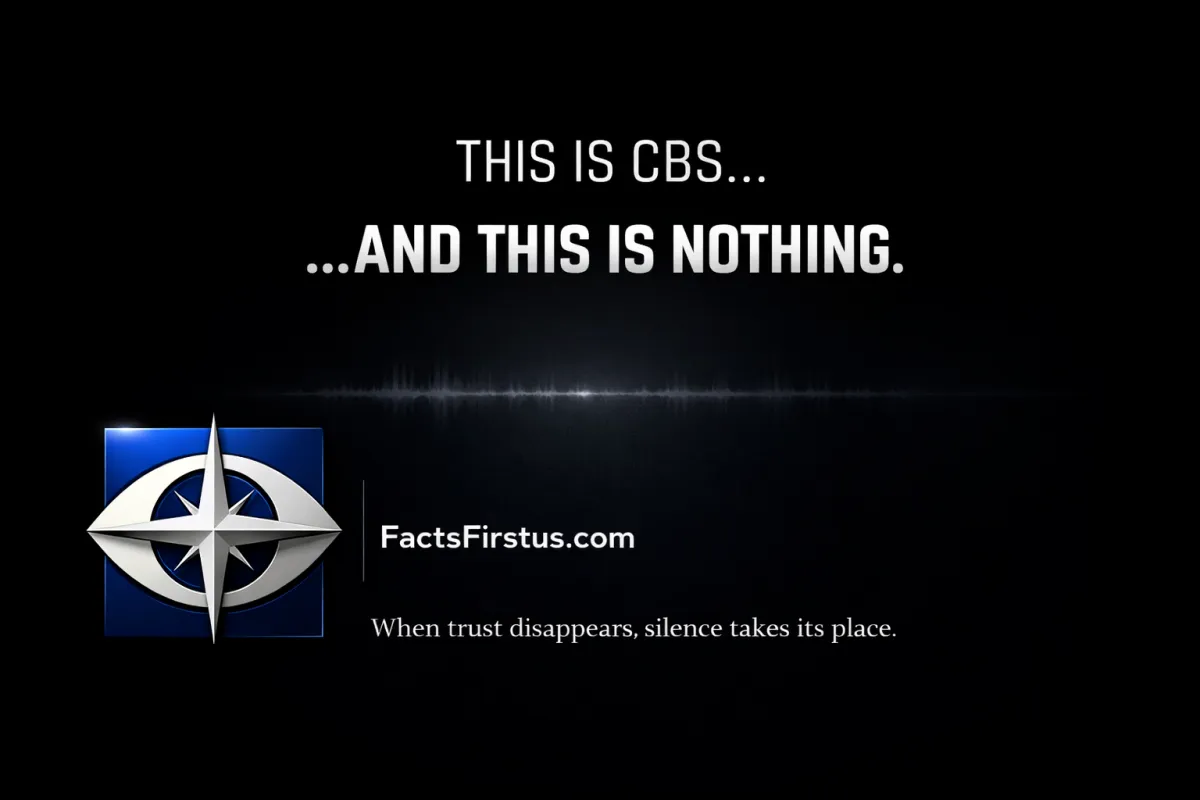
THIS IS CBS… AND THIS IS HOW TRUST WAS LOST
“This Is CBS… Or Was It?” — When the Signal Faded, So Did the Trust
The silence left behind by a century-old voice reveals more than a business decision. It exposes a crisis of credibility in American media.
By Staff Writer
March 21, 2026
The red “ON AIR” light still glowed.
In a quiet studio, long after the headlines had been written and the microphones adjusted for the thousandth time, a veteran producer sat staring at the clock, not to time the next segment, but to watch something end.
For decades, this room had been alive with urgency. Breaking news. Election nights. National tragedies. The hum of purpose.
Now, it was counting down to silence.
For nearly a century, four words carried authority across that silence.
“This is CBS…”
They were more than an introduction. They were a promise to deliver facts, not noise. To inform, not persuade. To serve the public, not shape it.
Soon, that promise will no longer be broadcast.
CBS News Radio, founded in 1927, distributed to more than 700 stations, and home to the longest running daily newscast in the United States, is shutting down.
Not reinventing.
Not transitioning.
Ending.
“A shift in radio station programming strategies, coupled with challenging economic realities, has made it impossible to continue the service.”
CBS News leadership memo
That is the official explanation.
But it is not the full story.
Institutions that survive wars, depressions, and technological revolutions do not simply disappear because of challenging economic realities.
They disappear when something more fundamental erodes.
Trust.
According to Gallup, public confidence in mass media has fallen to historic lows, with only a small fraction of Americans saying they trust it a great deal or even a fair amount. Pew Research echoes the trend, showing a fractured audience that is increasingly skeptical of national news organizations.
This did not happen overnight.
“Journalism did not collapse in a moment. It drifted there.”
Not every newsroom lost its way. Not every journalist abandoned the craft. But somewhere along the path, the discipline that once defined mainstream media began to soften.
Objectivity became optional.
Framing replaced reporting.
And for many Americans, the news began to feel less like a mirror and more like a lens.
Trust is not lost in headlines.
It is lost in habits.
Over time, those habits changed.
Many Americans point to specific moments when that trust began to fracture.
Coverage of President Donald Trump remains one of the most cited examples, where supporters and critics alike often saw not just reporting, but interpretation, framing, and at times contradiction.
Stories that were later revised.
Narratives that shifted.
Moments that some viewers felt were amplified, while others were overlooked.
For a significant portion of the country, it created a lasting impression.
“The outcome of a story sometimes felt predetermined.”
Public sentiment reflected in media trust studies
Whether that perception is fully justified or not, its impact is undeniable.
Because in journalism, perception and credibility are inseparable.
Once an audience begins to believe that coverage is filtered through an agenda, whether real or perceived, the relationship changes.
Not gradually.
Permanently.
Audiences noticed.
They questioned.
They disengaged.
They left.
When trust leaves, everything built on it begins to fracture.
Ratings decline.
Advertising follows.
Legacy institutions that once seemed untouchable begin making decisions that would have been unthinkable just years before.
What we are witnessing now is not a sudden collapse.
It is the consequence of a long drift.
In Chicago, that consequence has a very real sound, the absence of something that has always been there. WBBM Newsradio, the city’s top rated all news station, has long relied on CBS national broadcasts to anchor its programming.
Soon, those broadcasts will be gone.
“While this was a necessary decision, it was not an easy one.”
CBS internal memo
Necessary.
A word that suggests inevitability but avoids reflection.
Behind that word are dozens of careers now ending. Journalists, editors, and producers who spent their lives telling the story of a nation are now watching their own chapter close.
“They have been critical to our success and remain treasured friends and professionals.”
CBS leadership memo
Their work mattered.
The question is whether the institution they served remained as committed to its original purpose.
An industry executive, speaking anonymously, offered a stark assessment.
“The expectations were not aligned with the marketplace.”
Anonymous media executive
The marketplace, in this case, is not just financial.
It is the public.
The public has been clear.
They are not rejecting journalism.
They are rejecting what journalism became.
Across the broader media landscape, the signs are everywhere. Consolidations. Layoffs. Corporate restructuring. Paramount’s influence over CBS. Transformations within CNN. Shifting distribution models through companies like Audacy.
These are not isolated events.
They are course corrections.
Attempts, some late and some uncertain, to stabilize an industry that drifted away from the very thing that made it essential.
Even within CBS, there are signs of recognition. New leadership has expressed a desire to move toward a more journalistic identity, less perceived alignment and more credibility.
Trust does not return because it is declared.
It returns when it is earned.
Slowly.
Consistently.
Without agenda.
The role of journalism was never to lead the public to a conclusion.
It was to give the public the truth and trust them to find their own.
For nearly 100 years, CBS News Radio helped define what that sounded like.
A steady voice.
A measured tone.
A belief that facts mattered more than feelings.
Soon, that voice will go silent.
In that silence, something larger becomes impossible to ignore.
This is not just the end of a broadcast.
It is the echo of a question that will define the future of American media.
What happens when the institutions once trusted to tell the truth are no longer believed?
And perhaps more importantly, what will it take to earn that belief back?
Because someday soon, someone will turn on the radio, expecting to hear those familiar words.
“This is CBS…”
And instead, they will hear nothing.
In that moment, they may finally understand.
The silence did not happen all at once.
It was earned.
Sources
CBS News internal communications and leadership memos (2026)
Economic Times, “CBS News Radio is closing down after 100 years of operation” (2026)
CBS corporate and historical records on CBS News Radio and World News Roundup
Public opinion data on media trust (Gallup; Pew Research Center)
Industry analysis and executive commentary on broadcast media consolidation and restructuring