CHECKS IN THE DARK
Checks in the Dark
As federal investigators scrutinize Illinois for fraud, lawmakers quietly rush $12 million to NASCAR—without receipts, debate, or accountability.
January 6, 2026 | Staff Writer
SPRINGFIELD — As Illinois parents, child-care providers, and social service agencies brace for potential federal funding freezes, a different kind of check quietly cleared in Springfield.
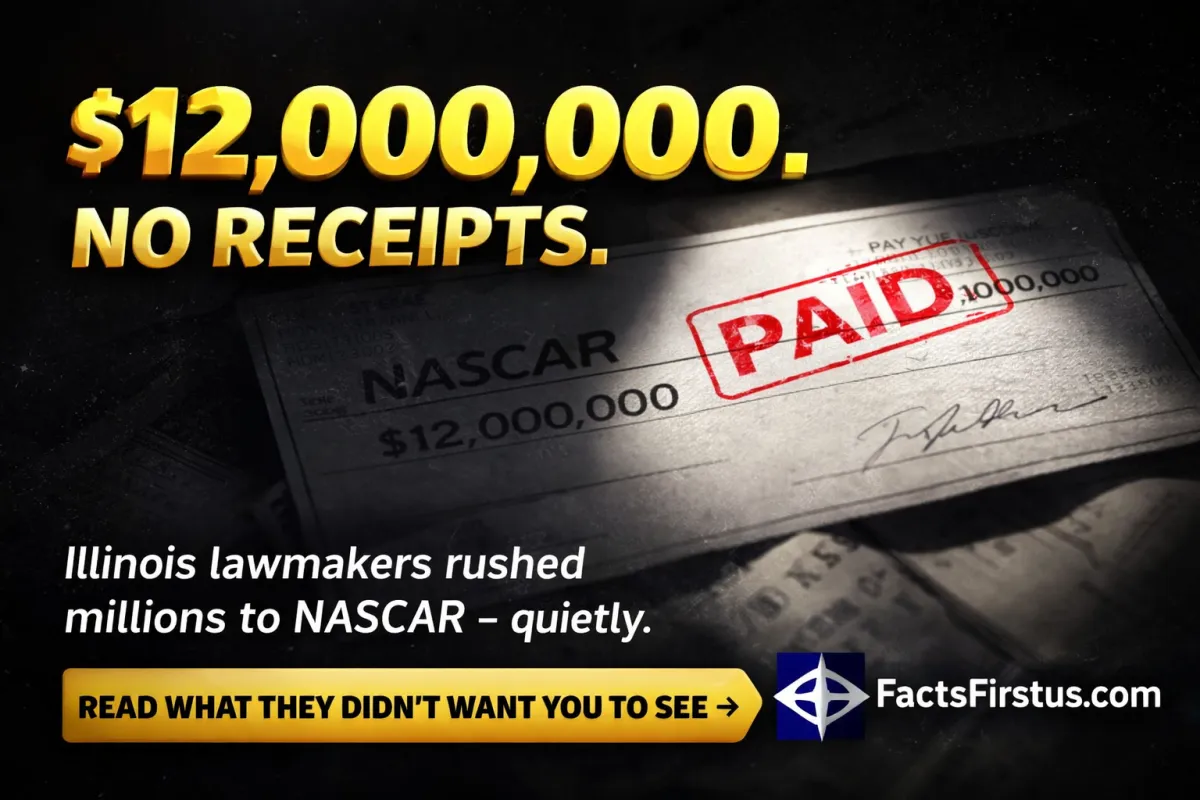
Buried deep in the state’s newly passed 2026 budget is $12 million in taxpayer money for NASCAR—approved in the final hours of session, rushed through with virtually no public explanation, and released at a moment when federal authorities say Illinois already suffers from systemic oversight failures.
Illinois didn’t just write NASCAR a check.
It wrote it in the dark.
Millions Approved, Questions Unanswered
The budget directs public funds to the racing organization through three separate channels:
$5 million from the General Revenue Fund for unspecified “operating expenses,”
$5 million from the Build Illinois Bond Fund for “capital improvements, including prior year costs,” and
$2 million through Enjoy Illinois Tourism for additional NASCAR-related operating expenses.
Nowhere in the budget are vendors named. No projects are outlined. No timelines, deliverables, audits, or performance measures are attached.
The tourism funding is widely believed to support the Enjoy Illinois 300, a NASCAR race held in Madison, Illinois, where the state tourism office serves as title sponsor. But even that connection is not explicitly disclosed in budget language.
“Fast and furious is no way to handle public money.”
What the Budget Doesn’t Say
For a state now under federal scrutiny for failing to verify how taxpayer dollars are spent, the omissions are striking.
The NASCAR appropriations include:
No contracts attached
No itemized costs
No reporting requirements
No clawback provisions if expectations are not met
No explanation for why public funds were necessary at all
By contrast, small nonprofits and child-care providers must submit extensive documentation for grants worth a fraction of that amount—documentation federal investigators now say Illinois routinely failed to verify.
A Profitable Company, a Public Subsidy
NASCAR is not a struggling startup. It is a private, for-profit corporation that reported $102.6 million in profit in 2024. It owns major infrastructure, including Chicagoland Speedway in Joliet, and has successfully operated large-scale events nationwide without taxpayer support.
The organization previously staged a high-profile Chicago street race, converting public roads into a temporary racetrack. That event is not scheduled for 2026, raising further questions about why Illinois taxpayers are funding operating and capital costs this year.
“Taxpayers don’t know why the money was appropriated—or what they’re getting for it.”
Pork by Another Name
Lawmakers insisted the 2026 budget contained no pork-barrel spending. A closer look tells a different story.
More than 2,815 earmarks exceeding $200,000 were approved in the final hours of session—many too late for public review. Among them: $40 million for a high school sports complex tied to the alma mater of Illinois House Speaker Chris Welch.
The NASCAR funding is part of a broader pattern: major appropriations rushed through a broken process where speed replaces scrutiny and transparency becomes optional.
Why Timing Matters
The revelations come as Illinois faces intensifying federal scrutiny.
Earlier this week, federal officials confirmed Illinois has emerged as a central flashpoint in a widening fraud crackdown involving child-care and social services funding. Led by the U.S. Department of Health and Human Services, with assistance from the FBI and Department of Homeland Security, the investigation has already frozen tens of billions of dollars nationwide.
Federal officials say Illinois now presents even deeper oversight failures than Minnesota, once considered the epicenter of the scandal.
“This isn’t just mismanagement. This is a breakdown of accountability.”
— Federal official familiar with the investigation
Illinois alone was slated to receive more than $412 million in federal child-care funding in 2025, serving nearly 173,000 children—funding now at risk unless the state can prove taxpayer dollars are being properly tracked.
Against that backdrop, a no-strings-attached $12 million appropriation to a profitable sports organization appears less like economic development—and more like confirmation of federal concerns.
The Tourism Defense—and Its Cost
Supporters of event subsidies argue they generate tourism and economic activity. But watchdogs note such projections often ignore hidden expenses: increased policing, traffic control, emergency services, and infrastructure wear—costs borne by taxpayers whether events succeed or fail.
Critics also argue the approach allows government to pick winners and losers, favoring politically connected organizations while smaller businesses compete without public assistance.
A more transparent approach, they say, would reduce barriers for all visitors—such as lowering hotel or travel taxes—rather than issuing multimillion-dollar checks behind closed doors.
Follow the Money
How the $12 Million Flows
Taxpayers → State Budget → Three Separate Funds → NASCAR / Tourism Sponsorship
No public accounting at the end.
Repeated requests for comment from the Governor’s Office, the Illinois Department of Commerce, and NASCAR were not returned by publication time.
A System Built for Secrecy
Unlike competitive grants that require applications, scoring, and audits, earmarks like the NASCAR funding bypass safeguards entirely.
Illinois’ budget is routinely passed in a rush, with limited debate and no mandatory public review period for earmarks—conditions that allow questionable spending to slip through unnoticed.
The consequences are visible: low economic growth, mounting debt, ballooning pension obligations, and now federal intervention.
What Reform Would Look Like
Good-government advocates point to clear solutions:
Spending caps
Mandatory public review periods
Detailed grant disclosures
Objective scoring and post-award audits
Without reform, Illinois risks more than wasted dollars.
It risks frozen federal funding, deeper investigations, and the erosion of public trust—a cost far higher than $12 million, and one taxpayers will pay long after the check clears.
Official Sources
Illinois Fiscal Year 2026 Budget Documents
Illinois General Assembly Appropriations Records
U.S. Department of Health and Human Services
Federal Bureau of Investigation
Department of Homeland Security