
INSIDE THE ILLINOIS MEGAPROJECT BILL THAT COULD CHANGE CHICAGO AND SPRINGFIELD FOREVER
The Bears, the Billionaires, and the Taxpayers Left Holding the Bag
How Illinois leadership turned a stadium negotiation into a political crisis exposing property taxes, insider influence, and a growing fear that ordinary families are paying the price
By Staff Writer
May 23, 2026
It is late May in Illinois.
The air is heavy. Kids are out of school. Backyard grills are firing up across Chicago and Springfield. Sports radio callers are already debating Caleb Williams, the offensive line, and whether this might finally be the year the Bears matter again.
Because in Illinois, football season is never really that far away.
Every fall, generations of families pull navy and orange jerseys from closets like family heirlooms. Fathers teach sons how to hate Green Bay. Grandparents still talk about Ditka like they knew him personally. Sundays become rituals.
The Chicago Bears are not just a football team here.
They are part of the identity of Illinois itself.
Now politics may be the reason they leave.
Not because Illinois could not keep them.
Because Illinois leadership may have fumbled the negotiation so badly that Indiana smelled blood in the water and moved aggressively while Illinois politicians argued with each other in public.
That is the part many taxpayers cannot believe.
This was supposed to be Illinois’ negotiation to win.
Instead, it became another example of what frustrated residents believe Illinois government does best: overcomplicate, overpromise, overspend, and eventually ask taxpayers to clean up the mess.
While Illinois lawmakers leaked details, battled over political control, contradicted one another publicly, and turned negotiations into political theater, Indiana leaders quietly did something far more dangerous.
They acted like they wanted the Bears.
Aggressively.
Disciplined.
Unified.
Indiana understood the basic rule of every major negotiation: uncertainty costs money, hesitation weakens leverage, and chaos drives businesses elsewhere.
Illinois offered chaos in abundance.
Now the unthinkable no longer feels impossible.
The Chicago Bears, one of the NFL’s founding franchises and one of the most recognizable brands tied to the identity of Chicago itself, may eventually leave Illinois entirely.
Every delay weakened Illinois’ hand.
Every public contradiction weakened Illinois’ hand.
Every political turf war weakened Illinois’ hand.
Indiana watched all of it happen.
And when governments negotiate from weakness, taxpayers almost always pay more in the end.
That is why the current debate has exploded far beyond football.
Because this story is no longer really about a stadium.
It is about who government moves fastest for.
The Bears have repeatedly made clear they want property tax certainty.
That is not unreasonable.
But Illinois families immediately recognized the deeper problem.
So does everyone else.
Homeowners want certainty.
Small businesses want certainty.
Retirees on fixed incomes want certainty.
Families living in modest bungalows across Illinois want certainty.
For years, they have received almost none.
That is why comments from Illinois Senate President Don Harmon suddenly cut through the noise surrounding the debate.
“People living in bungalows also want property tax certainty.”
— Illinois Senate President Don Harmon
For many taxpayers, it was the first honest statement made during the entire conversation.
Because for decades Illinois residents have watched government move at lightning speed when billion-dollar developments are involved while ordinary taxpayers wait endlessly for relief that never arrives.
And now lawmakers are scrambling to rescue the situation through a sweeping “megaproject” bill designed to tie together massive economic development proposals across Illinois, including efforts connected to the Bears stadium negotiations and another controversial development project hundreds of miles south in downtown Springfield.
That connection matters.
Because the same legislation being pushed to help keep the Bears in Illinois also contains provisions tied to the expansion of Springfield’s BOS Center and the construction of a massive downtown hotel development project.
The projects are different.
The strategy is the same.
Use government-backed financing, redirect future tax revenues, create special development structures, and sell the projects as economic transformation.
Supporters call it visionary.
Critics call it another example of government moving mountains for powerful interests while ordinary taxpayers continue drowning under some of the highest property taxes in America.
Even Gov. J.B. Pritzker has acknowledged property tax reforms are needed.
Many Illinois residents hear those statements with skepticism.
Pritzker has overseen multiple tax increases and fee hikes during his time in office while housing costs and property taxes have continued crushing families across Illinois. Critics argue many longtime residents have effectively been priced out of homes their families owned for generations.
That is why many taxpayers now wonder whether the governor is genuinely committed to reform or simply saying what sounds politically convenient during an election cycle.
Illinois residents have heard promises before.
They are still waiting.
And taxpayers are asking an increasingly uncomfortable question.
If lawmakers are willing to reshape tax policy and financing structures for billion-dollar projects, why can they never seem to move with the same urgency for ordinary homeowners?
That frustration is exactly why proposals from State Rep. Dan Ugaste and the Property Tax Relief Conference are gaining traction.
One proposal would end so-called “back-door referendums,” where taxpayers continue paying long after bonds are retired without new voter approval.
Another would require property tax referendum questions to appear only on November ballots when turnout is higher and communities are actually paying attention.
The ideas are simple.
Transparency.
Accountability.
Public consent.
None of them would kill a stadium deal.
But they would force government to stop treating taxpayers like silent financial partners who never get a vote.
Then the story takes another turn.
One that leads directly into the heart of downtown Springfield.
Under the proposal buried inside the megaproject legislation, a newly created Capital Area Tourism Authority Board would oversee the BOS Center expansion, own the future hotel project, and use tax-generated revenue streams from downtown Springfield to help finance roughly $200 million in development costs.
The proposal immediately triggered alarm among some Springfield officials and residents who feared local taxpayers could eventually become entangled in another complicated financing structure tied to politically connected development interests.
Sangamon County Board Chair Andy Van Meter attempted to calm those concerns.
“A lot of things are getting confused.”
— Sangamon County Board Chair Andy Van Meter
Van Meter argued the city was simply being asked to participate in ways similar to other development partnerships and insisted current city revenue streams would largely remain protected.
Critics inside Springfield government remained unconvinced.
Some worried the proposal concentrated too much authority inside an unelected board while allowing public tax revenues to fuel projects with enormous private-sector benefits. Others feared Springfield was surrendering long-term control over downtown development.
Ward 3 Alderman Roy Williams Jr. became one of the most vocal opponents.
“It’s designed to weaken us.”
— Ald. Roy Williams Jr.
Then came the questions that make Illinois politics especially combustible.
Because whenever massive taxpayer-supported projects appear in Illinois, people inevitably begin asking the same thing.
Who benefits personally?
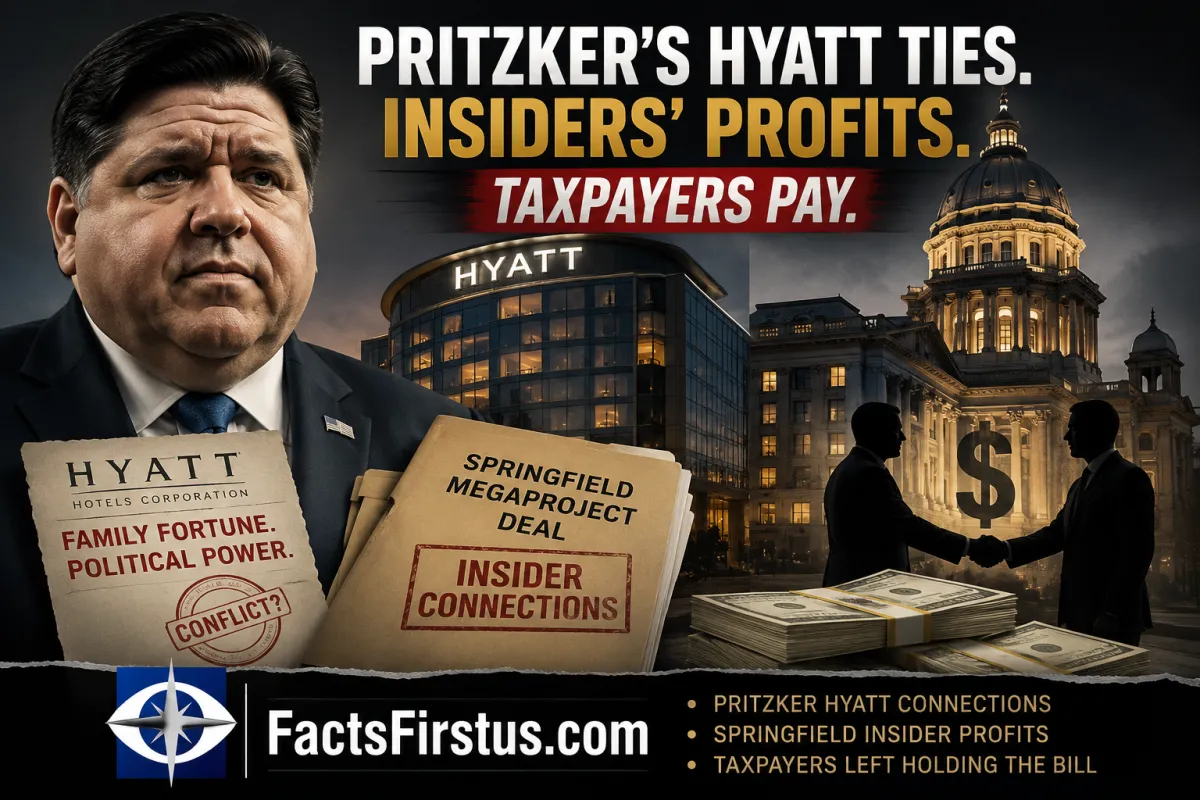
Gov. Pritzker is not only the governor of Illinois.
He is also an heir to the Hyatt hotel empire.
That fact alone does not prove wrongdoing.
But Illinois is not just any state.
Illinois taxpayers are now being asked to trust a government pushing hotel-centered megaprojects while being led by a governor whose family fortune was built in the hotel industry.
According to reporting surrounding the Springfield proposal, Hyatt was among the hotel operators expressing interest in the downtown project alongside Marriott and Hilton.
That reality creates unavoidable political and ethical questions, even if no laws are broken.
Could the governor personally or indirectly benefit from hotel expansion policies tied to projects his administration may ultimately support or influence?
Even the appearance of a conflict becomes politically explosive when ordinary taxpayers are simultaneously told there is never enough money to provide meaningful property tax relief.
The scrutiny does not stop there.
Questions have also surfaced surrounding State Rep. Michael Coffey, who has played a significant role in discussions involving the BOS Center legislation while also serving as chair of the Springfield Metropolitan Exposition and Auditorium Authority and maintaining business interests connected to Springfield’s hospitality economy.
Again, the issue is not simply legality.
It is public trust.
Because Illinois residents are exhausted by the appearance that politically connected insiders repeatedly sit on both sides of major economic development decisions while taxpayers assume the risks.
And that may become the viral moment that sends this story everywhere.
Not the Bears.
Not the stadium.
Not even the politics.
But this image:
An Illinois family misses a property tax payment and risks losing their home.
A billionaire NFL franchise wants certainty and receives an emergency megaproject bill.
That contrast is impossible to ignore.
In Illinois, taxpayers are told there is never enough money for relief until a billionaire asks for a stadium.
That is the line many voters will remember long after the headlines disappear.
Illinois residents are not anti-development.
They are not anti-growth.
They are not anti-stadium.
What they are tired of is watching government move mountains for billionaires while ordinary taxpayers are told to wait their turn.
The Bears deserve a solution.
Chicago deserves economic growth.
Springfield deserves revitalization.
But taxpayers deserve leaders willing to negotiate on behalf of the people paying the bills instead of the people benefiting from them.
Families built the Bears.
Taxpayers built Illinois.
Many are now wondering whether either one still matters to the people running the state.
Official Sources and References
Public reporting and legislative discussions surrounding Illinois megaproject legislation and Chicago Bears stadium negotiations
Public comments from Illinois Senate President Don Harmon regarding property tax certainty for homeowners and taxpayers
Statements from Sangamon County Board Chair Andy Van Meter
Statements from Ald. Roy Williams Jr.
Details regarding projected financing structure for the BOS Center and hotel proposal
Reporting and public records regarding the Capital Area Tourism Authority proposal and BOS Center expansion discussions