
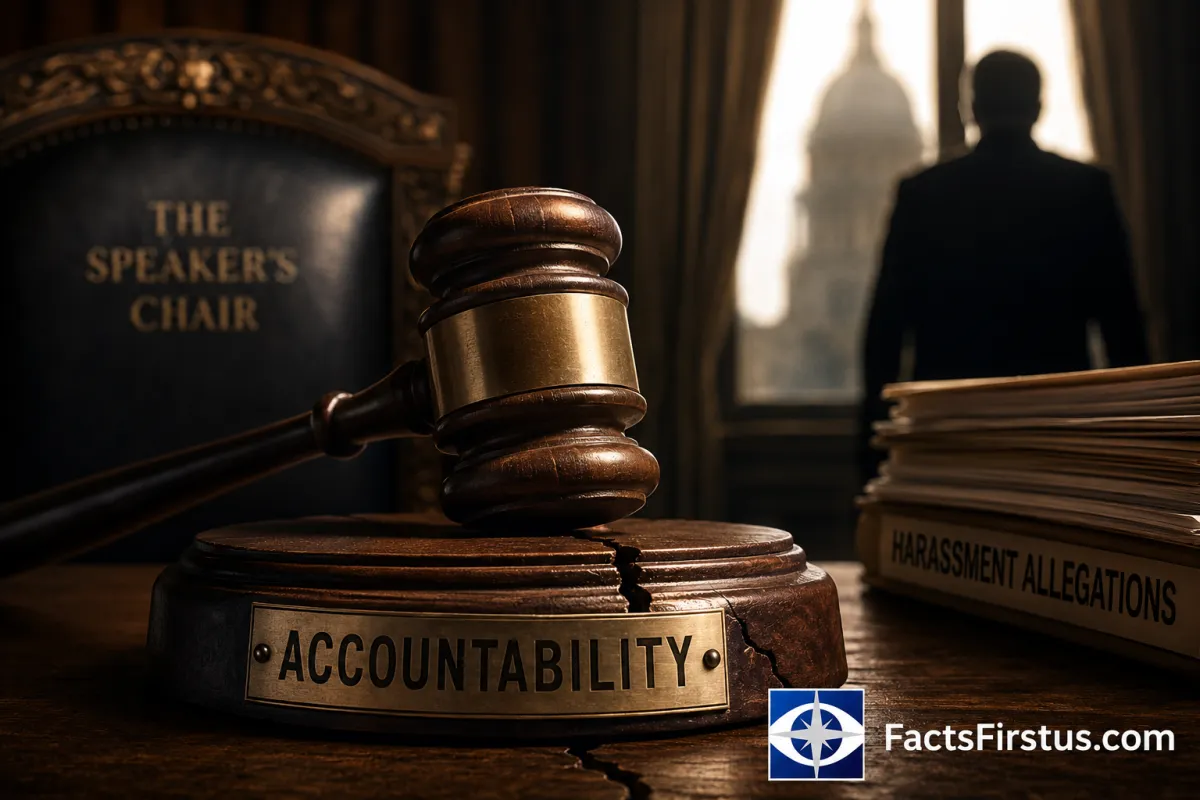
THE RESIGNATION WAS THE EASY PART
BENTON RESIGNED. THE SCANDAL DIDN'T.
Harry Benton is gone. Chris Welch still holds the gavel. Now a sexual harassment scandal that began with one lawmaker is forcing Illinois to confront a much bigger question. What happens when the trail of accountability reaches the people in charge?
By Staff Writer | August 27, 2026
Harry Benton resigned.
Chris Welch demanded it.
For a moment, Springfield had its ending.
The accused lawmaker was gone. The speaker had acted. The institution could promise reforms and move forward.
Except the scandal did not leave with Benton.
It moved up.
Now the questions are sitting outside the office of Illinois House Speaker Emanuel "Chris" Welch.
What did his office know?
When did it know it?
What happened after it knew?
Why did political support for Benton continue?
And if Welch now acknowledges that the system failed, how much responsibility belongs to the man who leads that system?
State Representative Chris Miller has reached his conclusion.
Welch should resign.
"The people of Illinois deserve to know what Speaker Welch knew, when he knew it, what actions he took and why Benton was allowed to remain in office for years after allegations were brought to his attention."
State Representative Chris Miller
That is why this is no longer primarily a Harry Benton story.
Benton has already paid the ultimate political price.
He lost his seat.
The question now is whether accountability stops with him.
THE COMPLAINT THAT DID NOT END THE STORY
The controversy reaches back to 2023, when concerns about Benton's behavior toward a young district employee reached Welch's office.
Welch has said his office conducted an informal review and that the employee did not want to pursue a formal complaint because she feared retaliation.
That matters.
Victims should not be blamed for being reluctant to enter a formal process, particularly when their employment and careers may be at stake.
But something else matters too.
Benton remained in office.
He remained politically viable.
And political committees controlled by Welch later spent approximately $1.4 million supporting Benton's 2024 reelection.
Welch has defended the decision by pointing to due process and Benton's denial of the allegation. He has since said he regrets the political support.
Due process matters.
But due process and political support are two different things.
A political leader can refuse to declare someone guilty without evidence while also deciding not to spend approximately $1.4 million helping that person return to office.
That distinction has become increasingly difficult to ignore.
Then came 2026.
New allegations surfaced.
Welch removed Benton from committees and caucus activities in February.
A confidential complaint was filed with the Legislative Inspector General in March.
The investigation expanded.
The inspector general ultimately concluded that Benton committed two acts of sexual harassment and described his conduct as part of a broader pattern and practice of inappropriate sexual conduct.
Welch demanded Benton's resignation.
Benton resigned.
If that had been the entire story, it might have ended there.
It wasn't.
THEN THE SPOTLIGHT TURNED TO WELCH
Questions soon emerged about Welch's own interactions with the former staff member whose concerns about Benton had reached his office.
She said some of those interactions made her uncomfortable.
Welch apologized.
"When I read that, I felt terrible. That certainly was not my intent, but I made her feel uncomfortable, and I have to own that."
Illinois House Speaker Chris Welch
Four words in that apology stand out.
"When I read that."
Miller seized on them.
"It's embarrassing that the Speaker of the House has to read a news article to realize his behavior is not acceptable."
State Representative Chris Miller
That is where the controversy crossed an important line.
The question was no longer only whether Welch's office properly handled complaints about somebody else.
Questions were now being asked about Welch's own judgment.
And Welch himself acknowledged something had failed.
"My office did its best. They followed their processes and procedures in place. But clearly, we failed this young woman and all women who are afraid to come forward. The system failed. We can do better."
Illinois House Speaker Chris Welch
"The system failed."
It is a powerful admission.
It is also an incomplete one.
Because systems do not fail in isolation.
People design them.
People operate them.
People supervise them.
And leaders are ultimately responsible for them.
Chris Welch is not a backbench lawmaker observing dysfunction from across the Capitol.
He is the Speaker of the Illinois House.
He leads the House Democratic caucus.
His party holds a supermajority.
He holds the gavel.
So when the speaker says the system failed, Illinois has every right to ask the question that follows.
What responsibility belongs to the person at the top?
THE SOLUTION DEVELOPED ITS OWN PROBLEM
Welch responded by creating a House Culture and Accountability working group.
It was supposed to help solve the problem.
Instead, it became part of the controversy.
The group was organized as a private, Democrat-only effort.
Then something remarkable happened.
Democrats began declining to participate.
State Representative Kelly Cassidy questioned whether the group would amount to little more than "lip service" or a "PR stunt."
She declined to join.
Her explanation went directly to the credibility problem facing Welch.
"We have a responsibility to victims and survivors to ensure any such body is credible and effective, and I currently do not have confidence it will be."
State Representative Kelly Cassidy
She was not alone.
State Representative Gregg Johnson also declined.
State Representative Tracy Katz Muhl later became the third Democrat to decline participation.
Three Democrats.
Not three Republicans attacking Welch from across the aisle.
Three members of Welch's own party stepping away from a group created to address accountability.
Consider the contradiction.
The speaker created a working group to restore confidence.
Before it could restore confidence, members of his own party demonstrated that confidence was already a problem.
THEN PRITZKER MADE THE PROBLEM CLEARER
Governor J.B. Pritzker has not called for Welch to resign.
But he has questioned the speaker's proposed response.
Pritzker has warned against allowing another Springfield working group to drag on while a problem everyone acknowledges needs attention remains unresolved.
"I've seen working groups go on for a year and a half. There is no time here."
Governor J.B. Pritzker
Pritzker has pointed out that models for handling workplace harassment already exist elsewhere.
He is right.
Illinois does not need 18 months to discover that sexual harassment complaints require a credible reporting system, timely investigations, protection against retaliation, and leadership willing to act.
But Pritzker's position creates its own question.
If the governor believes Welch's working group is not enough, what is enough?
If there is no time to wait, what should happen now?
If the process was inadequate, who should answer for that inadequacy?
That is where Pritzker's response becomes politically difficult.
He has been willing to question the remedy.
He has been far less willing to question whether Welch should remain the person overseeing it.
Miller has no such hesitation.
He wants the speaker gone.
NOW CHANGE ONE LETTER
There is an uncomfortable test that can be applied to almost any political scandal.
Change the party.
Imagine that the speaker were Republican.
Imagine that a Republican lawmaker faced sexual harassment allegations that reached Republican leadership.
Imagine that political committees controlled by the Republican speaker later spent approximately $1.4 million helping that lawmaker win reelection.
Imagine that additional allegations followed.
Imagine an inspector general finding violations and describing a broader pattern of inappropriate sexual conduct.
Imagine questions then emerging about the Republican speaker's own interactions with the woman who first raised concerns.
Then imagine the Republican speaker announcing a private, Republican-only accountability group.
And imagine Republicans themselves declining to participate because they questioned its credibility.
Would Illinois Democrats consider that enough?
Would Governor Pritzker?
Would Democratic lawmakers be preaching patience?
Would they tell Illinois to wait for the working group?
Nobody can prove what politicians would do in a hypothetical situation.
But the question exposes the standard.
Accountability is easy when it belongs to the other party.
The test comes when accountability reaches your own.
MILLER WANTS TO MAKE THE TEST EVEN HARDER
Miller is not stopping with his demand for Welch's resignation.
He is pushing ethics reforms that would force Illinois lawmakers to confront protections available to politicians themselves.
One involves campaign money.
Illinois law permits political committees to pay certain legal expenses, including expenses connected to criminal defense.
Miller wants lawmakers prohibited from using campaign funds for criminal defense.
Think about the underlying question.
When someone contributes money to elect a politician, should that money later be available to help defend the politician against criminal accusations?
Supporters of the current system can argue that allegations connected to public service may require legal representation and that being accused does not make someone guilty.
That is true.
But Miller's proposal forces lawmakers to answer a different question.
Should political fundraising double as legal insurance?
Then there are pensions.
Current Illinois law generally ties pension forfeiture to a qualifying felony conviction connected to public service.
House Bill 1727 would go further.
The proposal would allow pension or annuity payments to be suspended when a public employee or official is indicted or formally charged with a felony connected to public service, if the pension board determines the necessary connection exists.
There is an important protection.
If the person is not convicted, the withheld benefits would be restored with interest.
If there is a qualifying conviction, the suspended benefits would not be paid.
That matters because an accusation is not guilt.
A charge is not a conviction.
Due process must remain part of the equation.
But due process does not prevent Illinois from asking whether public benefits should continue without interruption while someone faces felony charges directly connected to public service.
Miller also wants Legislative Inspector General reports released publicly within 60 days.
Those proposals can be debated.
They can be amended.
They can be defeated.
They can become law.
But there is something fundamentally different about them compared with another working group.
They require lawmakers to vote.
And votes leave fingerprints.
THAT MAY BE WHAT SPRINGFIELD NEEDS MOST
Illinois government has become very good at responding to controversy.
There is almost a rhythm to it.
A scandal erupts.
Officials express concern.
A review begins.
A task force appears.
A working group is announced.
Everyone promises change.
Then the headlines disappear.
The public moves on.
Springfield moves on.
And eventually another scandal arrives.
That is why the Welch controversy matters beyond Welch.
The question is not whether Illinois government knows how to respond to a scandal.
It does.
The question is whether Illinois government knows how to change because of one.
Harry Benton is gone.
That was accountability for Benton.
Now comes the harder part.
Welch says the system failed.
Members of his own party have questioned the credibility of the process created to repair it.
Pritzker says Illinois does not have time for another drawn out working group.
Miller says Welch should resign.
And lawmakers are being asked to consider ethics reforms that would put their own campaign money, pensions, and transparency rules under greater scrutiny.
Those are no longer abstract questions.
They are tests.
Tests for Welch.
Tests for Pritzker.
Tests for Republicans demanding reform.
Tests for Democrats who control the House.
And ultimately, tests of whether the standards proclaimed when the accused belongs to the other party still apply when the questions reach your own leadership.
FactsFirstus.com has followed this controversy as it developed.
Earlier, the focus belonged on Benton.
It belonged on the allegations.
It belonged on the investigation.
It belonged on what Welch knew and how his office responded.
But this story has moved.
Benton no longer holds office.
Welch still holds the gavel.
And that may be the most important fact in Springfield right now.
Because eventually every accountability scandal reaches the same point.
The investigation is finished.
The findings are public.
The resignation has happened.
The apology has been given.
The reforms have been promised.
Then everyone finds out whether accountability travels upward.
Harry Benton resigned.
The scandal didn't.
Now Illinois gets to find out how high accountability is allowed to go.
SOURCES
Official and Primary Sources
Illinois Office of the Legislative Inspector General. LIG Case No. 26-005 and related correspondence concerning former State Representative Harry Benton. Official records document the complaint, investigation, disciplinary timeline, and findings involving Benton.
Illinois Legislative Ethics Commission. Official records and published materials concerning the Legislative Inspector General investigation involving Benton.
Illinois House of Representatives. Speaker Emanuel "Chris" Welch's official responses concerning the Benton investigation, disciplinary action, and Benton's resignation.
Illinois General Assembly. House Bill 1727. Proposed legislation concerning suspension of pension or annuity payments following certain felony indictments or charges connected to public service and restoration of suspended benefits when there is no qualifying conviction.
Illinois General Assembly. Illinois Pension Code provisions governing forfeiture of pension benefits following qualifying felony convictions connected to public service.
Illinois State Board of Elections. Illinois campaign finance laws and disclosure requirements governing political committees and expenditures.
Office of State Representative Chris Miller. Public statements calling for Speaker Welch's resignation and advocating reforms involving campaign funds, pension benefits, and Legislative Inspector General reports.
Office of Governor J.B. Pritzker. Public comments concerning the House Culture and Accountability working group and the need for a timely response to workplace harassment.
Office of Illinois House Speaker Emanuel "Chris" Welch. Public statements concerning the handling of allegations involving Benton, Welch's apology, and creation of the House Culture and Accountability working group.
Additional Reporting and Background
Capitol News Illinois. Reporting on the Legislative Inspector General's findings, Benton's resignation, Welch's handling of the allegations, and the creation and membership of the House Culture and Accountability working group.
Chicago Sun-Times. Reporting on Welch's response to the controversy, Kelly Cassidy's criticism of the working group, Democratic concerns about the process, and Governor Pritzker's comments.
NPR Illinois. Reporting and analysis concerning Welch's response to the Benton controversy and continuing calls for his resignation.
Illinois Public Media. Reporting examining what Welch and his office knew about allegations involving Benton and when that information became known.
NBC Chicago. Reporting on calls for Welch to answer questions or resign following the Legislative Inspector General investigation.
East Central Reporter. August 19, 2026, reporting on State Representative Chris Miller's criticism of Welch, his call for resignation, and proposed ethics reforms.
FactsFirstus.com. Previous reporting in the "Silence Above the Gavel" series examining the Benton allegations, Speaker Welch's response, Governor Pritzker's position, and questions surrounding accountability within Illinois Democratic leadership.