
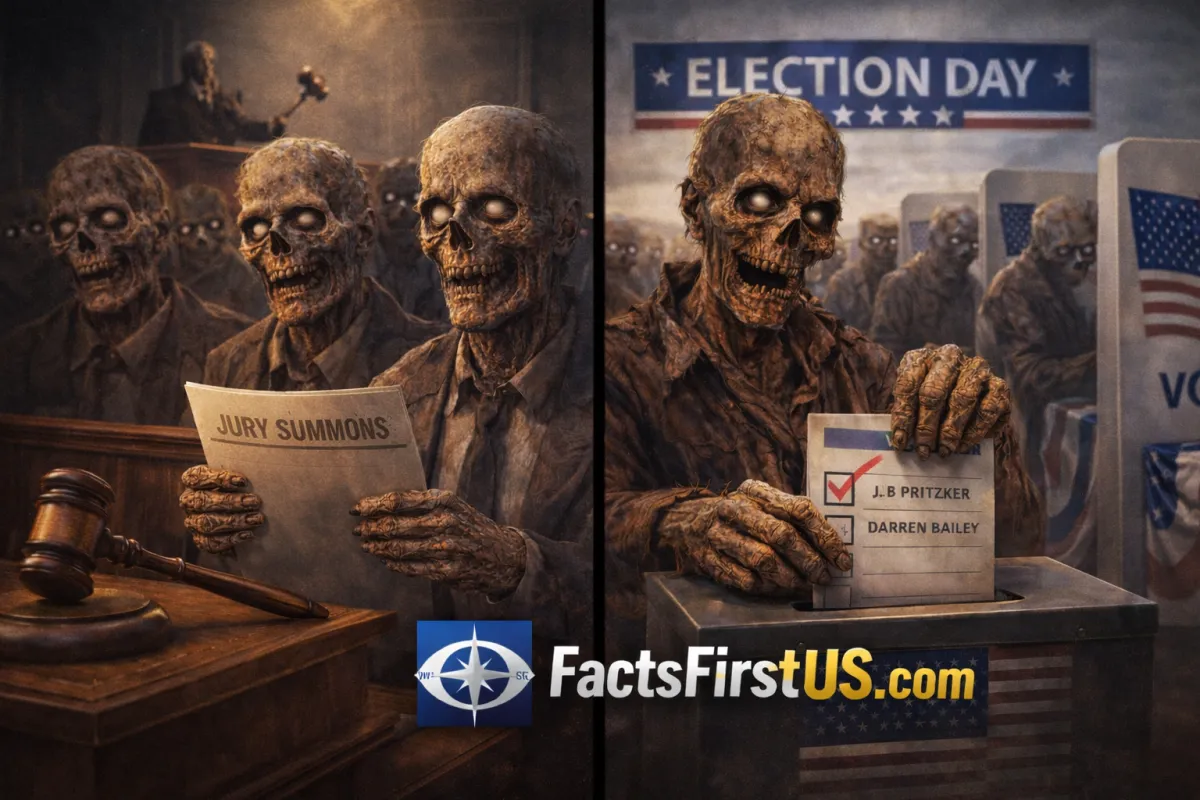
THE DEAD IN ILLINOIS ARE BEING CALLED TO SERVE
THE DEAD ARE BEING CALLED TO SERVE
As new findings emerge from an Illinois jury panel, the same names are raising urgent questions about voter rolls and who is still being counted
By Staff Writer
April 20, 2026
The letter arrived like any other piece of mail.
A name.
An address.
A command to appear.
Show up. Serve. Be counted.
But the person it was sent to had been buried for years.
At first, it might have been easy to dismiss. A clerical slip. A name that should have been removed but wasn’t. The kind of thing people assume gets fixed somewhere along the way.
It didn’t.
Because that name was not alone.
According to court filings in a Whiteside County case, a 2026 jury panel included at least 60 individuals who are confirmed deceased. Out of 200 names, nearly one in three belonged to someone who could never respond. One had been dead for 35 years.
Pause on that for a moment.
A courtroom.
A list of citizens.
Dozens who will never walk through the door.
This is not a mistake.
This is something else.
“This is not merely a Whiteside County problem,” defense attorney James W. Mertes wrote in a motion challenging the panel.
And then it gets worse.
Because the problem was not only who was included.
It was who was missing.
Not a single person under the age of 42 appeared on the list. In a county where the median age is 43, the panel’s median age was 72.
An entire generation, absent.
The deeper you look, the harder it becomes to explain away.
Twenty-seven individuals were reportedly over the age of 100. Fifty-two were over 90.
The dead remain.
The elderly dominate.
The middle disappears.
That is not random.
That is a system drifting away from reality.
Illinois builds its jury pools using a combination of statewide data sources, including voter registration records, driver’s licenses, and unemployment filings.
Two of those systems correct themselves.
One often does not.
Voter registration records can remain long after someone dies unless they are actively removed.
Names are added.
But not all of them leave.
“As long as the master list continues to add to the older subgroup without subtracting from it, this problem will only worsen,” the court motion states.
And so it does.
Not suddenly.
Quietly.
Until one day, the dead are being called to serve.
And that is when the question changes.
Because jury duty is not the only place this data lives.
The same underlying records are part of broader systems that depend on accuracy, maintenance, and trust.
Think about that.
A system that can summon the dead…
and never notice.
And then something else comes into focus.
Concerns about voter roll accuracy in Illinois are not new. They have been raised for years, both locally and nationally.
In 2016, a CBS Chicago investigation found multiple instances of individuals casting ballots after they had died. The analysis identified 119 deceased individuals who were recorded as having voted a total of 229 times over a decade.
“I don’t see how people can be able to do something like that and get away with it,” one family member said after learning a deceased relative was still listed as voting.
Some cases were explained away as clerical confusion.
Others were not.
That was years ago.
The assumption was that the system would improve.
But now, a jury list tells a different story.
And when federal authorities asked to review voter roll data tied to these kinds of concerns, Illinois refused.
Governor JB Pritzker’s administration declined to turn over full voter roll records, even as scrutiny increased and legal challenges questioned whether the state is meeting federal requirements to maintain accurate lists.
Supporters say the state is protecting voter privacy.
Critics say something more direct.
That transparency should not require resistance.
That confidence in public systems depends on verification.
And that refusing to open the records, in the face of mounting questions, raises one of its own.
Why not show the data?
The Whiteside County case does not answer that question.
But it does something more powerful.
It makes it impossible to ignore.
State officials have not publicly acknowledged widespread failures in jury list compilation, and the Governor’s office did not respond to requests for comment.
Illinois operates under a Democratic supermajority, placing responsibility squarely on current leadership.
And when failures like this surface, after years of control, accountability is no longer abstract.
It is immediate.
It raises a simple question.
Who was responsible for making sure this did not happen?
A hearing is scheduled for May 7, where experts are expected to testify about how this system failed.
The court may dismiss the panel and start over.
But replacing a list does not fix what created it.
And it does not resolve what now sits in plain view.
If the dead can remain in the system long enough to be summoned…
How long have they been there?
And where else do those names still exist?
The people who were called will never answer.
They will never take the oath.
They will never sit in judgment.
But somehow…
Their names still are.
SOURCES
Administrative Office of the Illinois Courts, jury list compilation procedures and data sources
Illinois Supreme Court documentation on jury selection and statutory requirements
Court filings in People v. Michael C. Cover, Whiteside County, Illinois
CBS Chicago Investigators report on deceased individuals appearing in voter records