
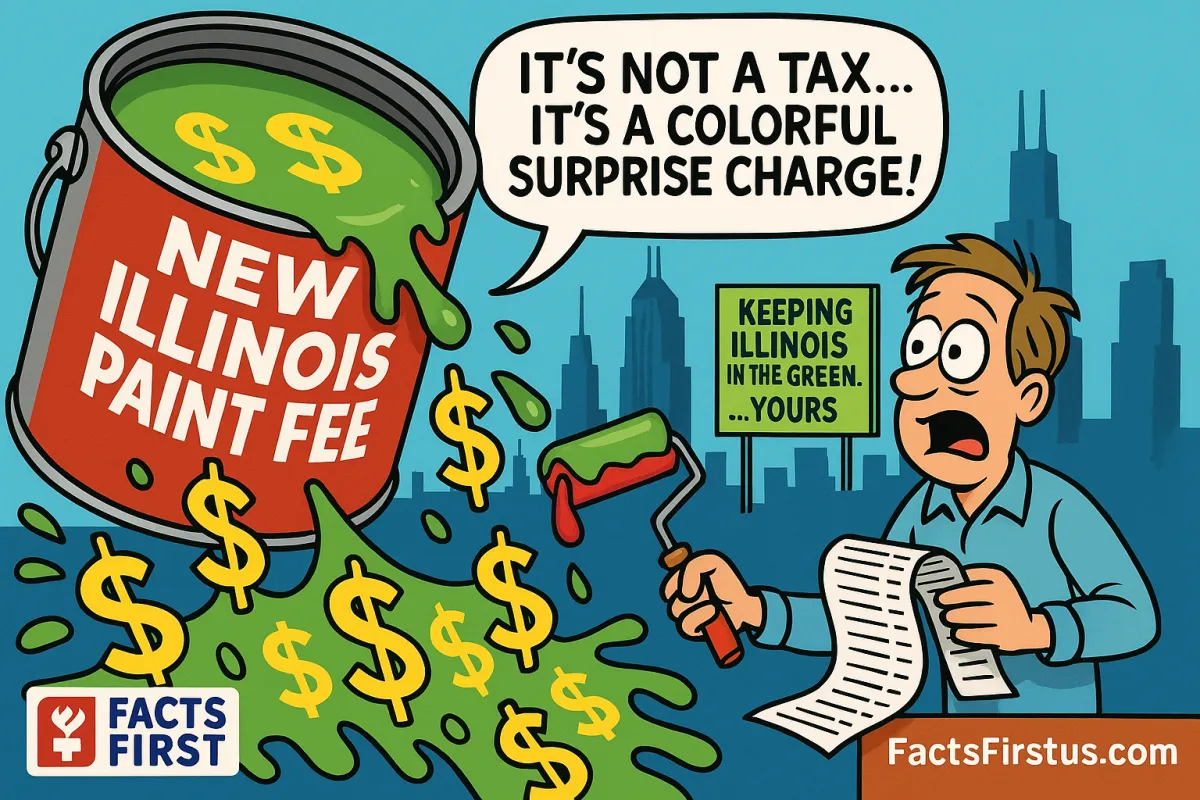
THE FEE THAT CAME OUT OF THE BLUE: ILLINOIS PAINTS A NEW COST ON EVERY CAN
Illinois Adds a Fresh Coat of Fees — Right to Your Wallet
A quiet “paint stewardship” program lands with a loud thud on every checkout receipt across the state.
By Staff Writer | December 1, 2025
Illinois has done it again. Just when residents thought they had memorized every creative fee, surcharge, and eyebrow-raising add-on the state could invent, Governor JB Pritzker’s administration found one more corner of daily life to color a little pricier. This time, it isn’t gas, groceries, or streaming services. It’s paint.
Yes — in Illinois, even your weekend DIY dreams aren’t safe from fiscal innovation.
A Tax by Any Other Name Still Drips From Your Wallet
On December 1, 2025, Illinois officially launched its Paint Stewardship Program — the newest entry in a long lineage of revenue-generating experiments. The program stems from the 2023 Paint Stewardship Act (Public Act 103-0372), approved by the Illinois Environmental Protection Agency and quietly constructed in the background, far from the noise of headlines.
The fee schedule is a masterpiece of nickel-and-diming precision:
Free for a half-pint or smaller
45¢ for anything larger than a half-pint but under a gallon
95¢ for 1–2 gallons
$1.95 for 2–5 gallons
And, because this is Illinois, these fees don’t replace taxes — they join them, forming a layered masterpiece reminiscent of the soda tax, the bag fee, the amusement tax on your Netflix subscription, and every other entry in the state’s proud tradition of charging you for things you forgot could be charged.
“It’s not a tax; it’s a fee,” officials say. Which, in Illinois, is usually code for: It works exactly like a tax, but we gave it a softer name.
A Human Moment at Aisle 12
Consider the scene playing out today in hardware stores across the state.
A homeowner stands in the paint aisle with a gallon of “Sunrise Beige” in one hand and a receipt in the other. The total is higher than it was last week — higher than yesterday. The cashier, sympathetic but resigned, explains the new fee. A sigh. A shrug. A glance at a sign taped to the counter.
Multiply that quiet moment by millions, and you get the true picture of the program’s impact.
For professional painters and small contractors, the stakes are louder. A 30-gallon job now carries nearly $30 in fees — before taxes. “It adds up,” one contractor mutters while loading paint into his truck. “Everything adds up.”
Where the Money’s Supposed to Go
State officials defend the new program with a clear narrative: this is about environmental stewardship, not revenue. Manufacturers selling architectural paint in Illinois are required to fund a statewide system that collects leftover paint for recycling or safe disposal. PaintCare, the industry-run nonprofit, will manage the collection network — largely through the same retailers where you buy the paint.
The promise is this:
You’ll pay more at checkout, but you won’t have to hide old paint cans in your basement until they become artifacts.
“You’ll pay more now, but you can feel better when you stare at your old paint cans.” That’s essentially the pitch.
What It Really Means at Checkout
For consumers, December 1 marks the day every paint purchase got a little heavier on the wallet. Retailers have been adjusting their point-of-sale systems, slapping up explanatory signs, and prepping employees to field questions from confused shoppers.
Then comes the punchline: the fee becomes part of the taxable amount.
Only in Illinois do you get to pay:
a tax… on the fee… created by a tax-like law.
It’s fiscal creativity at its finest.
Illinois Joins a National Trend — But With Flair
To be fair, Illinois isn’t alone. Several states — including California, New York, Washington, and Colorado — have adopted PaintCare programs. But in classic Illinois style, ours manages to feel just a little heavier, a little more complicated, a little more… Illinois.
Where other states roll out their programs with quiet efficiency, Illinois layers on its signature moves: additional regulatory updates, a taxability twist, and enough small-print details to give any homeowner a migraine.
The fee may be small, but the feeling is familiar.
The Quiet Law with Loud Consequences
The Paint Stewardship Act was signed in July 2023 and took effect January 1, 2024, but the true impact hits today. While the public stayed blissfully unaware, counties rewrote waste-management rules, the Pollution Control Board amended hazardous waste regulations, and retailers prepared to redesign billing systems.
Local governments like Kane County are promoting “free” paint drop-off sites starting December 1 — conveniently skipping the detail that “free” is now baked invisibly into every gallon sold.
Behind the scenes, paint waste is now treated as “universal waste,” a bureaucratic label that signals permanence. Once a fee is written into infrastructure, it rarely fades.
“It’s amazing how ‘no big deal’ a fee sounds until you multiply it by every gallon of paint in an entire state.”
Tax, Fee, Surcharge — Whatever the Name, You’re Paying It
Supporters argue this is producer responsibility, funded by modest fees. Critics argue the producer is you, the homeowner or contractor, because every cent passes straight to the customer.
And starting today, anyone walking into a hardware store will feel it.
Because in Illinois, if you can dream up a way to spend money — paint, bags, soda, streaming, parking, or a day of amusement — Springfield can dream up a way to tax it.
Sorry — “fee” it.
And the Closing Brushstroke…
If Illinois can find a hidden charge at the bottom of a paint can, one wonders what everyday item is next.
A “stir stick stewardship fee”?
A “roller recycling tax”?
A surcharge on the emotional toll of repainting a room?
At this point, nothing would surprise the average Illinois resident, who has learned to expect that every new law — even the quiet ones — eventually shows up in the same place:
the receipt.