
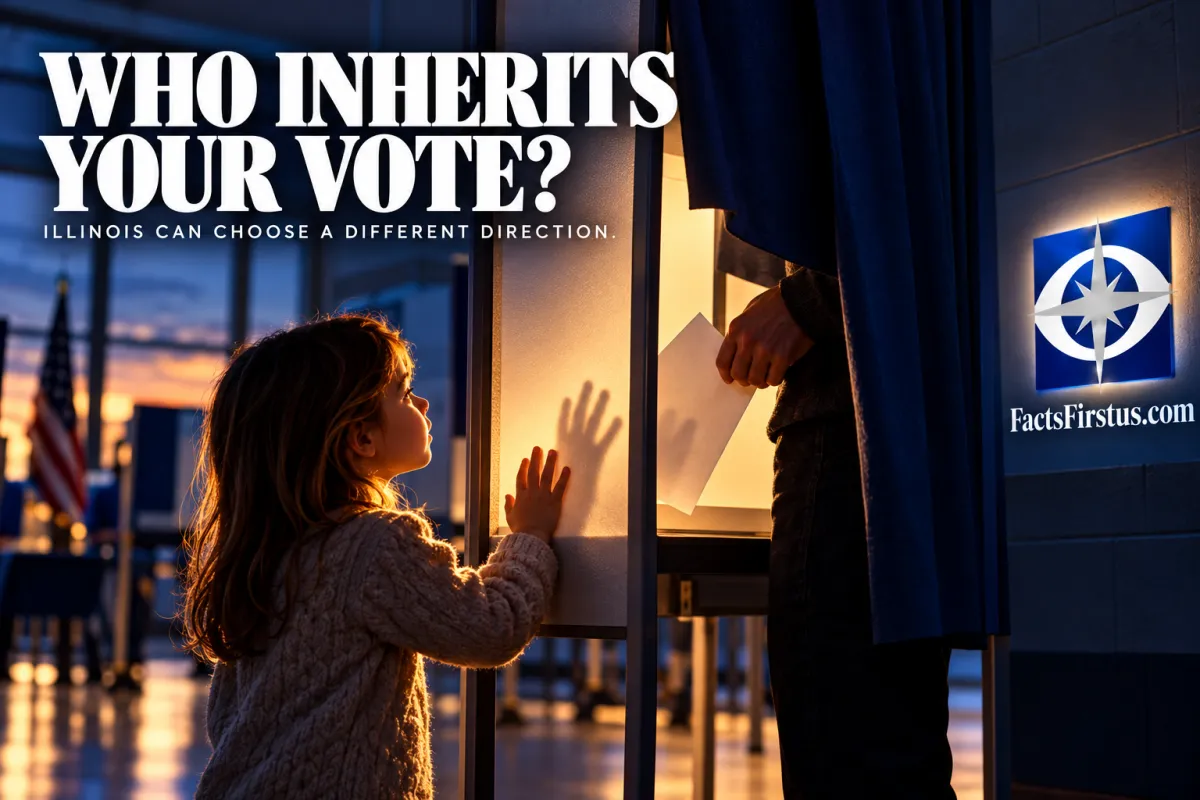
ILLINOIS, YOU’VE SEEN THE COST. WHAT WILL YOU CHOOSE NOW?
THE QUESTION ILLINOIS KEEPS PUTTING OFF
One image leads to another. A child. A bill. A dark street. A ballot. FactsFirstus is launching a campaign that asks what the next vote should change.
By FactsFirstus Editor | September 26, 2026
The first image may look familiar. A child sits at a kitchen table, trying to finish homework. The lights are on. The house is quiet. Outside the window, the Illinois Capitol glows in the distance.
Who is looking out for that child?
The next image takes you to a neighborhood street after dark. Then to a grocery receipt. A property tax bill. A waitress watching a customer leave a tip. A worker finishing another long shift. A senior couple sorting through the mail.
Each scene is different. Each leads back to the same question: Is life in Illinois getting better for the people who live here?
That question is why FactsFirstus created Illinois Can Choose a Different Direction, a visual campaign that will unfold one image at a time as Election Day approaches. Some images may make you stop. Some may make you angry. One may remind you of a conversation you had at your own kitchen table last night.
Keep watching. There is more to see, and there is a reason the final image ends with a ballot.
For years, elections in Illinois have followed a familiar script. A candidate says the other party is dangerous. The other party responds in kind. Voters are asked to pick a team, defend it and come back for the next election.
But the bill still arrives after Election Day. The child still has to go to school. The shop owner still has to unlock the door in the morning. Families still want to feel safe on the walk home.
So before anyone asks for your loyalty again, ask for an account of what that loyalty has produced.
Democrats hold the governor’s office and veto-proof majorities in both chambers of the Illinois General Assembly. They have the votes to set much of the state’s course. The current legislature has 78 Democrats in the 118-member House and 40 in the 59-member Senate. Those are not small margins. They make this a moment to examine the results of governing power, not merely another round of campaign promises. www.ilga.gov
Look at the schools. Look at the Illinois Report Card. Ask whether children in your community are learning what they need to learn, and whether the ones falling behind are getting help in time. www.isbe.net
Look at public safety. Read the crime reports, but also listen to the people living on the blocks behind the numbers. What is improving? Where are families still afraid? What will candidates do that can be measured, not merely applauded at a press conference? isp.illinois.gov
Look at what it costs to stay. A property tax bill is not an abstract debate when it is due next week. Neither is a grocery receipt, a medical expense or a tank of gas. Each has a different cause, and different officials control different pieces. Voters can insist that every one of them explain what they have done to ease the pressure. tax.illinois.gov
Then look at the people doing the work. Federal deductions for eligible tips and overtime offer some workers relief on their federal income taxes, while Illinois still taxes those earnings at the state level. A senior may qualify for a new federal deduction and still sit at home wondering how far the rest of the budget will stretch. These are the everyday choices behind the images. They deserve more attention than another party slogan. www.irs.gov
One of the campaign’s starkest images puts a family’s bills beside Gov. J.B. Pritzker’s estimated fortune. Forbes places his net worth at $4.2 billion, about $1 billion more than when he took office in 2019. The image asks a simple question: During those same years, how many Illinois families felt themselves getting ahead? www.forbes.com
That question is not answered by cheering for one party or despising another. It is answered by examining the record and demanding a credible plan for what comes next.
If you support the governor and the Democratic majority, tell us which results have made life better and where you want them to go further. If you want Republicans to take their place, ask those candidates exactly what they would change, how they would pay for it and how voters could judge whether it worked. The party label beside a candidate’s name does not tell you what they will do for your family.
November 3 is approaching. The images will keep coming between now and then. Take the one that speaks to you and share it. Use it to open a conversation in your neighborhood, your business or your own campaign. Ask the candidate who knocks on your door to answer the question printed across it. If you see a better question we have missed, send it to FactsFirstus. www.elections.il.gov
You do not have to agree with every image to take part. You only have to care enough about Illinois to ask whether the people seeking your vote have earned it.
The closing image will bring the people from this campaign together. The child, the worker, the parent and the senior will be there. So will a ballot. The choice on that ballot belongs to the voter, and the consequences will belong to all of us.
This time, do not ask which party you have always voted for. Ask which choice gives Illinois a better life.
Official sources
Illinois State Board of Elections, 2026 election information.
Illinois General Assembly, current House and Senate membership.
Illinois State Board of Education, Illinois Report Card data.
Illinois Department of Revenue, property tax statistics, motor fuel tax rates and retirement income guidance.
Internal Revenue Service, deductions for qualified tips, overtime and eligible seniors.
Additional source