
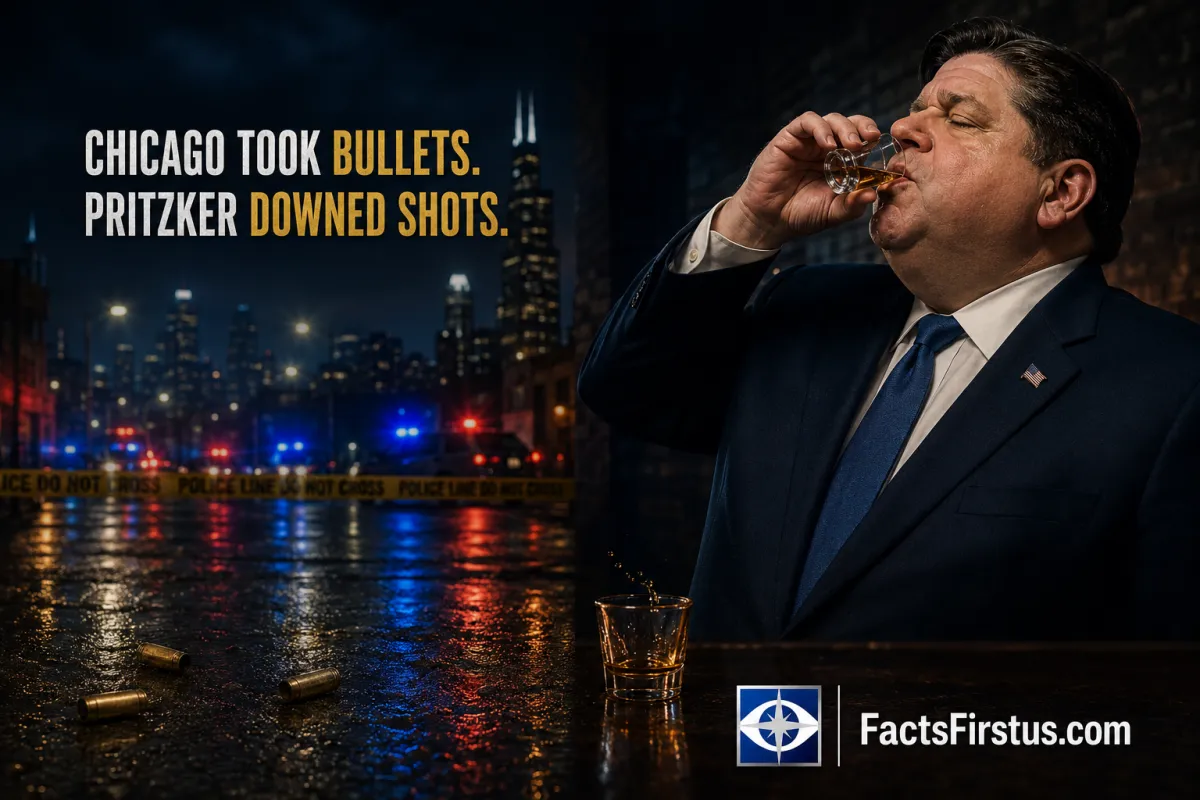
CHICAGO TOOK BULLETS. PRITZKER DOWNED SHOTS.
THE EMPTY HANDCUFFS OF ILLINOIS: FIFTEEN PEOPLE SHOT, ONE FATHER DEAD AND NOT A SINGLE ARREST
Masked gunmen opened fire on a Chicago reunion as families ran for their lives. Police found video, witnesses, shell casings and a weapon. The handcuffs remained empty while Governor JB Pritzker celebrated with shots of a different kind.
By Staff Writer
September 1, 2026
The shooters wore black. Their faces were hidden. Their guns were not.
On Saturday night, former residents of the Robert Taylor Homes gathered in Washington Park for a reunion. It was supposed to be a celebration of old friendships and shared memories.
Then the gunfire began.
Masked gunmen opened fire on the crowd, turning a community reunion into the scene of Chicago’s largest mass shooting of the year.
Fifteen people were shot.
Rontonio Guterz, a 35-year-old father of three, was struck six times and killed. Fourteen others, ranging in age from 21 to 47, were wounded.
When the shooting stopped, dozens of shell casings covered the ground. Some came from a rifle. Video of the attack exists. Eyewitnesses saw what happened. Someone in the crowd returned fire. Police recovered a weapon.
There was evidence. There were witnesses. There was video.
There were no arrests.
“Fifteen people were shot. A father of three was killed. Police recovered evidence, video and a weapon. The handcuffs remained empty.”
Another weekend brought another mass shooting, another grieving family and another set of empty handcuffs.
This was not an isolated explosion of violence.
Across Chicago that same weekend, at least 41 people were shot and three were killed. The numbers are staggering, but they are no longer surprising. That may be the most disturbing part of all.
Under nearly eight years of Governor JB Pritzker and the leadership of Chicago Mayor Brandon Johnson, weekend shooting totals have become part of the city’s routine. The public sees the same cycle repeated. People are shot. Families grieve. Officials issue statements. Political leaders condemn the violence. Then another weekend begins.
The violence is no longer confined to Chicago. Communities across Illinois are also confronting crime and growing fears about public safety.
The question is no longer whether Illinois has a violence problem.
The question is why the people committing the violence continue to walk free.
Fox News has openly questioned whether Chicago police officers have the tools and political support necessary to confront this level of violent crime. A growing number of residents, police advocates and even some Democrats believe they do not.
Critics point to the policies championed by Pritzker and Johnson, including cashless bail under the SAFE-T Act, reduced accountability for repeat offenders and a political culture that increasingly treats enforcement as something to be apologized for instead of supported.
Police officers are expected to enter dangerous neighborhoods, confront armed offenders and investigate shootings involving witnesses who may be terrified to speak. At the same time, officers are asked to operate inside a system that critics say has become more concerned with protecting a political agenda than protecting the public.
The result is a force that appears outmanned, under-supported and unable to bring immediate justice even after the most visible and heavily witnessed acts of violence.
One Democratic state lawmaker has watched the same pattern unfold and now believes the state is moving in the wrong direction. The lawmaker agreed to speak only on the condition of anonymity because of a fear of retaliation from within the Democratic Party.
“Illinois is unsafe. It’s getting worse. We need change, and perhaps, as much as I don’t want to say this, Governor JB Pritzker is not the person to bring about that change.”
Illinois State Representative, speaking on condition of anonymity out of fear of retaliation from the Democratic Party.
Those words did not come from a Republican attacking a Democratic governor during an election.
They came from inside Pritzker’s own party.
That matters.
Top Democrats are growing increasingly uneasy about the direction in which the governor is taking Illinois. Some may not be willing to say it publicly, but their silence should not be mistaken for confidence.
The fear runs in two directions. There is fear of the violence spilling into streets, parks and neighborhoods. There is also fear of the political machine that protects the people and policies responsible for the status quo.
Illinois residents do not need another political speech to tell them what they see.
They are already voting with their feet.
Some are leaving the state. Others are avoiding Chicago. Even residents of neighboring Wisconsin say they are willing to drive miles out of their way to avoid passing through the city.
On social media, William Countryman explained why he no longer goes to Chicago.
“I got beat up on Facebook for saying this is why I don’t go to Chicago anymore. Anyone else think this way?”
William Countryman.
Amy Leddy responded with four words.
“I agree with you.”
Amy Leddy.
Judy Ann described how people in Wisconsin view traveling through Chicago.
“We avoid it like the plague. Anyone in Wisconsin drives way out of the way to avoid Chicago unless flying out of O’Hare.”
Judy Ann.
These are not policy experts examining crime statistics from behind a desk. They are ordinary people making personal decisions about where they will travel, spend money and take their families.
They have decided that personal safety matters more than loyalty to a city, a political party or a carefully managed public image.
Chicago has world-class restaurants, museums, entertainment, businesses and neighborhoods. It should be a destination for families and visitors from across the Midwest.
Instead, some people are planning their trips around avoiding it.
That is more than a public relations problem. It is an economic warning and a profound failure of leadership.
People see a governor who has held office for nearly eight years presiding over a state where many residents can no longer afford to remain and where others fear becoming the next name in a weekend shooting tally.
Then they see that same governor step behind a bar and join revelers taking Malört shots as part of a world-record celebration.
There is nothing inherently wrong with a governor participating in a lighthearted public event.
The problem is the contrast.
As Illinois families were confronting the consequences of another violent weekend, images of the governor celebrating with shots of a different kind offered a split-screen view of the state.
On one side were laughter, cameras and raised glasses.
On the other side were shell casings, crime-scene tape and a father of three who would never return home.
That contrast will not be erased by another prepared statement.
“On one side were raised glasses. On the other side were shell casings, crime-scene tape and a father of three who would never return home.”
Republican lawmakers have been warning about the state’s direction for years.
State Representative Patrick Sheehan, a veteran police officer, has accused Pritzker of offering “lip service on public safety” while refusing to pursue meaningful reforms to the SAFE-T Act, even after police officers are shot and students are murdered.
“Lip service on public safety.”
State Representative Patrick Sheehan.
State Representative John Cabello, another lawmaker who still wears the badge, has accused Pritzker of turning a “blind eye to the public safety crisis” while promoting soft-on-crime policies that leave families frightened and communities vulnerable.
“A blind eye to the public safety crisis.”
State Representative John Cabello.
Their warning has remained consistent.
The policies are not working. The streets are not safer. Police officers do not feel supported. Families are afraid. The people in charge refuse to change direction.
Pritzker is now asking Illinois voters to give him a third term.
Before voters answer, they should ask what another four years would look like.
How does a governor ask to be rehired when groceries, electricity and housing continue to become more expensive while public safety deteriorates?
How does the state explain a mass shooting in which police recover shell casings, review video, interview witnesses and retrieve a weapon, yet make no immediate arrests?
How many times will Illinoisans hear that “gun violence has no place here” while the policies that critics say contribute to the crisis remain untouched?
How many press conferences, statements and promises will it take before the results finally change?
The question confronting Illinois voters is no longer theoretical. It is personal.
It is the question parents ask before allowing their children to play in a neighborhood park.
It is the calculation families make before attending an event in Chicago.
It is the detour drivers take because adding an hour to a trip feels safer than passing through the state’s largest city.
It is the moment a police officer wonders whether the system will support an arrest after the risk has already been taken.
It is the empty chair at the dinner table of a father who was shot six times.
The absence of immediate arrests following Saturday night’s massacre should not be treated simply as a failure by individual officers. Chicago police did not write the laws, create the political climate or design the system in which they are being asked to work.
The empty handcuffs are the visible symbol of a much larger failure.
Critics say they are the predictable result of leadership that places ideology before enforcement, political appearances before accountability and carefully worded statements before public safety.
Illinoisans are not asking for a perfect state. They are asking for a state in which violent criminals fear the consequences of their actions more than families fear leaving their homes.
They want to raise their children without deciding which parks are too dangerous.
They want to attend reunions without wondering whether masked gunmen will open fire.
They want to travel through Illinois without planning detours around Chicago.
They want police officers to have the authority, resources and political support necessary to remove violent offenders from the streets.
Most of all, they want to know why the same leaders who have failed to provide that basic security continue asking to be rehired.
Saturday night left Illinois with 15 shooting victims, a dead father, frightened families, dozens of shell casings and no arrests.
Those empty handcuffs are more than an unanswered question in a police investigation.
They are an indictment of a system.
The answer will be written at the ballot box.
The only question left is whether Illinois voters are finally ready to stop accepting a life measured in shell casings, weekend shooting totals and empty handcuffs.
Official Sources
Chicago Police Department reports and statements on the Washington Park shooting, August 29 through September 1, 2026.
Cook County Medical Examiner’s Office identification of Rontonio Guterz.
City of Chicago Violence Reduction Data Portal.
Interim Chicago Police Department Superintendent Fred Waller’s public comments, September 1, 2026.
Secondary Sources
Chicago Tribune, Chicago Sun-Times, NBC Chicago, Fox 32 Chicago, CWB Chicago and Block Club Chicago reporting on the August 29 through August 31, 2026, weekend violence.
New York Post, September 1, 2026.
Public statements and social media posts by Illinois State Representatives Patrick Sheehan, John Cabello and other Republican lawmakers.
Social media commentary from William Countryman, Amy Leddy and Judy Ann.