
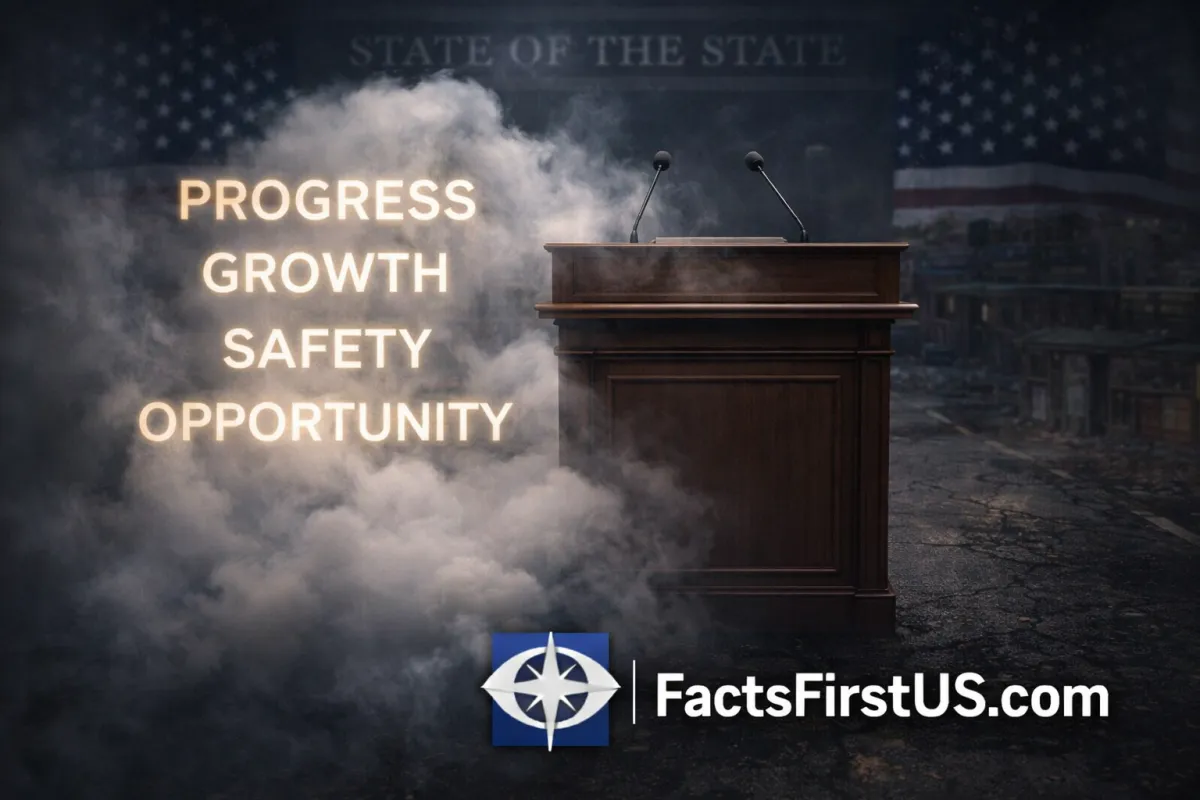
WHEN THE STATE OF THE STATE ISN’T THE STATE
ILLINOIS IN RUIN
The Hidden Catastrophe Pritzker Will Bury Tomorrow
As the billionaire governor prepares to boast of “progress” and blame Washington, the cold data tells a far darker story: a one-party experiment that hollowed out a state, punished work, and drove families away.
By Staff Writer
February 17, 2026
Illinois is not collapsing in a riot or a recession—it is emptying out quietly, one family at a time.
Tomorrow morning, Governor J.B. Pritzker will walk into the Illinois House chamber and deliver a State of the State address designed to reassure, to soothe, and above all to distract. He will speak of resilience. He will gesture toward selective gains. He will point an accusing finger at President Trump and Washington for every budget squeeze and every anxious household. Applause will rise from a supermajority secured by gerrymandered maps, and the message will be clear: Illinois is on the right track, and any pain you feel is someone else’s fault.
Do not believe it.
This account is built from federal tax records, labor data, state audits, and the government’s own reports—numbers that cannot be spun, only ignored. Behind the polished talking points lies a record the governor would rather you not examine—a record assembled not from partisan rhetoric, but from official admissions. It reveals a state in accelerated decline after nearly a decade of one-party progressive rule. Illinois is not a victim of distant forces. It is bleeding from self-inflicted wounds: crushing taxes, a pension system on the brink, policies that reward dependency and punish production, and a governing class that confuses spending with solutions.
“Roughly half of Illinois residents say they would leave the state if they could. That warning should be a wake-up call to state and local leaders.”
— Paul Vallas, February 17, 2026
Start with the most basic measure of a state’s health: whether people choose to live there. Pritzker’s team will trumpet a modest population “gain” of 16,108. What they will not say is how it happened. Illinois lost roughly 40,000 residents to other states last year alone, a continuation of a trend that stretches back a quarter century. That loss was offset only by an influx of approximately 45,000 illegal aliens. Since 2000, Illinois has hemorrhaged about 1.6 million people—the third-worst net loss in the nation. More than half of the state’s 102 counties are shrinking. Chicago’s population sits near a century-long low.
The human cost is written starkly across Chicago’s South and West Sides. From 2000 to 2020, the city lost more than 250,000 Black residents, overwhelmingly middle-income families seeking safety, opportunity, and stability elsewhere. The Black adult population fell 14 percent. The number of Black children collapsed by nearly 50 percent. Chicago Public Schools’ Black enrollment is less than half what it was at the turn of the millennium. These are not abstract numbers. They are classrooms emptied, churches shuttered, neighborhoods hollowed.
The Internal Revenue Service confirms what moving vans already told us. In 2022 alone, 87,311 Illinoisans left, taking $9.9 billion in adjusted gross income with them. These were not the poor fleeing opportunity; they were prime working-age, high-earning households averaging between $435,000 and $700,000 in AGI. They went where policy rewards effort—Florida, Texas, and other low-tax states. Meanwhile, the income gap between those leaving and those arriving exploded from $5,519 in 2010 to $37,922 in 2022. Illinois is systematically trading taxpayers for tax consumers.
The bill is staggering.
“Illinois has spent roughly $3 billion statewide on programs supporting and educating new migrants, including about $600 million from the city of Chicago.”
While Springfield expanded agencies, issued press releases, and celebrated “historic investments,” families absorbed the cost in smaller paychecks, higher rent, and decisions no press conference could undo.
That spending comes as the broader economy falters. In its February 2026 forecast for the Commission on Government Forecasting and Accountability, Moody’s Analytics delivered a blunt assessment: Illinois will lose jobs this year and next, marking the first sustained annual decline since the pandemic. Five-year employment growth is projected at just 0.6 percent, compared with 1.6 percent across the Midwest and 2.8 percent nationally. Unemployment already exceeds the regional average. Persistent out-migration will continue to suppress income and job creation for years to come.
This is after Illinois received roughly $54 billion in federal COVID aid—money critics argue was squandered on expanding government rather than fixing structural problems. The result: projected combined deficits of $23 billion over the next five years.
Taxes tell the same story of misrule. Since taking office, Pritzker has signed off on at least 49 tax and fee increases. Over the past 15 years, the Democratic supermajority has imposed roughly $110 billion in tax hikes, including more than 70 increases since 2019 alone. Per-resident collections surged 44 percent, from $2,790 to $4,030—twice the rate of inflation. Illinois now ranks first in the nation for combined state and local taxes, fines, and fees. Property taxes are the highest in America.
What do residents get in return? Illinois ranks last in economic equity and 40th in racial equality in education.
Private-sector vitality has been smothered. From 2019 to 2024, the state added 11,542 public-sector jobs while losing 1,942 private-sector positions. Net new jobs since January 2019 total a paltry 15,500—the second-worst performance in the country. In the same period, Florida added 1.1 million jobs. Texas added 1.5 million. Businesses are closing their doors here: 34,914 shuttered between March 2023 and March 2024. The number of licensed businesses has fallen to a ten-year low, down 17 percent since 2015. April 2025 alone saw 1,023 mass layoffs.
Hovering over everything is the pension time bomb: $144 billion in unfunded liabilities, the worst in the nation, consuming nearly one-third of state-source revenues and growing faster than those revenues. The crisis predates Pritzker by decades, but under his watch the supermajority has offered no meaningful reform—only demands for more taxpayer money.
Then there is public safety. For 13 consecutive years through 2024, Chicago wore the grim crown of America’s murder capital. The governor’s signature SAFE-T Act, which eliminated cash bail, has been blamed by law enforcement and victims’ families for releasing repeat offenders back onto the streets. In February 2026, bar owner Courtney M. Drysdale was shot and killed during a robbery by a repeat felon who should never have been free. Her name joins a long list of Illinoisans whose families were promised “reform” and delivered grief.
Even now, as politicians rush to claim credit for a decline in homicides in 2025—Chicago recorded roughly 416 to 417, its lowest level in 60 years—the context is carefully omitted. The earlier spike followed years of lenient pretrial release, sanctuary policies that shielded criminal illegal aliens, and obstruction of federal enforcement. Recent drops coincide with federal operations removing criminal non-citizens, not with any fundamental change in Springfield’s approach.
Education completes the picture of betrayal. Illinois students remain dramatically behind pre-pandemic levels, lagging roughly 30 percent in math and 37 percent in reading by some measures. Statewide, only about 38 percent of students meet math standards. Reading proficiency hovers near 52 percent—and far lower in urban districts. Chicago Public Schools’ results remain dismal despite billions spent. Black and Latino children bear the brunt of a system the supermajority refuses to overhaul.
The governor will point to $1.1 billion in medical debt relief as proof of compassion. He will not dwell on the more than $650 million spent since 2023 on migrant healthcare, housing, and services while long-time residents face soaring utility bills driven by green-energy mandates—up 22 percent in some areas—a push toward a $27 minimum wage that threatens small businesses, and the social fallout of cannabis legalization, including spikes in youth emergency-room visits for psychosis and impaired-driving crashes.
Across the state, infrastructure crumbles. Forty-two percent of roads are in poor condition. Families quietly pack up and leave. The Ramirez family sold their 200-acre Peoria farm under the weight of regulation; for them, a century of stewardship ended not with a harvest, but with a for-sale sign. Machinist John Martin is heading to Indiana. “We built our life here,” he says, “but the jobs are drying up, taxes are crushing us, and our kids see no future”—a future his children asked about at the dinner table, and did not like the answer. In Joliet, Elena Kowalski closed her century-old bakery after $20,000 in unpunished theft; the final click of the lock sounded like the end of an era. Carla Thompson, widowed by a carjacking involving a repeat offender, watches her pension erode as food-pantry lines grow longer, justice still a promise deferred.
None of this happened overnight. And none of it happened by accident.
This did not begin with Donald Trump. The exodus started in the early 2000s. Pension abuse has been a bipartisan scandal for decades. But the policies accelerating the collapse—relentless tax hikes, the SAFE-T Act, sanctuary rules, educational stagnation, and the squandering of COVID aid—belong squarely to Springfield’s Democratic supermajority and to Governor J.B. Pritzker’s tenure.
Tomorrow, he will offer a polished narrative of progress under siege by federal “chaos.” The official data—cold, unforgiving, and complete—tells another story entirely.
Illinoisans deserve more than spin. They deserve the truth. Progressive governance has turned the Land of Lincoln into the Land of Leaving. The experiment is failing. And Illinoisans are already delivering their verdict with their feet, their businesses, and their futures.
A state can survive bad years. What it cannot survive is leadership that refuses to learn from them.
The only question is how many will be left by the time Springfield finally listens.
Official Sources
U.S. Internal Revenue Service, Migration and Income Data (2022)
U.S. Bureau of Labor Statistics, Employment Data (2019–2024)
Moody’s Analytics Forecast for the Illinois Commission on Government Forecasting & Accountability (February 2026)
U.S. Census Bureau / American Community Survey, Population Trends (2000–present)
Chicago Police Department CompStat; University of Chicago Crime Lab, Crime Data through 2025
Illinois State Board of Education, Report Card (2025)
Illinois Policy Institute analyses of tax burden, business migration, and pension liabilities
U.S. Bureau of Economic Analysis, GDP and Economic Growth
The numbers do not lie. Tomorrow’s speech will. Illinoisans already know the difference.