ILLINOIS DEMOCRATS CAN HANDLE CORRUPTION, TAXES, AND PEOPLE LEAVING THE STATE, BUT APPARENTLY MEMES ARE A BRIDGE TOO FAR
Illinois Democrats Can Handle Corruption, Taxes, and People Leaving the State But Apparently Memes Are a Bridge Too Far
Critics say JB Pritzker’s supermajority is now targeting political satire, parody, and online speech with controversial new legislation.
By Staff Writer | May 9, 2026
Somewhere in Springfield, a politician apparently saw a political meme, sighed dramatically, and decided Illinois needed a new law to protect politicians from hurt feelings.
That may sound sarcastic, but critics across Illinois say that is exactly what House Bill 4557 feels like.
The proposal, known as the “Digital Forgeries in Politics Act,” is being pushed by Illinois Democrats as a way to stop deceptive AI generated campaign content. However, opponents argue the bill could easily become something far bigger and far more dangerous by opening the door to lawsuits over satire, parody, memes, edited videos, and political commentary during election season.
Because in Illinois, when politicians do not like what people are saying, the answer apparently is not debate. It is legislation.
Or a lawsuit.
Or both.
The bill is sponsored by Democrat State Representative Jennifer Gong-Gershowitz and backed by the same Democrat supermajority that already controls virtually every corner of Illinois government under Governor JB Pritzker.
Under Governor JB Pritzker, Illinois Democrats already dominate the governor’s office, the legislature, and virtually every major lever of state government. Critics now fear political speech itself may be next on the list.
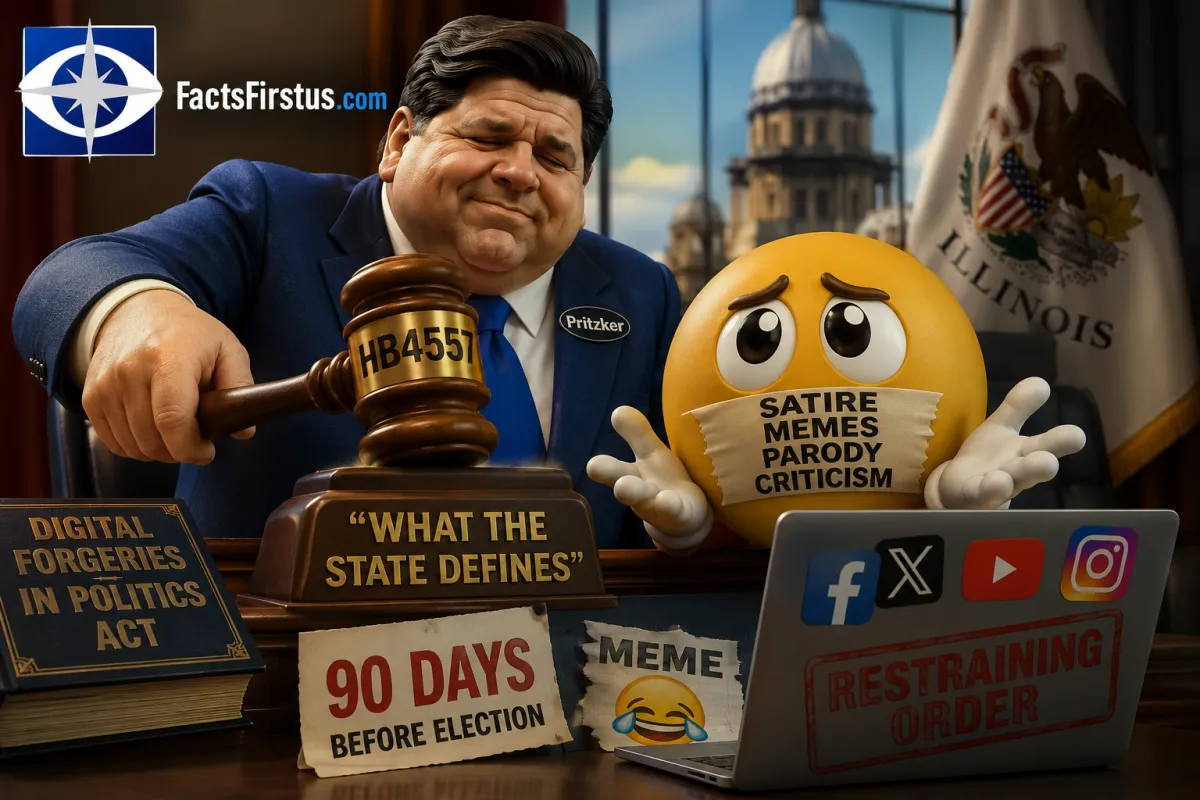
Under HB4557, if someone distributes what the state defines as a “digital forgery” of a political candidate within 90 days of an election, and the content could potentially harm the candidate’s reputation or campaign, that candidate could sue.
Read that again carefully.
Not what is objectively false.
Not what a jury later proves was malicious.
Not even what voters themselves reject.
What the state defines.
And that is exactly where critics say alarm bells should start ringing.
Because once government officials begin deciding which political speech is “acceptable,” the definition tends to expand very quickly.
Today it is AI generated deepfakes.
Tomorrow it could be parody accounts.
Political memes.
Satirical videos.
Edited campaign clips.
Cartoons.
Or maybe just criticism powerful politicians do not particularly enjoy seeing shared online two weeks before an election.
Governments rarely ask for power they intend to use sparingly.
Critics argue the wording is broad enough to become a lawyer’s playground and a free speech nightmare.
After all, modern political content is almost always manipulated in some way.
Campaign ads are edited.
Photos are filtered.
Videos are clipped for dramatic effect.
Memes exaggerate reality on purpose.
Political cartoons are literally built around distortion and ridicule.
That is the entire point.
Apparently, Springfield has now decided jokes need supervision.
“Cartoonists have been making fun of politicians since the 1750’s. This concept has just advanced more through the development of technology and AI.”
— Melodie Maruri-Cornelio
Political satire is woven deeply into American history.
Benjamin Franklin’s famous “Join or Die” cartoon appeared in 1754.
Thomas Nast spent years humiliating corrupt political machines through savage newspaper illustrations.
Abraham Lincoln endured brutal political cartoons.
Theodore Roosevelt was mocked relentlessly.
Public officials surviving criticism is not a flaw in democracy.
Critics argue it is one of the requirements.
Yet under HB4557, critics fear ordinary citizens could suddenly find themselves wondering whether a joke, meme, or sarcastic Facebook post now falls under whatever “the state defines” as unacceptable political manipulation.
And in Illinois, many residents are not exactly eager to hand more interpretive power to the same political machine already controlling the governor’s office, the legislature, and virtually every lever of state government.
Because politicians usually love free speech right up until it becomes inconvenient.
Judges could also issue restraining orders and injunctions forcing content to be removed before Election Day.
Critics immediately raised concerns over free speech and the broad wording of the legislation.
The law specifically targets speech distributed within 90 days of an election, precisely when political debate matters most and when satire, criticism, and public commentary traditionally explode online.
Critics say giving courts the ability to order speech removed during campaigns creates serious First Amendment concerns.
Picture this for a moment.
A judge in Springfield deciding whether a sarcastic Facebook meme posted two weeks before an election counts as protected political humor or illegal manipulation.
Critics say that possibility alone should concern every voter, regardless of party.
Because the First Amendment was not written to protect comfortable speech.
It was written to protect uncomfortable criticism, satire, political mockery, and dissent, especially when powerful people dislike it.
“Free speech for me but not for thee.”
— Matt Johnson Ving Tsun
“Illinois has become the UK with extreme censorship.”
— Christine Sebek
In fast moving election cycles, judges could face enormous pressure to quickly decide what is satire, what is parody, what is manipulation, and what speech deserves protection.
That line can become dangerously subjective very quickly.
One judge may see political humor.
Another may see “harmful misinformation.”
And in a one party dominated state like Illinois, many residents simply do not trust government officials to fairly referee political speech.
Especially when the politicians writing the rules are often the same ones being mocked.
“Who are the real ‘Kings’ here?”
— Tim Kinnaman
“Someone got their feelings hurt apparently.”
— Gerald Gross
Critics argue HB4557 feels less like voter protection and more like political insulation for powerful insiders who are tired of being criticized online.
Illinois residents have watched taxes climb, businesses leave, population decline, and corruption scandals pile up for years.
Many now see this latest proposal as another example of politicians focusing on protecting themselves instead of addressing the problems driving people out of the state.
Apparently, memes are now part of Illinois’ growing list of public safety concerns.
And the irony has not gone unnoticed.
The same politicians who constantly warn voters that “democracy is under attack” are now proposing legislation critics say could chill political speech before elections.
“They can dish it out, but they can’t take it.”
— Bob Stover
Online reactions exploded almost immediately after the bill began circulating on social media.
Some commenters openly mocked the proposal as authoritarian while others compared it to censorship policies seen in foreign countries.
“Sounds like we live in Russia now.”
— Dulcimer Play
“Illinois politicians can handle corruption, high taxes, and people fleeing the state, but apparently memes are where they draw the line.”
— Social media reaction
Some critics also warned the people most likely to silence themselves will not be wealthy political operatives or major media organizations.
It will be ordinary citizens.
Small meme pages.
Independent creators.
Everyday voters wondering whether one sarcastic post could suddenly attract legal threats from powerful politicians with endless attorneys and campaign money.
Because once speech becomes dependent on what “the state defines,” many people stop speaking long before the government ever has to force them.
To be fair, not everyone criticizing the outrage surrounding the bill believes all AI generated political content should be unrestricted.
Some observers acknowledged legitimate concerns over fake videos and fabricated audio designed to intentionally deceive voters before elections.
Others argued clear disclaimers on manipulated content may be reasonable.
“The issue is intent. Parody is protected speech.”
— Michael Cavanagh
“I thought everywhere was considering making it a law to tag AI videos. Nothing wrong with that.”
— Joel Boettcher
There is also an important distinction many legal observers point out.
The bill does not explicitly ban satire, political cartoons, or parody accounts in its written language. Critics are raising concerns based on how broadly the legislation could potentially be interpreted and enforced in court.
“The bill is real. The description of its basic purpose is mostly accurate. The claims about satire bans and broad censorship are interpretations and criticisms, not established legal facts.”
— Robert McFarland
That distinction matters legally.
Politically, however, the optics are brutal.
At a time when public trust in government is already collapsing, many voters are unlikely to feel comfortable watching politicians hand themselves expanded authority over political speech during election season.
Because history has shown that governments rarely stop at the narrow limits they originally promise.
Today it may be AI generated deepfakes.
Tomorrow it may be parody accounts, memes, political cartoons, or satire that powerful people simply do not enjoy being reminded of.
And many Illinois residents are beginning to ask a very uncomfortable question.
If politicians gain the power to decide which political speech is acceptable, who exactly decides when criticism becomes illegal?
For now, HB4557 remains in the House Rules Committee after being re referred in March 2026.
But the debate surrounding it has already sparked something far larger than artificial intelligence.
It has reignited an old American argument about free speech, political power, satire, and whether government officials should ever be trusted to regulate criticism of themselves.
Because when politicians start policing jokes, critics say the punchline usually ends up being the public.
And in Illinois, critics are beginning to wonder whether free speech itself now survives only at the pleasure of what “the state defines.”
Official Sources and Legislative References
Illinois General Assembly HB4557 Digital Forgeries in Politics Act
BillTrack50 Legislative Tracking
TrackBill Legislative Summary
National Archives History of Political Cartoons and Satire
American Experience Thomas Nast and Political Cartoons
Public Facebook reactions compiled from community discussion