
THE TAX THAT NEVER STOPS GROWING
THE TAX THAT NEVER STOPS GROWING
Illinois families are preparing for another painful increase at the gas pump as automatic fuel tax hikes continue without lawmakers ever having to publicly vote again.
By Staff Writer
May 7, 2026
The numbers on the gas pump climb fast in Illinois now.
Fifty dollars. Seventy dollars. Ninety dollars.
For many working families, filling up the tank has become a moment of quiet frustration and financial anxiety. Parents stare at the screen calculating what must now wait until next paycheck. A dinner out with the kids. Groceries. A utility bill. Maybe even medicine.
And beginning July 1, the cost of simply driving in Illinois is set to rise once again.
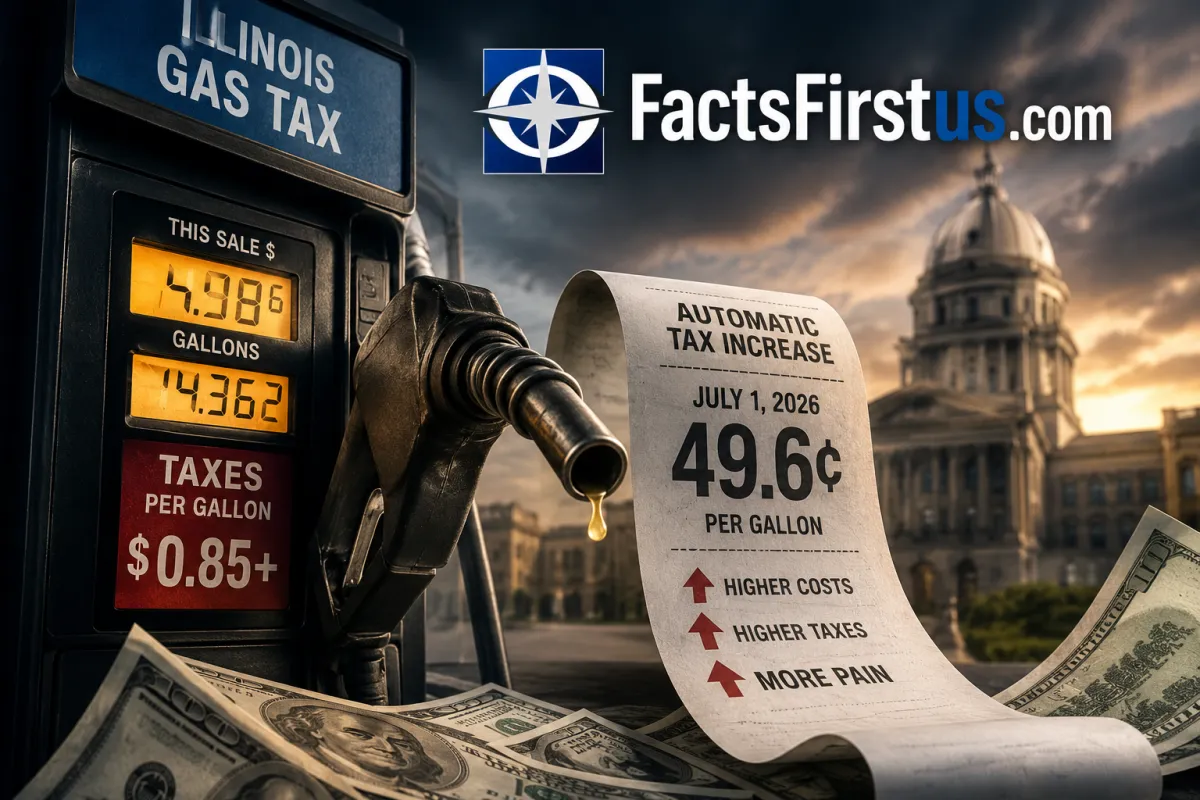
Under the automatic inflation increases built into Governor J.B. Pritzker’s 2019 Rebuild Illinois infrastructure law, the Illinois state gas tax will climb to 49.6 cents per gallon, nearly 50 cents before local and federal taxes are added on top.
Once all taxes are combined, many Illinois motorists now pay more than 85 cents per gallon in taxes alone every time they pull up to the pump.
Only heavily Democrat controlled states such as California and Michigan rival Illinois for the highest fuel tax burdens in America.
According to AAA, the average price of gasoline in Illinois reached $4.986 per gallon on May 6, nearly a dollar and a half higher than this time last year.
But for many Illinois residents, the growing anger is no longer just about high gas prices.
It is about a system many believe was intentionally designed to keep taking more money from taxpayers year after year while shielding politicians from accountability.
“The more Illinois families suffer at the pump, the more Springfield profits,” critics of the state’s fuel tax structure have argued as frustration continues building across the state.
Most Illinois drivers know gas prices are high.
What many still do not realize is that lawmakers built automatic annual tax increases directly into state law in 2019 when Governor Pritzker signed legislation doubling the state gas tax from 19 cents per gallon to 38 cents per gallon virtually overnight.
At the same time, lawmakers approved automatic inflation linked increases moving forward, allowing future gas tax hikes to happen every single year without requiring another recorded vote.
Critics say that decision gave lawmakers permanent political cover.
“Illinois families are now trapped in a system where taxes automatically rise while elected officials never have to publicly defend another vote,” taxpayer advocates have repeatedly argued.
To many frustrated residents, the issue feels bigger than gasoline.
It feels like a government that found a way to quietly build permanent tax increases into everyday life while working people continue falling further behind.
And the financial burden does not stop there.
Illinois also applies a 6.25 percent sales tax to gasoline purchases, meaning drivers are effectively paying taxes on top of taxes every time they fill their tanks.
As fuel prices increase, state revenue rises alongside them.
Your paycheck buys less.
Your tank empties faster.
Springfield collects more money.
For suburban and rural Illinois families, driving is not optional.
Construction workers commuting long distances in pickup trucks. Nurses driving overnight shifts. Factory employees traveling before sunrise. Parents hauling children between school, daycare, and work.
Many middle- and lower-income residents are driving older, less fuel-efficient vehicles because replacing them simply is not financially possible in today’s economy.
A Joliet tradesman filling a work truck several times each week can now spend hundreds more every month just getting to jobsites compared to only a few years ago.
A single mother commuting from Springfield to Decatur for work may now spend grocery money just keeping enough gas in the vehicle to make it through the week.
“For many Illinois families, the trip to work is becoming one more financial burden they can barely survive,” critics of the tax increases have warned.
The original justification for the massive gas tax increase was infrastructure.
Illinois residents were told the additional revenue was necessary to rebuild roads, repair bridges, modernize transportation systems, and improve critical infrastructure throughout the state.
Seven years later, many taxpayers say they are still dodging potholes, sitting through endless construction zones, and watching roads deteriorate while billions continue flowing into Springfield.
That frustration is now evolving into skepticism.
Many Illinois residents increasingly question whether taxpayer dollars intended for infrastructure are instead being swallowed by government waste, politically connected projects, and spending priorities far removed from the promises originally made to motorists.
Critics argue Illinois families were sold a vision of rebuilt infrastructure but instead received permanent automatic tax increases with little transparency and even less accountability.
And the political backlash is no longer aimed solely at Democrats.
While Governor Pritzker and the Democratic supermajority controlling Springfield continue facing criticism over the gas tax increases, growing frustration is also being directed toward Republican lawmakers who voted in support of the original legislation.
The votes remain part of the public legislative record.
In the Illinois Senate, Republicans Neil Anderson, John Curran, Don DeWitte, Steve McClure, Chapin Rose, and Dave Syverson voted in favor of the legislation.
In the Illinois House, Republican lawmakers Randy Frese, Jeff Keicher, Charlie Meier, Dave Severin, and Joe Sosnowski also supported the measure.
For many conservative voters, the anger runs deeper than partisan politics.
Grassroots organizations across Illinois increasingly argue that lawmakers who campaigned as fiscal conservatives instead helped create a system of permanent automatic tax increases that continues punishing working families today.
Calls for a political “house cleaning” inside the Republican Party are growing louder as grassroots activists push for what they describe as “true conservatives” willing to aggressively oppose future tax hikes and challenge Springfield leadership more directly.
Meanwhile, families across Illinois continue paying more.
While other states temporarily paused gas taxes or offered relief during periods of rising fuel costs and international instability, Illinois drivers are preparing for yet another automatic increase.
For many residents, this debate is no longer about politics alone.
It is about survival.
Every extra dollar spent at the pump is money no longer available for groceries, rent, medicine, school clothes, savings, or emergencies. Every automatic increase feels like another reminder that ordinary people are expected to absorb endless financial pressure while political leaders remain insulated from the consequences of the policies they pass.
Across Illinois this summer, families will once again stand beside gas pumps watching the numbers climb higher than they can comfortably afford.
Many will stop the pump early.
Many will quietly rearrange their budgets once again.
And many are beginning to ask the same question.
How much more can working people endure before the cost of simply living in Illinois becomes too heavy to carry?
Official Sources
Illinois Department of Revenue
AAA Gas Price Data
Illinois General Assembly legislative voting records
Rebuild Illinois Infrastructure Program legislation
Public fuel tax data from the State of Illinois
Illinois Policy Institute reporting and analysis