
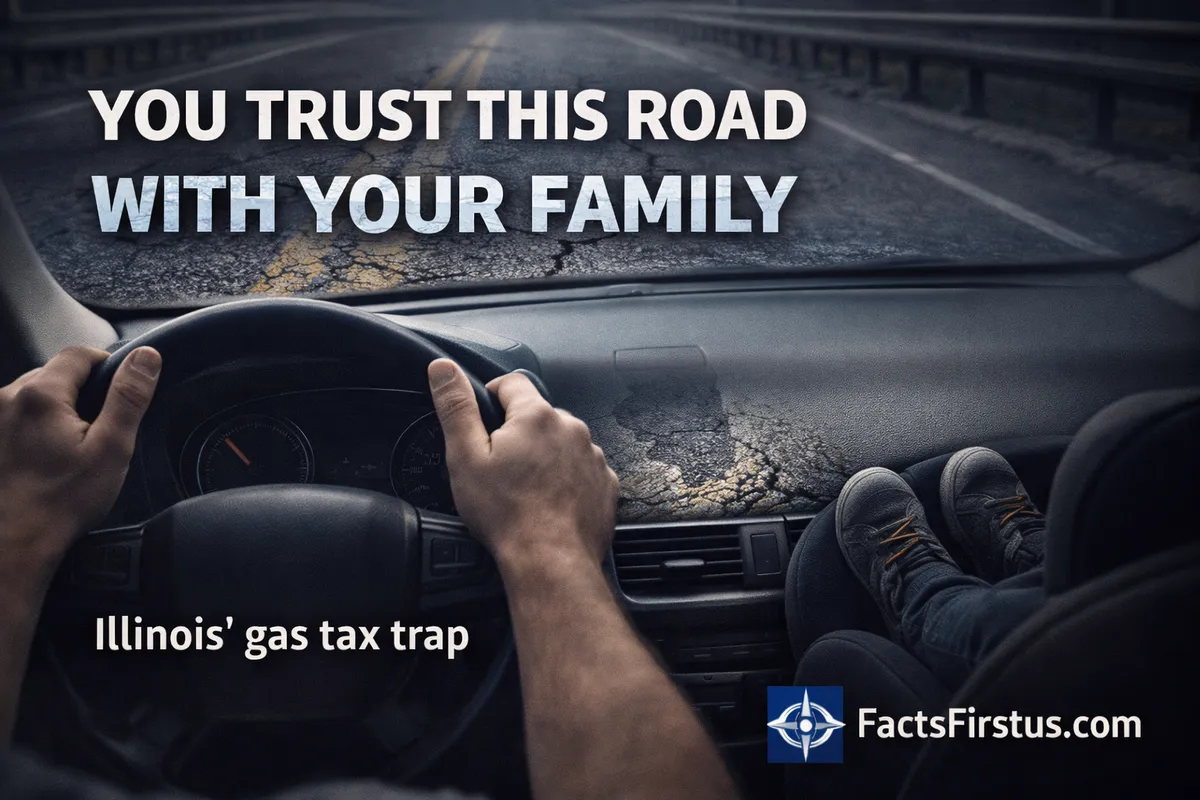
ILLINOIS’ GAS TAX TRAP
ILLINOIS’ GAS TAX TRAP
Why drivers here keep paying more—long after the rest of the country caught a break
By Staff Writer
February 7, 2026
The receipt was still warm when Mark folded it and slid it into his truck’s console.
It read $3.00 a gallon, a price that had become uncomfortably normal in Illinois even as drivers elsewhere began to feel relief. Mark barely glanced at it. He was already late, the February air sharp against his hands as he pulled onto the road. Fuel was not a choice for him. It was overhead—paid before he earned a dime, every single day.
Mark is a self-employed contractor in central Illinois. His work takes him across counties, down two-lane highways and over bridges most people notice only when traffic slows for no clear reason. He knows which stretches of pavement dip after a hard winter, which detours have outlived their “temporary” signs, which warning placards have faded into the background.
Two days later, after crossing the Mississippi River, he stopped again.
Same truck.
Same fuel.
Sixty-five cents cheaper.
Nothing about the oil had changed. The supply was the same.
The market adjusted. Illinois didn’t.
Illinois’ motor fuel tax was built on a straightforward premise: drivers would pay at the pump, and the state would maintain the infrastructure those drivers relied upon. Roads, bridges, and highways would be funded by the people who used them, and that money would stay where it belonged.
That promise was reinforced in 2016, when voters approved a constitutional amendment explicitly locking motor fuel tax revenues into transportation purposes. Drivers were told higher taxes would finally mean safer roads and reliable bridges.
Today, Illinois’ gasoline excise tax stands at 48.3 cents per gallon, among the highest in the nation, and it rises automatically each July with inflation. No vote. No debate. No moment when lawmakers must stand before constituents and explain why the cost of driving just went up again.
Nationally, prices moved in the opposite direction. Expanded domestic energy production, streamlined permitting, and reduced regulatory friction—policies accelerated during the Trump administration—helped stabilize supply and push prices down across much of the country. In many states, drivers felt that relief quickly and directly.
In Illinois, the pump barely noticed.
Most drivers understand the gas tax as a single charge. Far fewer realize that Illinois also applies sales tax to motor fuel, calculated on the retail price—including the excise tax itself.
In effect, drivers are taxed on the tax.
The excise tax is constitutionally protected. The sales tax revenue is not. That loophole—legal, deliberate, and largely invisible—allows fuel-related dollars to leave the road without ever breaking the law. It allows the state to comply with the letter of the constitution while quietly sidestepping the expectation voters believed they were approving.
Beginning in fiscal year 2026, roughly $860 million a year in motor fuel sales tax revenue, along with hundreds of millions more in related interest, is redirected away from road-related uses and into northeastern Illinois transit systems.
The shift is lawful. It is also distant from the daily experience of drivers like Mark, who pay higher prices while navigating infrastructure that continues to age in plain sight.
Illinois’ roads reflect that imbalance. The American Society of Civil Engineers assigns the state a C-, citing aging bridges, deferred maintenance, and a backlog that has grown into the tens of billions despite years of record fuel tax collections.
For communities near state borders, relief can be as close as the next river crossing.
For much of downstate Illinois, there is no such escape.
Think about the next time you load your family into the car and head across an aging bridge that makes you instinctively lift your foot off the accelerator—not because of traffic, but because something about it doesn’t feel right. The concrete is cracked. Rust bleeds through the steel. The pavement shifts just enough beneath your tires to remind you how old the structure really is.
You don’t need an engineer’s report to understand the risk. You feel it in the steering wheel, in the way you hold your breath a moment longer than usual, in the quiet calculation every parent makes about what could happen if something fails.
This is the road you rely on. This is the bridge your family crosses. And there is no alternate route waiting ten minutes away, no neighboring state just over the horizon offering relief. There is only the infrastructure beneath you—and the knowledge that you are paying some of the highest fuel taxes in the region to use roads and bridges that look like they have been waiting years for attention.
Every extra cent per gallon doesn’t stay at the pump. It follows you home.
You feel it in the grocery aisle, pausing just a moment longer before putting something in the cart. Prices didn’t jump dramatically. They crept. Milk costs more to deliver. Produce travels farther. Nothing is labeled “fuel tax,” but the total at the register tells the story all the same.
It shows up in the work that gets delayed. A repair estimate comes back higher than expected. A construction job stretches longer because materials cost more to move. A service call that once felt routine now comes with a number that gives you pause.
For small businesses, the pressure is constant. Trucks still have to roll. Equipment still has to move. Landscapers fill tanks before sunrise. Contractors haul tools across counties. Delivery drivers make the same stops as always, watching profit margins thin mile by mile. Those costs don’t disappear. They settle somewhere—often in wages not raised, jobs not added, or prices quietly passed on to customers already stretched thin.
For low- and middle-income households, there is no buffer. Fuel is not discretionary. A longer commute isn’t optional. A second job isn’t a preference—it’s survival. A doctor’s appointment across town is something you go to even when the tank is low. Each mile costs more, and there is no alternative to paying it.
So budgets tighten where no one sees. A plan is postponed. A repair waits another month. A family conversation ends with, “Let’s just not do it right now.”
Since 2019, Illinois has doubled its gasoline excise tax and locked in automatic annual increases. Those increases require no yearly vote, sparing lawmakers the political cost of defending them. Revenue diversions operate the same way—no new hearings, no sustained public debate, no moment when citizens are asked to consent again.
It is a system built for efficiency, not accountability. Automatic mechanisms reduce friction, mute scrutiny, and allow difficult decisions to happen quietly, without confrontation.
Over time, temporary measures harden into permanent policy. Oversight fades.
Revenue can be replaced. Trust cannot.
Mark still drives the same miles. He still fills the same tank. He still folds the receipt and slips it into the console before pulling back onto the road.
The receipt doesn’t explain any of this.
It doesn’t have to.
Sources
Illinois Department of Revenue — Motor Fuel Tax Overview and Rates
Illinois General Assembly — Motor Fuel Tax Law and Transportation Fund Statutes
Illinois Department of Transportation — Transportation Fund Distribution Reports
American Society of Civil Engineers — Illinois Infrastructure Report Card
U.S. Energy Information Administration — Retail Gasoline Price Trends