
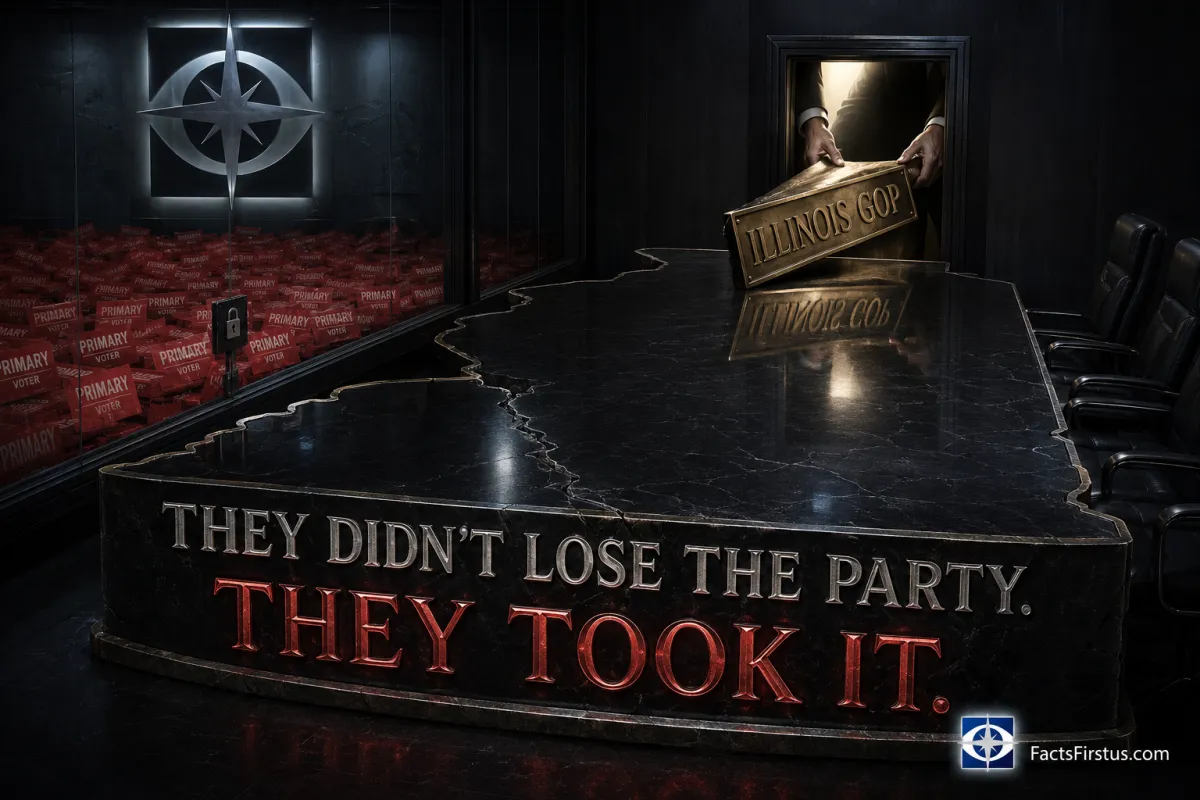
THEY DIDN’T LOSE THE PARTY. THEY TOOK IT.
EDITOR’S NOTE
FactsFirstus.com did not make the decision to publish this investigation because Thomas DeVore criticized the Illinois Republican Party. Political accusations, internal feuds and bruised feelings are common after a contested primary. They are not, by themselves, a story of this magnitude. We made the decision because the evidence began catching up with the accusations.
Election records supported the turnout figures DeVore presented. Campaign filings connected the names, committees and money he identified. Written communications emerged from people inside the structure he was describing. Then Illinois Republican Party Vice Chairman Zach Emberton was asked whether he had voted against providing financial support to the Republican statewide ticket. He did not deny it. He did not call the allegation false. He answered, “Yeah, I was a big no on that.”
That admission changed the standard by which this controversy had to be judged. The question was no longer whether an angry Republican was making accusations against his party. The party’s own vice chairman had confirmed that a vote occurred and that he opposed funding the statewide nominees selected by Republican voters. Soon afterward, former Illinois House Republican Leader Jim Durkin appeared on Chicago television, declared that there was “really no election in November,” attacked Darren Bailey and blamed Bailey and Donald Trump for Republican losses in Illinois.
The private vote and the public attack cannot be viewed in isolation. Together, they give weight to a concern Republican voters have voiced for years: that influential people inside and around the Illinois GOP are more committed to controlling the party than building the organization necessary to win with the candidates its voters select.
For years, Republicans across Illinois have watched presidential candidates attract hundreds of thousands more votes than Republican candidates receive in midterm elections. They have watched statewide nominees leave the primary without a visible statewide turnout operation behind them. County organizations have held dinners, collected small donations, staffed headquarters, made calls and knocked on doors. Meanwhile, many of the people doing that work have continued asking the same questions. Where is the state party? What is it building? Where is the money going? Whose interests are being protected?
DeVore’s ten-part release and subsequent reports attempt to answer those questions. His conclusion is explosive. He alleges that a small group of insiders took control of the Illinois Republican Party after losing the 2026 gubernatorial primary, withheld meaningful support from Bailey and Aaron Del Mar, and began preparing to use a November defeat as proof that Republican voters chose the wrong ticket.
Not every conclusion in DeVore’s release has been independently established. Some elements are confirmed by public records. Some are supported by named individuals describing events they say they witnessed. Others remain allegations or conclusions about motive and coordination. This report identifies those distinctions. It also refuses to use those distinctions as an excuse to ignore the evidence that is already in public view.
FactsFirstus.com is publishing this investigation now because waiting until after the election would serve the people whose decisions are being questioned. Illinois voters deserve to see the records, the money, the relationships, the public statements and the unanswered questions before ballots are counted and before anyone is allowed to write a convenient explanation for the result.
We are not asking readers to accept Thomas DeVore’s account on faith. We are asking them to examine what has been documented and decide for themselves whether the Illinois Republican Party is fighting to elect the ticket its voters chose, or whether powerful figures within the party are fighting to preserve control of what remains after another defeat.
THE PARTY THAT VOTED AGAINST ITS OWN TICKET
A party officer voted against funding the Republican ticket. A former Republican leader went on Chicago television and declared the election effectively over. Now records, money and political relationships are exposing a war inside the Illinois GOP before voters cast a single general election ballot.
By FactsFirstus.com Investigative Unit | September 1, 2026
The sentence was only nine words long.
“Yeah, I was a big no on that.”
According to a screenshot published by former Republican attorney general nominee Thomas DeVore, those words came from Zach Emberton, vice chairman of the Illinois Republican Party. A Republican voter had asked whether he voted to provide party money to Illinois Republicans running statewide.
There was no dense explanation of strategy. No description of another turnout program. No expression of regret over a difficult choice. There was only an answer: yes, the party’s number two officer had voted no.
Neither Emberton nor the Illinois Republican Party had publicly disputed the quoted response as this report was prepared. His answer confirmed the core fact at the center of an increasingly bitter revolt. A proposal to support the Republican statewide ticket reached the State Central Committee, and the party’s vice chairman voted no.
That vote was not symbolic. Emberton reportedly controls the largest weighted block on the committee. He used power created by Republican voters in one of the state’s strongest Republican congressional districts to oppose funding for the statewide ticket those voters had helped nominate.
Then, while that admission was spreading across Illinois, another prominent Republican supplied the words that made DeVore’s warning suddenly sound less like a prediction.
Former Illinois House Republican Leader Jim Durkin appeared on CBS News Chicago and effectively pronounced the Republican ticket dead before general election voting had begun.
“There’s really no election in November,” Durkin said.
He called Bailey’s campaign “foolish,” said Bailey “adds nothing to the equation for Republicans,” declared that he would not help the party and described him as “very intolerant.” Durkin then predicted Bailey would suffer the same result as four years earlier.
His most revealing statement went beyond Bailey.
“We’ve lost more Republicans because of people like Darren Bailey and Donald Trump in Illinois.”
Jim Durkin, former Illinois House Republican leader, during a CBS News Chicago interview
Read those developments together.
Inside the party, a senior officer used the largest weighted vote to oppose funding for the statewide nominees. Outside the meeting room, an established former Republican leader went on Chicago television and told the public there was essentially no election, ridiculed the nominee’s campaign and blamed Bailey and Trump for the party’s decline.
This is not merely a disagreement over tactics. It is a public declaration of war between the Republican voters who selected the ticket and influential Republicans who appear to have rejected their decision.
The party’s voters made their choice on March 17. Bailey and Aaron Del Mar received 304,162 votes, won an outright majority in a five-candidate primary and carried 98 of Illinois’ 102 counties. Durkin’s television appearance treated that decision as a mistake. Emberton’s vote denied it financial support.
The question is no longer whether the Illinois GOP is divided. The division is visible. The question is whether people with power inside and around the party have decided that proving Republican voters wrong matters more than giving their nominees a chance to win.
“Yeah, I was a big no on that.”
Zach Emberton, Illinois Republican Party vice chairman, in a social-media response published by Thomas DeVore
That question now hangs over a party facing a brutal calendar. Illinois’ general election is November 3. Vote by mail ballots are scheduled to go out in late September. Governor JB Pritzker commands a vast financial advantage, while Bailey is attempting to mobilize Republican voters in a state Democrats have dominated statewide for years.
The controversy is unfolding at precisely the moment when campaigns normally become most coordinated. Voter lists are refined. Mail is reserved. Field staff are deployed. Phones are worked. Irregular voters are reminded that the election is no longer months away.
Instead, Illinois Republicans are confronting evidence that powerful figures within their own party were writing off the ticket, withholding support and preparing the explanation for defeat before voting began.
The person dragging that conflict into public view is Thomas DeVore. He is an attorney who became one of the most recognizable opponents of Pritzker’s COVID-19 emergency orders, won the 2022 Republican nomination for Illinois attorney general and lost the general election to Democratic Attorney General Kwame Raoul. He is aligned with the party’s conservative grassroots and openly supports Bailey and Del Mar.
DeVore is not pretending to be neutral. He is making a case against people he believes seized control of the Illinois Republican Party and are using that control against its own voters. His political position is clear. So are many of the records he has placed before the public.
DeVore began with an arithmetic problem. In 2024, Republican presidential nominee Donald Trump received 2,449,079 votes in Illinois. In the 2022 governor’s race, Bailey received 1,739,095. The difference was 709,984 votes.
Pritzker defeated Bailey in 2022 by 514,653 votes. On paper, the Republican presidential-to-midterm drop-off was therefore larger than Pritzker’s margin by more than 195,000.
The number exposes the scale of the failure. Hundreds of thousands of Illinoisans who voted Republican for president disappeared from the Republican column when the governor’s race arrived. Pritzker’s entire 2022 margin fits inside that missing vote, with more than 195,000 left over.
DeVore’s larger point is that the gap is not unique to Bailey. Republican gubernatorial candidates with markedly different profiles have repeatedly landed in roughly the same range. Republican Governor Bruce Rauner received 1,765,751 votes in 2018. Bailey received 1,739,095 in 2022, a difference of 26,656. Bill Brady received 1,713,385 in 2010. George Ryan received 1,714,094 in 1998. Judy Baar Topinka received 1,368,682 in 2006.
Candidates matter. Campaign money matters. The opposition matters. But a pattern extending across ideologically different nominees strengthens DeVore’s contention that Illinois Republicans have a structural turnout problem, not merely a candidate-selection problem.
“The ceiling is not ideological. It is structural.”
Thomas DeVore
His accusation is not simply that party leaders have failed to solve that problem. It is that they have used the failure as an excuse to demand different nominees while declining to build the machinery needed to reach voters already inclined to support Republicans.
That is where the reported spending figure becomes politically explosive.
DeVore says the Illinois Republican Party’s July disclosure showed only $60.55 categorized as advertising and no meaningful statewide field program. He contrasted that figure with $137.50 in bank fees, $240.80 for one hotel stay, $402.28 in payroll processing fees and $511.25 in filing fees.
The party spent more on bank fees than it spent advertising to voters. It spent nearly four times as much on one hotel stay. It spent more than six times as much processing its own payroll.
If the Illinois Republican Party operated a serious statewide voter contact program, it can produce the expenditures, contracts, personnel and results. Until it does, the public record identified by DeVore shows $60.55 spent on advertising during July of a governor’s election year.
The urgency is magnified by the party’s weighted-vote system. State Central Committee members do not simply cast one equal vote each. Their voting strength is tied to Republican performance within their congressional districts. DeVore reports that Emberton controls 88,094 weighted votes from the 15th Congressional District, the largest single block, while Del Mar controls 16,566.
Under the allocation reported by DeVore, Emberton’s vote carried more than five times the weight of Del Mar’s on a question involving support for a ticket on which Del Mar is the lieutenant governor nominee.
That is not merely procedural trivia. The 15th District includes some of the state’s most consistently Republican territory. Its voters created that influence through turnout. DeVore’s charge is that Emberton used the weight produced by those voters to oppose the statewide ticket most of them had just chosen.
Emberton is not merely the party’s vice chairman. According to DeVore, he also works on House Republican staff under Minority Leader Tony McCombie. One of the most powerful votes inside the state party therefore belongs to a person whose livelihood is tied to one of Springfield’s most powerful Republican officials. Whether McCombie influenced his vote is a question both should answer directly.
Brown County Republican Chairman David Kurfman responded publicly that he had contacted Emberton and was awaiting an answer.
“I know this information doesn’t sit well with my constituents nor myself.”
David Kurfman, Brown County Republican chairman
That reaction matters because it shows the dispute moving beyond candidates and activists. County organizations are the people expected to sell tickets, recruit volunteers, staff events, knock doors and defend the party locally. If they believe the state organization is using their votes while disregarding their nominees, the result is not merely anger. It is institutional fracture.
Durkin’s intervention made that fracture impossible to hide. He was not an anonymous commenter or a disappointed primary voter. He led the Illinois House Republican caucus for nearly a decade. He was one of the most established Republican officials in the state. When a person with that history says there is “really no election in November,” his words do more than insult a candidate. They tell donors, volunteers and persuadable voters that the race is over and their effort is pointless.
That message is especially stunning when measured against Durkin’s own record. Illinois House Republicans held 51 seats following the 2016 election. By the end of the 2022 election, Durkin’s final cycle as leader, the caucus had fallen to 40. Republicans lost five House seats in 2022 alone. Durkin later stepped down as leader and resigned from the General Assembly.
Now the former leader who presided over an eleven seat decline is blaming Bailey and Trump for Republicans disappearing from Illinois government.
The contradiction reaches directly into Bob Grogan’s chairmanship. Grogan has preached party unity, invoked Ronald Reagan’s rule about accepting allies who agree 80 percent of the time and warned Republicans that “fratricide isn’t a good campaign strategy.” When he became chairman, he declared that Illinois Republicans were united and said he was ready to elect Republicans “up and down the ballot.”
Yet when Durkin went on Chicago television and attacked the Republican nominee for governor and the Republican president, the promised unity faced its first real test. Would Grogan publicly reject Durkin’s statements? Would he defend the ticket? Would his warnings against intraparty attacks apply to an established ally, or only to grassroots Republicans who challenge the establishment?
If unity is demanded only from the people who lost the internal power struggle, it is not unity. It is submission.
DeVore’s case then widens from one vote to a long-running turnout failure in DuPage County, the former heart of suburban Illinois Republicanism.
For decades, Republicans benefited from superior off-year discipline there. DeVore’s historical comparison argues that Republican midterm retention once substantially exceeded Democratic retention. By 2022, that advantage had reversed: Democrats retained a greater share of their presidential-year vote than Republicans.
The raw results tell the political story. In the 1998 governor’s race, Republican George Ryan received 175,223 votes in DuPage County while Democrat Glenn Poshard received 71,055. In 2022, Pritzker received 190,601 there while Bailey received 138,667. A county Republicans once carried by more than two to one favored the Democrat by nearly 52,000 votes.
Rauner’s 2018 loss in DuPage is particularly damaging to the claim that moderation alone solves the suburban problem. He was an incumbent Republican governor, a wealthy suburban businessman and the type of candidate establishment Republicans have often described as viable in the collars. Yet he lost DuPage to Pritzker.
This does not establish that ideology is irrelevant. Suburban voters have changed, national politics has changed and the Republican coalition has shifted geographically. But it does undercut any simple story in which a moderate nominee automatically restores the county.
DeVore argues that Democrats organized while Republicans explained. Democrats increased their ability to bring presidential-year supporters back for midterms; Republicans did not. In his telling, the people who lost control of DuPage are now exporting their strategy to the state party.
That accusation points directly at Chairman Bob Grogan and several DuPage figures named throughout DeVore’s series.
Grogan, a former DuPage County auditor, was elected state Republican chairman in May through the party’s weighted voting system. He had also served as treasurer of Ted Dabrowski’s 2026 gubernatorial campaign, while state Senator Jason Plummer was listed as chairman. Bailey and Del Mar defeated the Dabrowski ticket in the March primary.
Two months after Republican voters rejected Dabrowski, the treasurer of Dabrowski’s campaign controlled the Illinois Republican Party’s checkbook. Grogan’s past role did not remain in the past. His name reportedly remained attached to an active Dabrowski committee while the state party he now chaired refused financial support to the candidate who defeated Dabrowski.
DeVore alleges that Grogan entered the chairman’s contest only after receiving a State Central Committee seat representing the 6th Congressional District through an expedited acclamation process in DuPage County. Because committee votes are weighted, the seat gave Grogan both a vote and a place inside the deliberative body before the chairman’s election. DeVore further notes that Jeff Castle, one of the men he says helped advance Grogan’s appointment, later filled the seat Grogan vacated after becoming chairman.
DeVore is not alleging that someone stuffed a ballot box. His point is more unsettling. The people involved did not need to break the rules. They understood how to use them. Secure the seat. Enter the room. Cast the weighted vote. Win the chair. Fill the vacancy.
The proper questions are factual. Who called the meeting? How much notice was given? Were other candidates invited? Who moved and seconded the acclamation? What was the weighted margin in the chairman’s race? What commitments, if any, were discussed before the votes?
Until minutes, notices and participants’ accounts are produced, the public has DeVore’s reconstruction, not a complete record.
The most serious allegations in the series involve motive and retaliation.
DeVore says Kristina McCloy, a deputy State Central Committee member from DuPage County, openly backed Bailey and Del Mar after the primary. He alleges that Grogan first told her to stop and later pressured her superior, Bob Kelsey, to remove her. DeVore says both McCloy and Kelsey authorized him to make the account public. He further alleges that Grogan threatened to enlist other committee members to pressure Kelsey if he refused.
These are not anonymous whispers. DeVore says McCloy and Kelsey both authorized him to place their accounts on the record. Grogan has been given the opportunity to respond to an allegation that he attempted to use the authority of the state chairmanship against Republicans for supporting the Republican ticket.
If confirmed, the episode would be extraordinary: a state chairman using his influence not to discipline someone for opposing Republican nominees, but allegedly to silence a party official for supporting them.
“They have the energy. They have the time. They have the phone. They just do not point any of it at Democrats.”
Thomas DeVore
DeVore also focuses on the financial support Bailey has, and has not, received since winning the primary. He says only six of 59 Republican members of the General Assembly contributed directly to Bailey after the primary: John Cabello, Regan Deering, Dennis Tipsword, Andrew Chesney, Travis Weaver and Bill Hauter, totaling $4,614. He contrasts that with $61,249 he says came from 39 county Republican organizations.
The contrast is staggering. County organizations financing campaigns through dinners, small donations and volunteer labor collectively gave more than thirteen times what Republican state legislators gave directly. Thirty nine county organizations found $61,249. Fifty three Republican state legislators found nothing.
The grassroots wrote checks. The leadership produced explanations.
The phrase party officials reportedly used, “we do not write blank checks,” became the hinge of DeVore’s fifth installment.
He juxtaposed that rationale with large labor-PAC contributions reported by Friends of John Curran, the committee associated with the Senate Republican leader. DeVore cited two late-August contributions totaling $585,000: $300,000 from the Chicago Land Operators Joint Labor-Management PAC and $285,000 from the Engineers Political Education Committee.
The “blank check” explanation collapses under its own hypocrisy. Republican leaders accepted hundreds of thousands of dollars from organized labor without publicly disclosed, transaction specific conditions, while party officials invoked principle to reject even minimal support for their own nominee.
If Republican leaders can accept $585,000 without publicly stated conditions, why was even $50 for the Republican ticket treated as an intolerable blank check?
The answer may be that party leaders wanted control over spending rather than a direct transfer. If so, they could fund voter contact themselves. They could purchase mail, texting or data; finance a phone bank; or coordinate permissible activities under Illinois election law. DeVore says they did none of those things and did not even initiate a call with the nominees.
That allegation is readily answerable. Grogan, Emberton, McCombie, Senate Republican Leader John Curran and party executive staff can disclose the dates and substance of their contacts with Bailey and Del Mar, along with expenditures made to support the statewide ticket. If there was a plan, showing it would end much of this dispute.
If there was no plan, the “blank check” defense collapses into an excuse.
DeVore’s theory ultimately centers on Plummer, a Republican state senator from Madison County who chaired Dabrowski’s primary campaign. DeVore notes that Grogan served on the board of Constitution Bank, chaired by Plummer, and that Plummer is part of the Senate Republican caucus that chooses its leader. From those overlapping roles, DeVore infers that Plummer is the power behind the party’s current alignment.
The relationships form a chain that runs through the party. Plummer chaired Dabrowski’s rejected campaign. Grogan served as its treasurer and sat on the board of a bank chaired by Plummer. Grogan then became state party chairman. Plummer remained part of the caucus that determines whether Curran keeps his leadership position. DeVore’s conclusion is blunt: Grogan is the instrument, but Plummer is the architect.
Plummer can dispute that conclusion. He cannot dismiss the relationships that produced it.
But Plummer’s position leaves him with questions only he can answer. Did he advocate for Grogan as chairman? Did he communicate with State Central Committee members about funding Bailey and Del Mar? Has he contributed or provided assistance to the nominees? Does he support the ticket without reservation? Does he expect Dabrowski to seek office again in 2030?
The last question gained attention because the Ted for Illinois committee reportedly remained active with the State Board of Elections, with Plummer listed as chairman and Grogan as treasurer, months after the primary. Dabrowski’s campaign website and social-media presence also remained online.
An open campaign committee does not formally announce a 2030 candidacy. It does something politically significant nonetheless. It preserves the organization, keeps the officers in place and leaves the machinery ready. The chairman is Jason Plummer. The treasurer is Bob Grogan. The committee belongs to the candidate Bailey defeated. Those are not predictions. They are the names reportedly remaining on the filing.
The most defensible conclusion is also troubling enough: the current chairman of the Illinois Republican Party reportedly remained an officer of an active committee belonging to the candidate who lost the gubernatorial primary, while the state organization withheld financial support from the candidate who won. Even if lawful, that arrangement creates an appearance of divided loyalty that should have been resolved or publicly explained.
DeVore’s series also named Jeanne Ives, a former state representative and 2018 gubernatorial candidate. Ives endorsed Bailey in 2022 and told voters he was the only Republican in the field with a record of standing up to Pritzker. Four years later, she backed Dabrowski and, according to DeVore, publicly attacked the same man she had once praised and advised.
That history may expose inconsistency, but it does not establish involvement in a coordinated plan. Any allegations concerning confidential campaign information or leaked internal documents should be reported only with the original reporting, supporting evidence and Ives’ response. They should not be converted from allegation to fact through repetition.
As the ten-part release spread, public reaction ranged from fury to calls for a different campaign strategy.
Beth Simpson Montfort wrote that party officials should support the Republican nominee whether they personally liked him or not. Kim Miller alleged that precinct committeemen in her county had been pressured to support Emberton in the name of “party unity.” Don Moore wrote that some Republicans appeared content to remain in the minority so long as they could continue claiming to fight for conservative values. Alan Horn argued that the party should concentrate on reaching voters in heavily populated counties while improving Republican turnout statewide.
The anger was not simply about money. It reflected a growing belief that Republican voters had fulfilled their obligation, selected their nominees and supported their party, only to discover that party officials did not believe the obligation ran both ways.
After DeVore addressed Bailey directly, reactions became even more intense. Donna Hopwood called for a fresh start. Tim Latronico described the State Central Committee as morally bankrupt. Sandra Koehler urged presidential-year Republican voters to return for Bailey in November. Terry Blakeman offered a different emphasis: expose opposition from both parties, but run as a candidate for all Illinoisans and avoid allowing the campaign to become consumed by negativity.
Blakeman’s response may be the most strategically important because it identifies the choice now confronting Bailey. He can treat the state party dispute as an internal grievance, or he can use it to make a broader case that Illinois institutions are controlled by people more interested in preserving influence than delivering results. The first approach risks shrinking the campaign into a Republican family argument. The second could resonate beyond party activists, but only if it is supported by evidence and tied to the concerns of voters who do not follow State Central Committee politics.
DeVore’s public letter urged Bailey not to remain silent. He recounted their alliance during the COVID-19 restrictions, accused Republican leaders of failing to oppose Pritzker at the time and argued that the same establishment is now working against Bailey and Del Mar.
DeVore acknowledged that defeating Pritzker was always a difficult task. That is precisely why the party’s conduct matters. Bailey was facing a billionaire governor, a Democratic supermajority and a political machine years in the making. The Republican organization did not need to make the road harder. It needed to do everything within its power to give its nominees a chance.
But a difficult race is not a justification for a party to disengage. Political parties exist to recruit nominees, organize voters and compete. If leaders judged the race unwinnable and redirected resources elsewhere, they should say so openly and defend that allocation. If they opposed Bailey for ideological, strategic or personal reasons, they should explain how refusing assistance advances the interests of the Republicans whose votes gave them authority.
“They did not have to say no forever. They only had to say no long enough.”
Thomas DeVore
That is the allegation at the heart of DeVore’s final argument. He predicted that if Bailey loses, establishment Republicans would immediately say Illinois is no longer winnable for the GOP, Bailey was too conservative and the party needs a more moderate suburban nominee in 2030. DeVore says that explanation is being manufactured through inaction. Deny the nominee money, organization and coordination. Then use the loss as proof that the primary electorate chose incorrectly.
Jim Durkin did not wait until November 4.
He began delivering that argument before the first general election ballot was counted.
“There’s really no election in November,” Durkin declared. He called Bailey’s campaign foolish. He blamed Bailey and Trump for driving Republicans away.
That was not analysis after a defeat. It was surrender before the vote, delivered by a former Republican leader while the Republican ticket was still asking voters, donors and volunteers to believe the race mattered.
DeVore predicted the script. Durkin read from it early.
The Illinois Republican Party can still answer the accusation. It can release the vote tally and minutes from the meeting where statewide funding was considered. It can identify who proposed support, what amounts and conditions were discussed, and how every member voted. It can disclose what voter contact work it funded after the primary. It can document every meeting and call with Bailey and Del Mar. It can explain Emberton’s weighted vote and clarify Grogan’s continuing role with the Ted for Illinois committee.
FactsFirstus.com is waiting for responses from Grogan, Emberton, Plummer, McCombie, Curran, Ives, Castle, Coyne, Dabrowski, Kelsey, McCloy, Bailey, Del Mar and the Illinois Republican Party. Any denial, explanation or supporting documentation received will be presented prominently and will not be buried after readers have reached a conclusion.
This is no longer a quarrel that can be dismissed as social media noise. The Illinois Republican Party can dispute DeVore’s conclusions. It cannot erase the record.
It cannot erase Emberton’s admission.
It cannot erase the weighted vote.
It cannot erase the $60.55.
It cannot erase the county organizations that found money while state leaders found excuses.
It cannot erase the labor money flowing into Republican leadership accounts.
It cannot erase the active Dabrowski committee with Plummer and Grogan reportedly remaining as officers.
It cannot erase Durkin going on Chicago television and declaring the election effectively over before voting began.
Illinois Republican voters do not have to accept every conclusion DeVore reached to recognize the pattern. They need only ask what any shareholder, donor or volunteer would ask of an organization facing repeated failure. What was the plan? Who approved it? Where was the money spent? Who is accountable for the result?
The countdown is no longer theoretical. Ballots are approaching. The nominee has been chosen. The opposition is funded and organized. Every day lost is a day that cannot be recovered.
DeVore ended his public appeal to Bailey with the words, “Burn it to the ground.” He specified that he meant it figuratively and as a demand to rebuild the party. The deeper issue is not destruction. It is disclosure.
Open the minutes. Release the vote. Show the expenditures. Produce the contacts. Answer the allegations.
If there is an innocent explanation for the entire pattern, now is the time to produce it.
If the silence continues, Illinois Republicans will be left with a conclusion more damaging than another election loss. Their party may not simply be failing to fight for them. The people controlling it may be fighting to make certain the voters never control it again.
November will determine who governs Illinois.
What happens before November may determine whether the Illinois Republican Party still belongs to Republican voters.
Official Sources
Illinois State Board of Elections, certified election results for the 1998, 2006, 2010, 2018, 2022 and 2024 general elections, and the March 17, 2026 primary election.
Illinois State Board of Elections, campaign-disclosure records and Statements of Organization for the Illinois Republican Party, Friends of John Curran, Bailey for Illinois, Ted for Illinois, and committees referenced in this report.
Illinois Republican Party bylaws, State Central Committee membership records and weighted-vote allocations.
Illinois Secretary of State, business-entity and annual-report records for the Illinois Republican Party and related legal entities, where applicable.
Official Illinois General Assembly biographies and leadership rosters for members named in this report.
Secondary Sources and Source Material
Thomas DeVore, ten-part public release, encore installment, subsequent post concerning Zach Emberton and public letter to Darren Bailey, August 2026.
NPR Illinois/Capitol News Illinois, reporting on Bob Grogan’s election as Illinois Republican Party chairman and the party’s 2026 challenges.
Capitol News Illinois reporting on Darren Bailey’s turnout strategy and the 2026 gubernatorial campaign.
CBS News Chicago interview with former Illinois House Republican Leader Jim Durkin, broadcast in late August 2026.
Illinois Review, reporting and video excerpts from Durkin’s CBS News Chicago interview, August 31, 2026.
Axios Chicago and Illinois local-news reporting on the March 17, 2026 Republican gubernatorial primary.
Public social-media statements quoted or summarized in this report. These statements reflect the speakers’ opinions or allegations and are not treated as independent proof.