
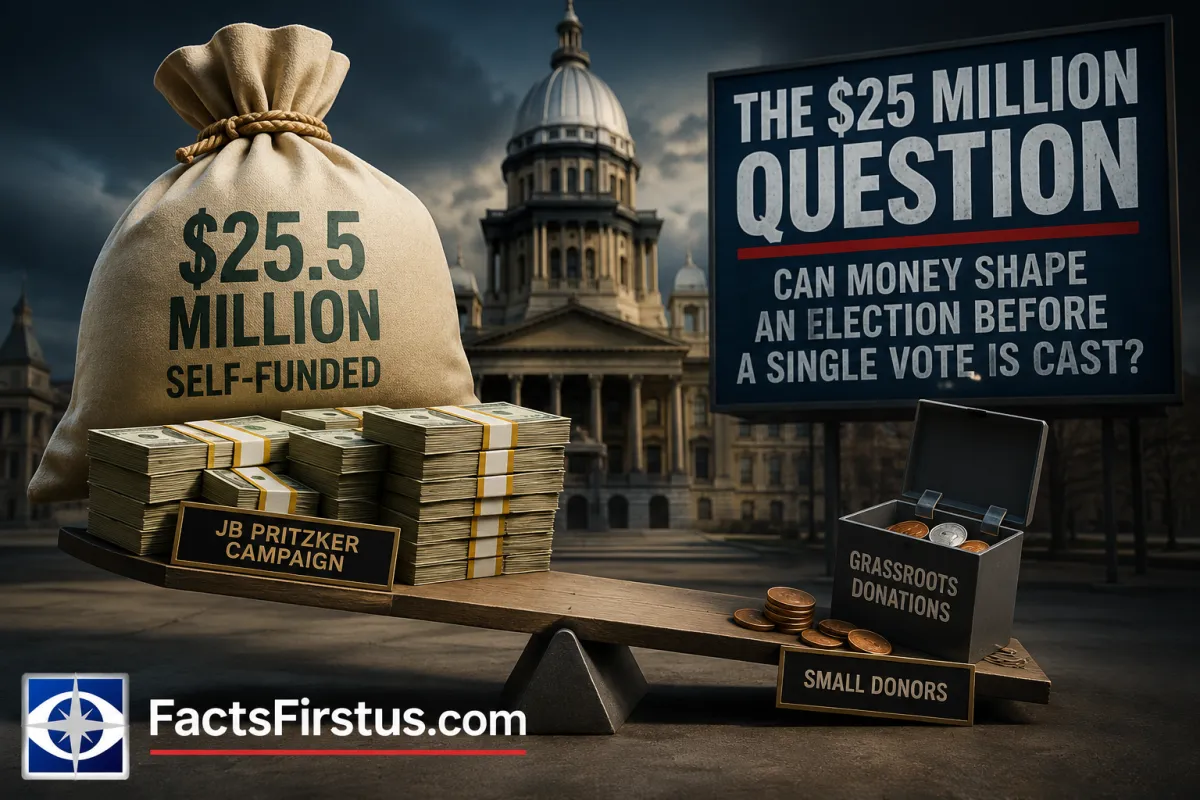
THE $25 MILLION QUESTION: HAS MONEY ALREADY DECIDED ILLINOIS' GOVERNOR'S RACE?
ILLINOIS' $25 MILLION QUESTION: WHEN DOES MONEY CHANGE AN ELECTION?
One candidate can write a campaign check larger than most Illinois families will earn in several lifetimes. Another depends on small-dollar donors simply to remain competitive. The latest campaign finance reports raise a question that reaches far beyond one election: Has money become the greatest barrier to political competition in Illinois?
By Staff Writer | July 21, 2026
The check cleared before most Illinois families had finished their morning coffee.
One signature.
Twenty-five and a half million dollars.
It wasn't a business investment.
It wasn't a charitable donation.
It was a campaign contribution.
With a single signature, Governor JB Pritzker transferred $25.5 million of his own money into his campaign as he began his bid for a third term.
The contribution was completely legal.
It was fully disclosed.
And it immediately underscored a reality that has become increasingly difficult to ignore in Illinois politics.
Long before campaign commercials dominate television,
Long before candidates crisscross the state holding rallies,
Long before millions of Illinoisans begin paying close attention to the governor's race,
Another contest is already underway.
The competition for attention.
Because before candidates compete for votes, they compete for visibility.
Who can afford the television commercials?
Who can dominate digital advertising?
Who can flood mailboxes?
Who can hire more campaign staff?
Who can stay on the air longer?
The latest campaign finance reports filed with the Illinois State Board of Elections suggest those questions may increasingly determine how the public experiences statewide elections.
"Money doesn't guarantee victory. It does guarantee a much louder microphone."
— Analysis based on Illinois State Board of Elections campaign finance filings
According to official filings, Pritzker contributed $25.5 million of his personal wealth to his campaign in late 2025.
Even after months of campaign spending on television advertising, consultants, digital outreach, travel, staffing, and operations, his committee still reported more than $3.1 million cash on hand at the close of June 2026.
For most candidates, fundraising determines what they can afford.
For extraordinarily wealthy candidates, personal wealth can substantially reduce those financial constraints.
Twenty-five and a half million dollars can finance months of statewide advertising.
It can support hundreds of campaign events.
It can build large campaign organizations.
It can help shape public awareness long before many voters have made up their minds.
Illinois law allows candidates to spend unlimited amounts of their own money on their campaigns.
The issue raised by these disclosures is not whether self-funding is legal.
It is whether extraordinary personal wealth changes the nature of political competition.
That question becomes even more striking when compared with the campaign finances of Governor Pritzker's Republican challenger.
Darren Bailey reported raising approximately $1.33 million during the latest reporting period.
That sounds impressive.
Until the next figure appears.
After spending roughly $1.28 million, Bailey entered July with $127,990 cash on hand.
Nearly half of the money his campaign raised came from contributors giving less than $150.
More than $900,000 went toward fundraising costs and direct mail, illustrating just how expensive statewide campaigns have become before many voters are even fully engaged.
"Illinois voters still decide elections. Campaign dollars often determine which messages they hear first."
— Analysis based on Illinois State Board of Elections campaign finance filings
The financial contrast is difficult to ignore.
One campaign can purchase another major advertising campaign.
The other must continue raising money simply to remain competitive.
Four years ago, the landscape looked different.
During the 2022 gubernatorial race, Bailey benefited from significant financial support from conservative businessman Richard Uihlein, allowing Republicans to compete more aggressively throughout much of the campaign.
That level of outside financial backing has not materialized in the same way during the 2026 election cycle, forcing Bailey to rely much more heavily on grassroots supporters.
The funding imbalance has also produced one of the race's more unexpected developments.
Independent candidate Collin Corbett, after loaning his campaign $500,000, reported approximately $379,000 cash on hand, leaving him with substantially more available campaign funds than Bailey despite running outside the two major political parties.
Taken together, the latest campaign finance reports paint a remarkable picture.
Governor JB Pritzker personally invested $25.5 million in his campaign and still reported more than $3.1 million cash on hand entering July.
Republican nominee Darren Bailey reported no personal self-funding and just $127,990 cash on hand after raising and spending more than $1.3 million during the reporting period.
Independent Collin Corbett, after loaning his campaign $500,000, reported approximately $379,000 cash on hand, giving him more available campaign funds than one of the two major-party nominees.
Campaign finance reports, however, do not decide elections.
They cannot measure public frustration over taxes.
They cannot predict how voters feel about crime, schools, healthcare, economic opportunity, or state government.
They cannot capture conversations happening around kitchen tables, coffee shops, church gatherings, or neighborhood ballfields.
And they certainly cannot predict what Illinois voters will do when they step into the voting booth.
History reminds us that well-funded candidates sometimes lose.
It also shows that money often shapes the conversation leading up to Election Day.
The candidate with the largest bank account does not automatically earn the most votes.
But that candidate often has the greatest opportunity to define the race before voters begin paying close attention.
"The ballots have not yet been cast. But the battle to shape the conversation has been underway for months."
— Analysis based on Illinois State Board of Elections campaign finance filings
The 2026 governor's race may ultimately be decided by issues, leadership, or the direction voters believe Illinois should take.
Only the voters can answer that question.
But the campaign finance reports raise another one.
Has the cost of running a modern statewide campaign reached a point where political competition itself is becoming increasingly difficult for candidates without extraordinary personal wealth or access to it?
That question extends well beyond Governor JB Pritzker.
It reaches beyond Darren Bailey.
It reaches beyond this election.
Because if statewide campaigns continue becoming more expensive every election cycle, Illinois voters may eventually find themselves choosing not simply between competing ideas...
But between those who can afford to compete and those who cannot.
Official Sources
Illinois State Board of Elections – Campaign Disclosure Reports for Friends of JB Pritzker, Bailey for Illinois, and Corbett for Governor committees (Quarterly filings through June 30, 2026).
Illinois State Board of Elections Campaign Disclosure Database – Official reports detailing contributions, self-funding, expenditures, loans, and cash-on-hand balances.
Chicago Tribune – July 2026 reporting on Illinois gubernatorial fundraising and campaign finance filings.