
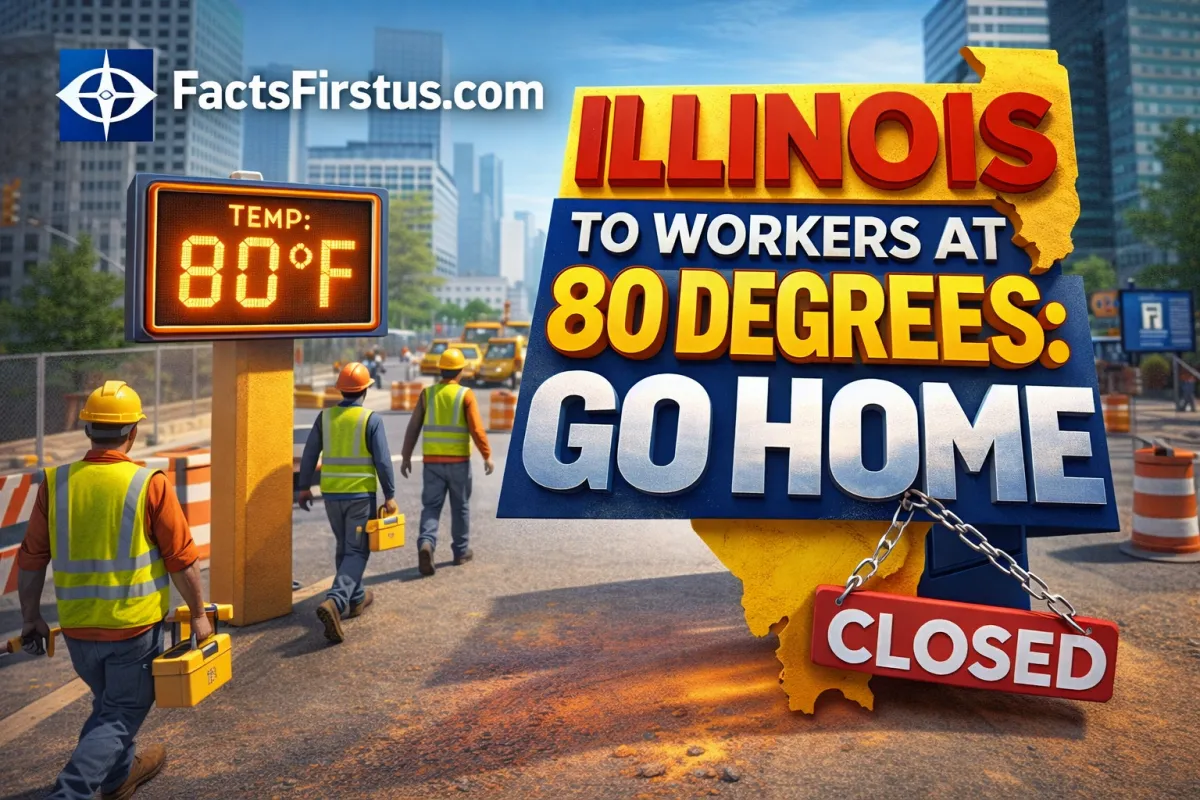
ILLINOIS TO WORKERS AT 80 DEGREES: GO HOME
ILLINOIS PUSHES 80 DEGREE WORK BAN AS CRITICS WARN OF A STATE DRIFTING FURTHER BEHIND
From job sites to ballparks, a controversial proposal fuels growing concern that Illinois is becoming less competitive, less predictable, and increasingly difficult for workers and businesses alike
By Staff Writer
April 19, 2026
Springfield, IL — In Illinois, where summers are short and opportunity is increasingly debated, lawmakers are now advancing a bill that could stop people from working when the temperature hits 80 degrees, prompting a broader and more uncomfortable question about the state’s future.
On a national and global stage, what kind of state is Illinois becoming?
The proposed Workplace Extreme Temperature Safety Act, House Bill 3762, backed by Democratic leadership and sponsored by Rep. Edgar González Jr. of Chicago, has cleared the House Labor and Commerce Committee and now moves to the full House for consideration. At the center of the controversy is a number that has stunned employers, workers, and industry leaders alike.
Eighty degrees.
Not extreme heat. Not record temperatures. Eighty degrees.
“Eighty degrees is not extreme in Illinois. It is normal. This bill treats everyday weather like a crisis,” said a representative from the National Federation of Independent Business.
Under the proposal, outdoor work could be halted when the heat index reaches 80 degrees, affecting construction, agriculture, landscaping, and a wide range of essential industries that depend on summer conditions to operate. In states with far hotter climates such as Texas, Florida, and Arizona, work continues well beyond that threshold with safety measures in place. In Illinois, it may soon be required to stop.
In most places, 80 degrees signals the start of a productive day. In Illinois, it may soon signal the end of one.
The real-world impact is not difficult to picture. It is a Saturday afternoon in July. The temperature is 82 degrees. A construction crew is halfway through a project. A landscaping team is working against time. A local restaurant is preparing for the lunch rush. Then everything stops. Not because workers cannot continue. Not because conditions are unsafe. Because the state says they cannot.
You just ordered your meal. The kitchen is moving. The food is minutes away. Then comes the explanation.
Sorry folks, we are closing. It is 80 degrees outside.
Beyond the temperature threshold, business groups warn the bill introduces a level of regulation that many small employers say is simply not sustainable. The legislation would require detailed safety plans, training protocols, and record keeping for up to three years. Failure to comply could result in penalties and potential legal action.
“This is exactly the kind of policy that forces small employers into impossible choices. Shut down or risk being sued,” NFIB representatives stated.
For many businesses, the outcome may be unavoidable. Send workers home. No work. No pay.
“You cannot grow an economy by telling people when they are allowed to work, especially when that line is drawn at 80 degrees,” said a Midwest construction contractor.
Opponents also argue the language of the bill is broad enough to reach beyond traditional labor sectors. Rep. Dan Ugaste has warned that the proposal could extend into unexpected areas, including professional sports and major outdoor events.
“The language is so expansive that it could apply in situations people would never expect. You could be looking at interruptions in activities that define summer in Illinois,” Ugaste said.
That includes baseball. A mid-summer game at Wrigley Field or Guaranteed Rate Field could, in theory, face interruptions tied to the same temperature threshold that defines a mild day in Chicago.
With a Democratic supermajority controlling the legislature and Governor JB Pritzker leading the state, critics argue this proposal reflects more than a single policy decision. They say it reflects direction. Illinois has experienced years of population decline, consistently ranking among the top states for outbound migration. Census data has shown residents leaving for states with lower costs, fewer regulations, and more predictable business environments. At the same time, businesses have relocated or expanded elsewhere, citing concerns over taxes, regulatory burdens, and long-term stability.
Against that backdrop, proposals like HB 3762 are drawing increased scrutiny.
“At some point, you have to ask whether these policies are helping people stay in Illinois or giving them another reason to leave,” said a small business owner who asked not to be named.
Critics argue that while the stated goal is worker protection, the cumulative effect of policies like this may be something very different. Less flexibility. Less opportunity. Less incentive to build, hire, and invest.
Supporters of the legislation frame it as a necessary step toward modern workplace safety standards. Opponents see it as part of a growing pattern, one that, when compared to other states competing for jobs and residents, raises serious concerns about Illinois’ long-term trajectory. While other states focus on attracting business investment and workforce growth, critics argue Illinois continues to add layers of complexity that may push both away.
The question is no longer just about this bill. It is about competitiveness. It is about direction. It is about whether Illinois is positioning itself to grow or to fall further behind.
The full Illinois House of Representatives is expected to vote on the measure in the coming weeks. If passed, the law would take effect on January 1, 2027. Until then, the debate will continue, not just about temperature thresholds or workplace rules, but about the future of a state that many believe stands at a turning point.
Because if 80 degrees becomes the point where work stops, the conversation is no longer about heat.
It is about direction.
And for many watching closely, the question is becoming harder to ignore.
Is it time for change in Illinois?
Sources
Illinois General Assembly, House Bill 3762
House Labor and Commerce Committee proceedings on Floor Amendment 2
National Federation of Independent Business statements on HB 3762
Comments from Rep. Edgar González Jr. and Rep. Dan Ugaste