
WHEN PEOPLE LEAVE BUT PRICES STAY
The Houses That Never Came
Illinois is losing people, losing businesses—and losing the future it refuses to build
By Staff Writer
January 9, 2026
Illinois is emptying out.
Families are leaving in record numbers. Employers are shifting jobs, offices, and headquarters beyond state lines. Population charts slope downward. Moving vans line the highways out.
By every traditional measure, housing should be loosening.
Instead, it is tightening.
Homes are scarcer. Prices are higher. Ownership is slipping further out of reach. And the contradiction at the heart of Illinois’ housing crisis exposes a deeper failure—one rooted not in markets, but in policy.
In November, Illinois Realtors reported home sales fell 9% compared to the same month a year earlier. Yet prices rose nearly 5%. That imbalance is not temporary. It is the product of years of constrained supply colliding with unchecked costs.
Since 2018, Illinois home prices have surged nearly 50%. A house that sold for $187,874 now costs $278,351—more than $92,000 for the same structure, the same walls, the same neighborhood.
For many families, that increase isn’t theoretical. It is disqualifying.
“This isn’t a housing boom. It’s a housing squeeze.”
The pressure is widespread. In Sauk Village, home values have jumped 163%. Harvey has seen increases exceeding 113%. Even places long considered stable—like Arlington Heights—have experienced nearly 40% growth, enough to push middle-income buyers out.
The reason is not demand. Illinois is losing people.
The reason is supply—and the state’s refusal to allow enough of it.
Across all 26 Illinois metro areas tracked by Zillow, housing inventory has declined since 2018. Chicago alone has lost more than 15,600 available homes, a 40% drop. Bloomington’s inventory has collapsed by 71%.
Year after year, fewer homes come to market. Fewer get built. And fewer families can compete.
Illinois now has just 41% of its pre-pandemic housing inventory, according to Realtor.com. Nationally, states have recovered 88%.
Illinois isn’t lagging—it’s failing.
And this failure sits squarely at the feet of state policy.
Under Gov. J.B. Pritzker, Illinois budgets have not been stabilized. State spending has surged year after year, expanding government obligations while doing little to remove the barriers that choke housing growth. The rhetoric of “balanced budgets” masks a reality of rising expenditures, temporary fixes, and long-term liabilities pushed forward.
At the same time, the policies governing housing have remained rigid and punitive.
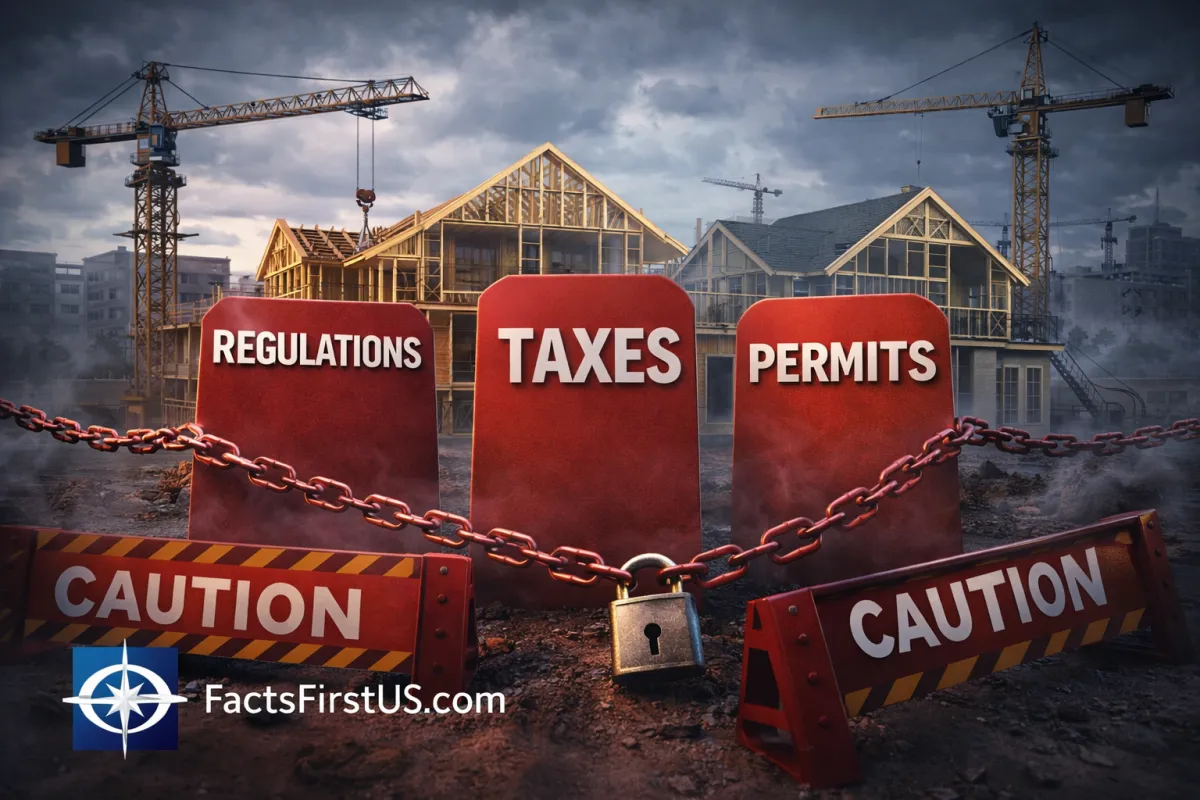
Restrictive zoning laws lock vast areas into single-family development even as demand concentrates around jobs and transit. Developers face layers of regulation that add cost, delay projects, or stop them altogether. Parking mandates force builders to spend money on empty spaces instead of homes. Density is treated as a threat rather than a solution.
And then there are taxes.
Illinois property taxes remain the highest in the nation, quietly sabotaging affordability long after a sale closes. For builders, they erode margins. For homeowners, they become a permanent second mortgage.
“Illinois didn’t run out of land. It ran out of permission to build.”
Construction has slowed to a crawl. New housing is not replacing old supply, much less expanding it. Even as residents leave, the housing stock shrinks faster.
This is the central paradox of modern Illinois: people flee, but prices rise. Businesses depart, but scarcity deepens.
Other states responded to the pandemic by loosening zoning, accelerating permits, and embracing modest density. Illinois did the opposite. It preserved a system designed for a different era—one that rewards delay, inflates cost, and guarantees shortage.
Experts have outlined clear solutions: legalize accessory dwelling units statewide, reduce minimum lot sizes, allow modest multi-unit buildings in high-demand areas, and eliminate excessive parking requirements. These are not radical ideas. They are common-sense adjustments already working elsewhere.
But statewide action has stalled.
Even if more homes were built tomorrow, affordability would remain fragile under the weight of rising taxes and expanding state spending. In Illinois, homeownership doesn’t end with the keys—it begins a long negotiation with government costs.
“You can’t tax your way to affordability.”
Illinois’ housing crisis is not the result of growth. It is the consequence of decline mismanaged.
Families leave. Businesses go. Yet the state continues to make staying harder, costlier, and riskier for those who remain.
The houses never came. The exits filled instead.
And until Illinois confronts the policies that punish building, inflate taxes, and expand spending without restraint, the most unaffordable thing in the state may not be a home—but the decision to stay.
Sources
Illinois Realtors Association, November 2025 Housing Report
Zillow Home Value Index (2018–2025)
Realtor.com Housing Inventory Recovery Data