
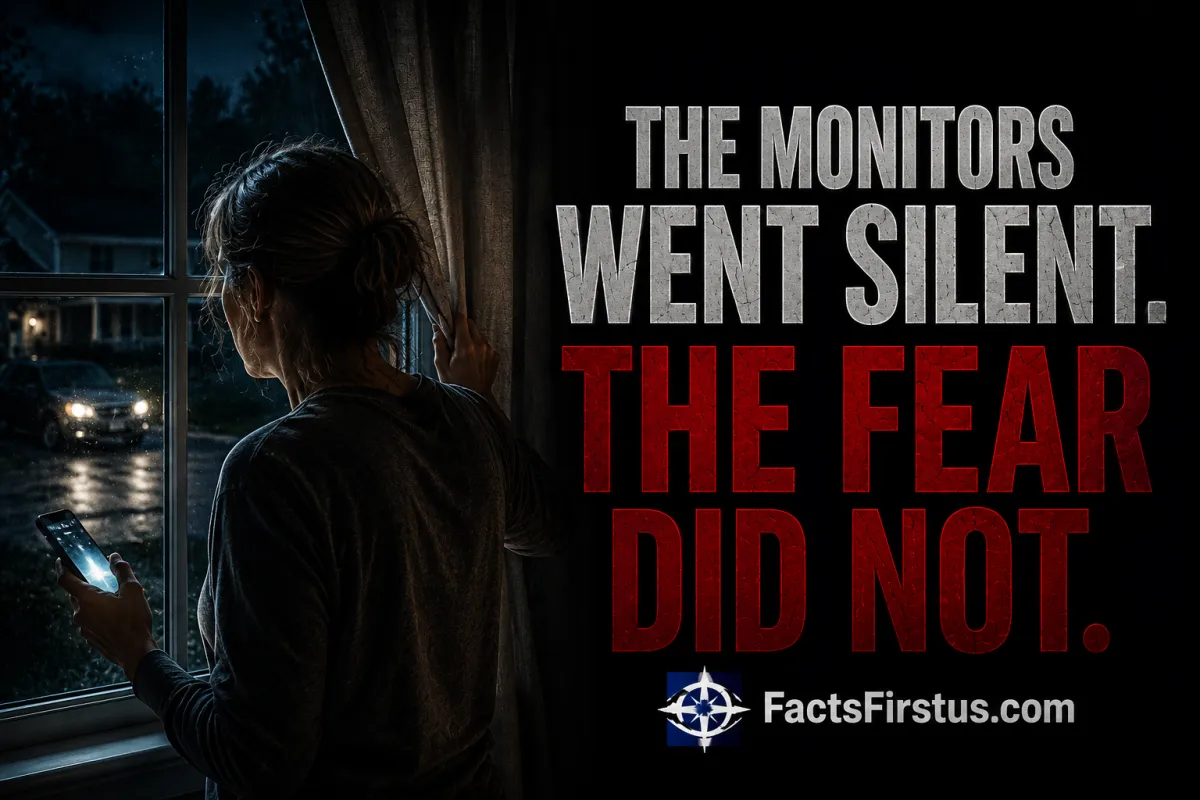
THE MONITORS WENT SILENT. THE FEAR DID NOT.
THE MONITORS WENT SILENT. THE FEAR DID NOT.
Across Illinois, families are locking doors earlier, watching headlights outside their windows longer, and wondering whether the state that promised safety and reform is slowly losing control of both.
By Staff Writer | May 15, 2026
The headlights passed slowly across the living room wall as a mother in Springfield stood frozen near the front window holding her phone in one hand and the curtain in the other.
Her teenage son was late coming home.
Not hours late.
Just late enough.
A few years ago, she would have sighed and rolled her eyes.
Tonight, she checked his location twice.
Then texted again.
Then walked to the front door when another car slowed near the curb.
Because something has changed in Illinois.
The fear no longer stays where the crimes happen.
It no longer disappears when the television turns off.
It follows people home now.
Into quiet neighborhoods.
Into suburban parking lots.
Into gas stations after dark.
Into conversations between parents waiting for children to walk through the front door.
And at the center of that growing fear is one deeply unsettling reality.
Hundreds of accused offenders released under Illinois’ justice system have vanished while supposedly under electronic supervision.
No confirmed location.
No active monitoring.
No certainty about where some of them may be tonight.
And increasingly, Illinois residents are asking the same question.
If Illinois cannot find them, who can?
According to newly released Cook County court data, 246 out of 3,048 defendants released pretrial with electronic monitoring are currently missing or no longer actively tracked.
Many are accused of violent crimes.
Twenty-one charged with murder.
One hundred three charged with sexual assault.
One hundred seventy-three charged with aggravated battery.
Thirteen charged with attempted murder.
Now many of them are simply gone.
The monitors went silent.
The fear did not.
For years, Governor JB Pritzker called Illinois’ SAFE-T-Act and criminal justice reforms a national model for fairness and reform.
Critics warned Illinois was building a system dependent on violent offenders obeying rules they had already shown they were willing to break.
State leaders dismissed those fears.
Now many Illinois families believe they are living inside the consequences.
And the fear moved beyond Chicago faster than officials could contain it.
From crime scenes.
To suburban Facebook groups.
To conversations outside little league games.
To church parking lots after Sunday service.
To family dinners where crime is now discussed before the food is even cleared from the table.
People are changing routines.
More porch lights stay on late into the night.
More parents track phones.
More residents sit inside parked cars for an extra moment before stepping out into the dark.
Because across Illinois, more residents are beginning to believe the people in charge lost control long ago.
Then came the moment that shattered whatever trust remained.
Authorities say Alphanso Talley, a seven-time convicted felon awaiting trial in a carjacking case, allegedly opened fire on Chicago police officers inside Endeavor Health Swedish Hospital in late April.
Officer John Bartholomew was killed.
Another officer was critically wounded.
At the time of the shooting, Talley was supposed to be under home confinement.
Court records indicate his electronic monitor stopped transmitting weeks earlier.
Weeks.
Nothing happened.
No statewide alert.
No emergency public warning.
No arrest.
Nobody found him.
The warnings came.
The system failed to react.
Then a Chicago hospital erupted in gunfire.
Officer John Bartholomew never went home.
For many Illinois residents, that was the moment everything changed.
Cook County Chief Judge Charles Beach acknowledged this week that authorities are actively searching for defendants who disappeared from electronic supervision.
“We are actively searching for them right now.”
Cook County Chief Judge Charles Beach
But when officials now say the situation is under control, many Illinois residents no longer hear confidence.
They hear damage control.
The fear deepened further after another horrifying case involving repeat offender Lawrence Reed.
Reed allegedly set a woman on fire aboard a Chicago Transit Authority train after previously being released while facing felony charges.
Court records show Reed had accumulated more than 70 arrests over the years.
Yet somehow, he was back on the streets again.
Critics say the pattern is no longer isolated.
Repeat offenders released.
Violent crimes committed again.
Warnings ignored.
Public trust collapsing.
And with Democrats controlling the Governor’s Mansion, the Illinois House, the Illinois Senate, and nearly every major lever of state power, critics say accountability now rests entirely with the leadership that promised these reforms would work.
Governor JB Pritzker promised Illinois residents they were witnessing reform.
What many Illinois families feel tonight is abandonment.
Supporters of the SAFE-T-Act continue defending the reforms by arguing the presumption of innocence remains central to the American justice system.
But critics say Illinois built a system dependent on trust, compliance, and perfect oversight in a reality where violent offenders repeatedly prove those assumptions dangerous.
And now the system itself appears to be unraveling in public view.
The monitors went silent.
Public trust followed.
Tonight, across Illinois, porch lights will stay on longer.
Parents will text children twice instead of once.
Doors will lock earlier.
And somewhere beyond the glow of those porch lights and locked front doors, hundreds of accused offenders the state once promised it was monitoring are no longer where they are supposed to be.
Illinois does not know where they are.
And for a growing number of families, that may be the most frightening part of all.
Official Sources
FOX News reporting by Mike Tobin and Adam Sabes published May 15, 2026
New York Post reporting by Caitlin McCormack published May 14, 2026
Cook County Circuit Clerk electronic monitoring data
Statements from Cook County Chief Judge Charles Beach reported by WGN Chicago