
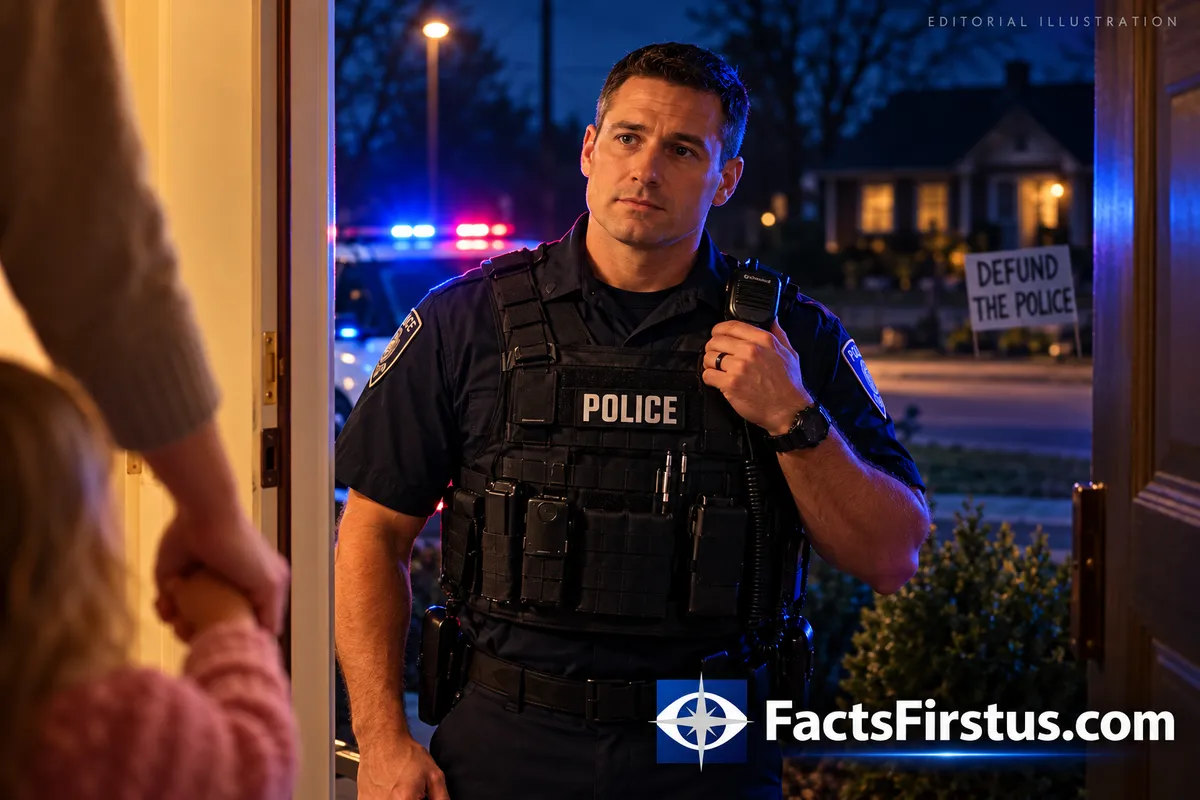
ILLINOIS POLICE UNDER ATTACK: THE POLITICS THAT PUT YOUR FAMILY AT RISK
ILLINOIS POLICE ARE UNDER ATTACK. THE POLITICAL CHOICES REACH YOUR FRONT DOOR.
Chicago’s reported assaults on officers have reached a ten-year high as departments across Illinois face recruiting pressures. From Springfield’s council chambers to the governor’s office, decisions about policing carry consequences for every family depending on someone to answer a call for help.
Staff Writer | October 31, 2026
The bullet struck Chicago SWAT Officer Nick Linker just below his protective vest as he helped rescue a family from a man who allegedly shot his mother-in-law and held his wife and 14-year-old daughter at gunpoint. Inside that house, a child’s safety depended on trained officers reaching her through a danger few people would willingly confront.
Linker went in. The family needed him, and the protection he brought reflected decisions made long before the emergency: the training his department provided, the equipment government funded and the staffing that made a specialized response possible. What might have looked like ordinary spending decisions in a budget meeting had become matters of survival.
That is the connection Illinois voters should carry into the coming election. Decisions about police resources and criminal justice eventually reach a home, a business or a street where someone needs help immediately. The people answering those calls are now confronting a troubling combination of reported attacks, staffing pressures and political campaigns seeking to reduce the institutions on which that response depends.
Chicago Police Department figures show 2,730 reported assaults and batteries against officers in 2025, the highest total in ten years. By late October 2026, seven officers had been shot, compared with two during the same period the previous year, and 38 had been shot at. Meanwhile, Chicago reported 11,433 officers on the job in September, its lowest staffing level in decades, according to reporting based on department figures.
The figures describe a department facing more reported attacks while struggling to maintain its workforce. When an officer is injured, retires or leaves for another agency, the responsibilities remain. Someone must cover the calls, complete the investigations and provide backup when an encounter turns dangerous. For residents, the concern extends beyond the badge to the protection available when their own emergency begins.
“It’s sad to see that people don’t respect law enforcement.”
Chicago SWAT Officer Nick Linker.
Elsewhere in Illinois, departments have been sounding their own staffing warnings for years. A 2022 Illinois Association of Chiefs of Police survey of 239 agencies found that 60 percent were understaffed and nearly one in five was more than 10 percent below authorized strength. Many reported entrance-exam participation falling 40 to 70 percent compared with a few years earlier.
Chicago did not participate in that survey. These concerns came from agencies serving other Illinois communities, where recruiting an experienced officer often meant drawing that person away from another department. Approximately half of reported hires were lateral transfers, allowing one community to fill a vacancy while another began searching for a replacement.
For smaller departments, losing an experienced officer can remove a substantial share of available personnel. Rural agencies must cover considerable distances, while larger departments must balance emergencies against investigations and neighborhood demands. Springfield, Decatur, Peoria, Rockford and the communities between them all depend on enough qualified people choosing to enter policing and remain in it.
The conditions surrounding that choice deserve attention. A 2024 investigation identified hundreds of former Chicago officers working for other police agencies or the Chicago Fire Department, with accounts of departures describing dangerous assignments, canceled days off and relationships strained by the job. A University of Illinois-hosted report similarly documented concerns among officers and recruits about danger, public hostility, mental strain and perceived lack of political support. Respondents also identified the SAFE-T Act as a source of anxiety about scrutiny, liability and restrictions on their work.
Recruiting campaigns can advertise compensation and career opportunities, but officers make their decisions against the conditions they experience. Political leaders help shape those conditions through the resources they approve, the rules they establish and the support they demonstrate.
That makes the organized movement to reduce police funding especially consequential. The Democratic Socialists of America’s National Abolition Working Group calls for rejecting police budget expansions while cutting budgets annually toward zero. Chicago DSA identifies defunding police among its desired reforms, while the American Friends Service Committee’s Chicago Peacebuilding program states its destination explicitly.
“We contribute to strategic coalition efforts to cut CPD’s budget, with the goal of abolishing police completely.”
American Friends Service Committee, Chicago Peacebuilding program.
These organizations advocate housing, treatment and community investment as ways to prevent harm and reduce dependence on policing. Those services have important roles, but families also need immediate protection when prevention fails. An armed offender holding a child hostage requires a response capable of stopping the threat, and the family inside cannot wait for a promised alternative to become effective.
The organizations seeking these changes are pursuing influence over the governments that fund that protection. Six self-identified democratic socialists won Chicago City Council seats in 2019. Following the 2023 election, a seventh had been elected, and five democratic socialist council members were positioned to lead committees, giving the movement a stronger place inside city government.
The political relationships extend into Springfield, where Jennifer Notariano, Roy Williams Jr., Teresa Tran and Juan Huerta are among the candidates drawing scrutiny. Notariano and Williams are seeking reelection, Tran is running for the open Ward 8 seat, and Huerta is challenging Ward 1 Alderman Jeff Cox.
FactsFirstus.com has reported campaign assistance involving Land of Lincoln Democratic Socialists of America activists for Notariano and Tran, along with Williams’ appearances at socialist events. Its reporting has also examined Huerta’s candidacy and the political relationships surrounding Springfield’s election. The offices these candidates seek carry authority over police resources, making their public safety commitments and political alliances relevant to residents throughout the city.
Springfield has already supplied a concrete example of how those priorities affect officers. Police requested a replacement for an approximately 20-year-old armored vehicle that had become unreliable, and Chief Joseph Behl described an occasion when officers needed it and it would not start. Notariano and Williams opposed the $445,000 replacement. Notariano raised cheaper, less intimidating alternatives, while Williams objected to police militarization and suggested the Illinois National Guard as an alternative.
The appearance of protective equipment should not outweigh its ability to keep people alive. Police described using the vehicle during barricades, hostage situations and high-risk operations, where its cover can help officers approach a dangerous location, protect civilians and gain time to resolve a confrontation. The council ultimately approved the replacement, 7–2.
The connection to Linker’s rescue is clear. Officers confronting an armed threat depend on equipment and training approved before the danger develops. A purchase debated in a council chamber can become the protection separating a civilian or an officer from gunfire.
Criminal justice decisions can carry equally serious consequences. Chicago Police Officer John Bartholomew was killed in April, and the man charged with killing him had previously been released on electronic monitoring over prosecutors’ objections while facing armed carjacking charges. He later stopped appearing in court, his monitor went silent and a warrant was issued.
Governor JB Pritzker said the judge should have ordered detention, which the law allowed. That identifies the decision Pritzker believes failed, but it leaves the governor responsible for explaining what his administration will do to prevent another such breakdown. Pritzker continues to defend the SAFE-T Act, calling it “highly effective” in January, yet that assessment does not resolve failures in detention decisions, supervision or enforcement.
Calling the law effective does not discharge the responsibility to confront a catastrophic breakdown. The public deserves a clear accounting of what failed, responsibility assigned to the authorities involved and corrective action that can be measured. A statement blaming a judge cannot accomplish that work.
Chicago’s leaders must also answer for staffing choices made under their authority. The city paused new academy classes for at least two months in 2024, and in November 2025 police officials outlined slower hiring and summer academy pauses as part of a savings plan. Recruiting difficulties and deliberate hiring delays have different causes, but both affect the workforce residents depend on.
For an Illinois household or business, these decisions eventually converge. A restaurant employee walking to a car after closing, a shop owner confronting a threatening customer and a parent reporting someone trying to enter a home all depend on qualified officers being available, dependable equipment and a justice system capable of responding to serious danger. A breakdown anywhere along that chain can reach the person waiting for help.
Families with money can purchase additional security or consider moving. Many residents have fewer choices and depend heavily on public institutions delivering the protection their taxes are supposed to sustain. They deserve professional policing, sound training and consequences for misconduct, along with sufficient personnel and resources to provide effective protection.
On November 3, Illinois voters will choose state leaders and legislators whose decisions will shape criminal justice and public safety. Springfield’s council elections follow in 2027, placing those responsibilities directly before local voters. Although the elections are separate, the chain of responsibility connects them: voters confer authority, officials establish priorities, and communities live with the results.
Candidates seeking that authority should be judged by their records, commitments and the agendas of organizations helping them gain influence. Officials defending existing policies should be judged by their willingness to identify failures and deliver corrections. Organizations advocating police defunding have stated their ambitions, and voters should understand those ambitions before helping them gain governing power.
The family Linker helped rescue needed an officer trained for the danger, equipment that worked and backup ready to respond. Those protections existed because decisions had been made before the emergency, and Illinois voters will help choose the leaders making the next decisions.
When that family called, Linker came. The next call could come from your home. What Illinois decides before then matters.
Official and Primary Sources
Illinois Association of Chiefs of Police, “Recruitment & Retention Member Survey,” April 19, 2022. Historical staffing and recruitment findings from 239 responding agencies, excluding Chicago.ilacp.memberclicks.net
Caleb Griffin, “Police Recruitment and Retention in Illinois,” May 5, 2023. University of Illinois-hosted legislative fellowship report documenting officer and recruit concerns through survey and focus-group research.csbs.research.illinois.edu
Democratic Socialists of America, “Abolition Working Group.” Published police defunding and abolition objectives.www.dsausa.org
Chicago DSA, “About Us.” The chapter’s stated objectives, including police defunding.chicagodsa.org
American Friends Service Committee, “Chicago Peacebuilding.” Published objectives concerning CPD funding and police abolition.afsc.org
Springfield Office of the City Clerk, Municipal Election Information. Municipal election documents for 2027.cityclerk.springfield.il.us
Secondary Sources
WGN Investigates, Ben Bradley, “Chicago police increasingly under attack, data shows,” republished by AOL, updated October 30, 2026. Credit for reporting the latest CPD assault, shooting and staffing figures, Officer Linker’s account and his statement.www.aol.com
FactsFirstus.com, “Socialism at City Hall’s Door. Springfield’s Next Vote Could Let It In.” Springfield campaign relationships, Huerta’s candidacy and police-equipment reporting.factsfirstus.com
Capitol City Now, “Pushback on SPD’s proposed armored truck,” March 4, 2026, and “Springfield City Council OK’s armored vehicle purchase,” March 17, 2026.capitolcitynow.com
Illinois Times, “Sending the wrong message?” April 30, 2026. Springfield’s armored vehicle, reliability concerns and objections to the purchase.www.illinoistimes.com
Capitol City Now, “McCarty, Josh Langfelder are final-day filers in Springfield.” October 2026 candidate reporting.capitolcitynow.com
Chicago Sun-Times investigation, republished by WBEZ, “Chicago Police Department exodus sees new cops are leaving in droves,” October 28, 2024.www.wbez.org
WTTW, “New City Council Set to Be More Diverse as Center of Power Moves Left,” April 5, 2023.news.wttw.com
ABC7 Chicago, “Gov. JB Pritzker defends SAFE-T Act, but leaves door open to possible changes in legislative session,” January 13, 2026.abc7chicago.com
WTTW, “SAFE-T Act Back in Spotlight After Killing of Chicago Police Officer,” May 1, 2026. Officer Bartholomew’s killing, the accused offender’s pretrial history and Pritzker’s response.news.wttw.com
WBEZ and Chicago Sun-Times, “Johnson cancels 2 months of police academy classes, orders layoff lists to cut $75M,” October 9, 2024.www.wbez.org
Chicago Sun-Times, “CPD to slow hiring, pause academy training next summer to cut costs, superintendent says,” November 5, 2025.