
THE NIGHT ONE PARTY UNITED—AND THE OTHER FELL APART
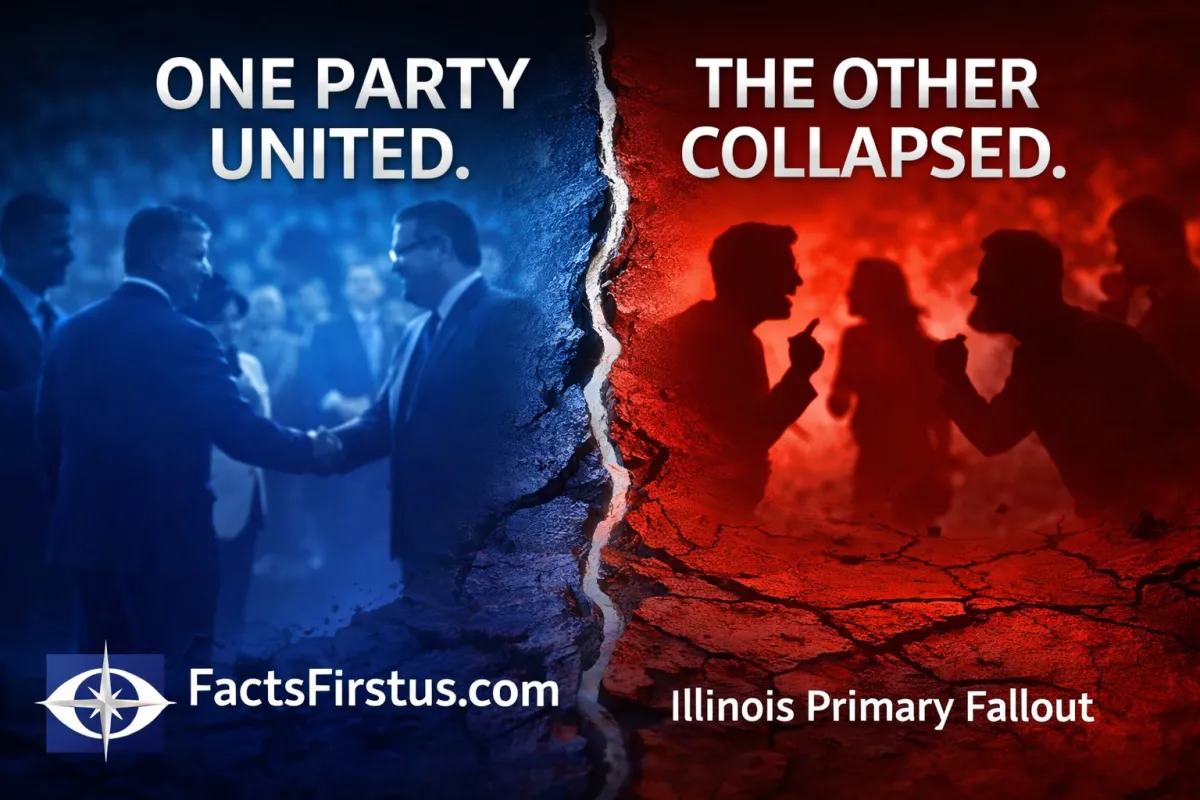
One Party United. The Other Unraveled.
Illinois Democrats moved forward. Republicans turned on themselves, and proved exactly why they keep losing.
By FactsFirstus.com Editor | March 18, 2026 | Political Commentary
The Illinois primaries didn’t end quietly.
They rarely do.
This one was hard fought, expensive, and at times unapologetically personal. Campaigns didn’t just contrast; they collided. Lines were drawn. Shots were taken. By the time voters had their say, both parties had the bruises to prove it.
But primaries are never the end of the story.
They are the pivot.
The moment when a party decides whether it’s ready to win or content to explain why it didn’t.
And in Illinois, one party made that decision. The other avoided it.
Democrats didn’t hesitate.
Before the final tallies were even fully settled, the shift was already underway. Opponents became allies, publicly, visibly, and without hesitation. Social media filled with shared photos, handshakes, and congratulations.
Unity wasn’t subtle. It was deliberate.
It wasn’t organic. It was organized.
Because Democrats in Illinois understand something Republicans continue to wrestle with:
Primaries are temporary. Winning is not.
So they did what successful parties do.
They closed ranks.
They aligned.
They moved forward together.
Then came the Republicans.
And this is where the story stops being predictable.
There was a moment, a clear and unmistakable moment, where unity could have taken hold.
A moment to rally.
To reset.
To show strength heading into the general election.
And then that moment passed.
To be fair, not everyone missed it.
Rick Heidner, who also ran for governor in this primary, recognized exactly what the moment required.
He showed up to the unity breakfast.
He spoke publicly about unity.
He pointed the party forward.
In a field of candidates, he behaved like a party.
It wasn’t complicated.
It was leadership.
And notably, he stood alone.
Others chose something different.
Or nothing at all.
DuPage County Sheriff James Mendrick, also a candidate for governor, was absent.
Not just from the unity breakfast.
From the moment itself.
No statement.
No post.
No acknowledgment.
In politics, silence is rarely neutral.
It is often the loudest message of all.
And here, it echoed.
Then came Ted Dabrowski.
Like others, he too was absent from the unity breakfast.
No appearance. No shared stage. No visible step toward bringing the party together in the immediate aftermath of the primary.
He did, however, issue a statement. What it revealed was just as telling.
“Wow - What an experience running for Governor has been! Carrie and I enjoyed traveling the state and meeting so many great Illinoisans. We are so thankful for the warm reception we received and the many folks who hosted us, donated to our campaign, and volunteered many hours to help us reach voters. God Bless All of You! And God Bless Illinois!”
Gracious? Certainly.
Complete? Not even close.
Because in a moment that demanded direction, something critical was missing.
No congratulations to Darren Bailey.
No call for unity.
No signal that the fight had shifted to November.
It wasn’t divisive. That would have at least been decisive.
It was something worse: directionless.
And in politics, directionless doesn’t just stall momentum; it surrenders it.
When leadership hesitates, something always fills the void.
In this case, it wasn’t unity.
It was doubt.
It was frustration.
It was division, loud, public, and immediate.
Supporters of Dabrowski and Mendrick didn’t rally.
They fractured.
“I’m moving out of Illinois,” one declared.
“The farmer can’t win,” another insisted.
What should have been a moment of consolidation became a moment of exposure.
“Parties don’t lose elections because they lack candidates.
They lose because they lack unity when it matters most.”
And then, as it often does, the frustration turned inward.
The target was Darren Bailey.
The very candidate Republican voters had just chosen, decisively, to lead them forward.
By that point, the contrast wasn’t forming.
It was unavoidable.
In the middle of that noise, one voice cut through.
Darren Bailey didn’t hesitate.
He didn’t attack.
He didn’t gloat.
He didn’t linger in the primary.
He moved forward.
While others looked backward, he looked ahead.
He congratulated his opponents.
He thanked them.
He called, clearly and consistently, for unity.
In his victory speech, he made the stakes unmistakable.
“This is going to be a hard fight. Illinois is failing, and it needs change, but we can only do this together.”
“I’m grateful for every candidate who stepped into this race. Now it’s time to come together and give Illinois a future it deserves.”
Agree with him or not, the contrast was clear.
Leadership versus hesitation.
Direction versus drift.
In a night filled with missed opportunities, Bailey didn’t just win a primary.
He stepped into the general election.
If there were any doubt about what was unfolding, Thomas DeVore removed it.
What had been visible was now being said out loud.
Politically active and unafraid to critique his own party, he said what many wouldn’t.
“Republicans don’t need a different candidate. They need a different mindset.”
“If Republicans lose, it will be because they failed to organize, failed to unify, and failed to turn out the votes that already exist.”
That’s not opposition messaging.
That’s internal diagnosis.
And right now, it is playing out in real time.
Here is the reality Illinois Republicans continue to circle, but rarely confront.
They don’t lack voters.
They don’t lack opportunity.
They lack cohesion.
They lack discipline.
And when the moment demands it most, they lack unity.
So now the question is no longer who won the primary.
That part is settled.
The question is whether the Republican Party is willing to follow its own nominee.
Because the window to answer that question is already closing.
Not eventually. Not later. Now.
Will the party rally, not just in statements, but in action?
Will leaders step forward and unify messaging?
Will voters shift from internal division to external focus?
Or will Darren Bailey walk into November carrying not just a campaign, but the weight of a divided party?
Illinois is not an easy state to win.
But it is not impossible.
What is impossible is winning while arguing with yourself.
And right now, that appears to be exactly what Republicans are doing.
Democrats have already made their decision.
They have unified.
They have aligned.
They have moved forward.
Republicans are still deciding if they will.
And November won’t wait for them to decide if they’re ready.
Official Sources & Statements:
Public Facebook statements from Thomas DeVore (March 2026)
Public statement from Ted Dabrowski following primary results
Public campaign statements from Darren Bailey following primary victory
Public social media statements from Rick Heidner regarding unity
Public social media activity from candidates and supporters during post-primary period