
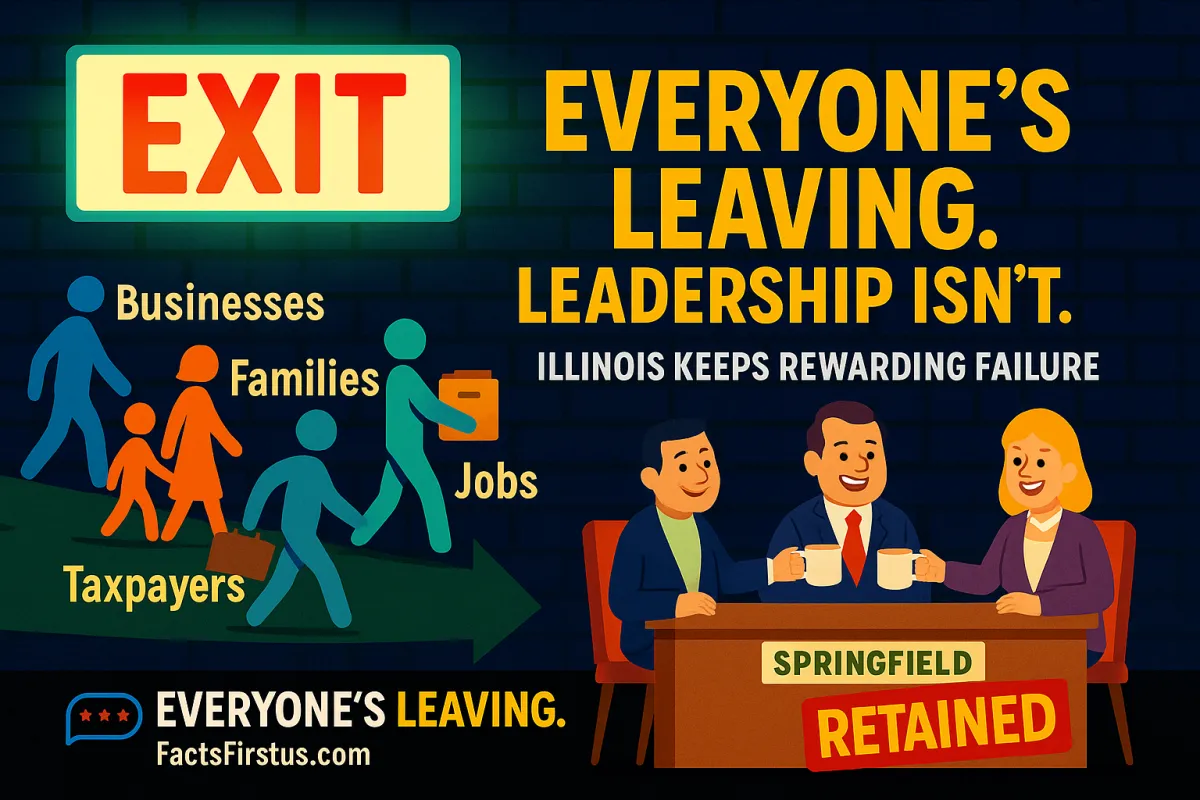
ILLINOIS KEEPS LOSING — LEADERS KEEP WINNING
If Illinois Were a Business, Its Leadership Would Have Been Fired Two Years Ago
FactsFirstus.com Editor — Op-Ed
December 13, 2025
For two straight years, Chicago’s economy has been in decline.
Not “slowing.”
Not “adjusting.”
Declining.
The Chicago Business Barometer has stayed below 50—the line that separates growth from contraction—since late 2023. November’s reading came in at 36.3, one of the lowest of the entire downturn.
That number isn’t partisan.
It’s a pulse.
And Illinois’ economic heart has been barely beating.
Chicago drives nearly 70% of the state’s economy, which means this isn’t just a city problem. When Chicago contracts, Illinois pays—factories, farms, freight, and families alike.
The scoreboard tells the story:
Illinois GDP fell 2.2%, more than four times worse than the national decline
Job growth limps along at 0.4% annually
Unemployment is higher than the U.S. average
Freight shipments dropped 9.4% in a single month
Illinois ranks 42nd in the nation for real GDP growth
And people are voting with their feet.
More than 100,000 residents left Illinois last year.
That’s not weather.
That’s not coincidence.
That’s a judgment.
They took their businesses, careers, and tax dollars with them—leaving fewer workers to support growing pension obligations and higher taxes for those who remain.
Yet somehow, the same leadership remains firmly in control.
Government Growth Is Hiding Private-Sector Collapse
Supporters of the status quo point to “job growth.” What they don’t mention is where those jobs are coming from.
Nearly all of Chicago’s recent job gains are in government-supported sectors like education and healthcare. The private economy—the engine that actually generates wealth—is shrinking.
Order backlogs have collapsed to levels not seen since the Great Recession. New orders are down. Production is down. Hiring is down.
That isn’t recovery.
That’s erosion.
And it gets worse.
Moody’s Isn’t Predicting a Rebound—It’s Warning About 2026
Moody’s Analytics is clear: 2026 will bring slower growth, continued wage stagnation, and a shrinking workforce for Illinois.
At the same time, federal funding cuts could strip $10 billion a year from the state by 2029—putting 86,000 jobs at risk.
Instead of preparing for that reality, Illinois leadership is burning political and financial capital fighting Washington.
Illinois Chose Ideological Warfare—and Taxpayers Are Paying for It
Illinois Democrats are openly fighting the Trump administration on immigration—funding lawsuits, resisting enforcement, and doubling down on sanctuary policies.
That fight isn’t free.
It’s diverting billions away from infrastructure, public safety, and economic investment. It’s creating uncertainty for businesses. And it’s already crushing retail in immigrant-heavy neighborhoods, where sales have dropped 50–70%.
This isn’t compassion.
It’s mismanagement.
And it’s coming straight out of taxpayers’ pockets.
Republican Economic Policies Work. Illinois Refuses to Try Them.
This isn’t a mystery.
States with lower taxes, simpler regulations, and pro-business policies—many of them Republican-led—are growing faster, adding jobs, and attracting residents.
Illinois does the opposite:
Property taxes nearly double the big-city average
Constant threats of new taxes, like a $33-per-employee head tax
Proposed taxes on cloud services and digital infrastructure
A regulatory environment that punishes hiring and expansion
Businesses don’t argue with ideology.
They follow math.
And the math says: leave Illinois.
Gerrymandering Explains Power—Not Performance
Yes, Illinois is gerrymandered.
Yes, competition is limited.
But here’s the truth voters can’t ignore:
If this were a business, leadership would already be gone.
If a CEO oversaw two years of declining revenue, lost customers, workforce shrinkage, and capital flight, the board wouldn’t debate—it would fire them.
Illinois did the opposite.
Democrats expanded their supermajority—78 House seats, 41 Senate seats—despite clear economic failure.
That isn’t stability.
That’s denial.
This Is the Choice Illinois Is Making
Illinois isn’t stuck with bad outcomes.
It’s choosing bad leadership.
Lower taxes.
Regulatory reform.
Fiscal discipline.
Economic realism.
These aren’t radical ideas. They’re proven ones.
The only real question left is simple:
How much more decline will voters tolerate before they do what every successful business does—replace leadership that isn’t working?
Because economies don’t collapse overnight.
They fail while leaders insist everything is fine.
And by the time everyone agrees it isn’t—
It’s already too late.