
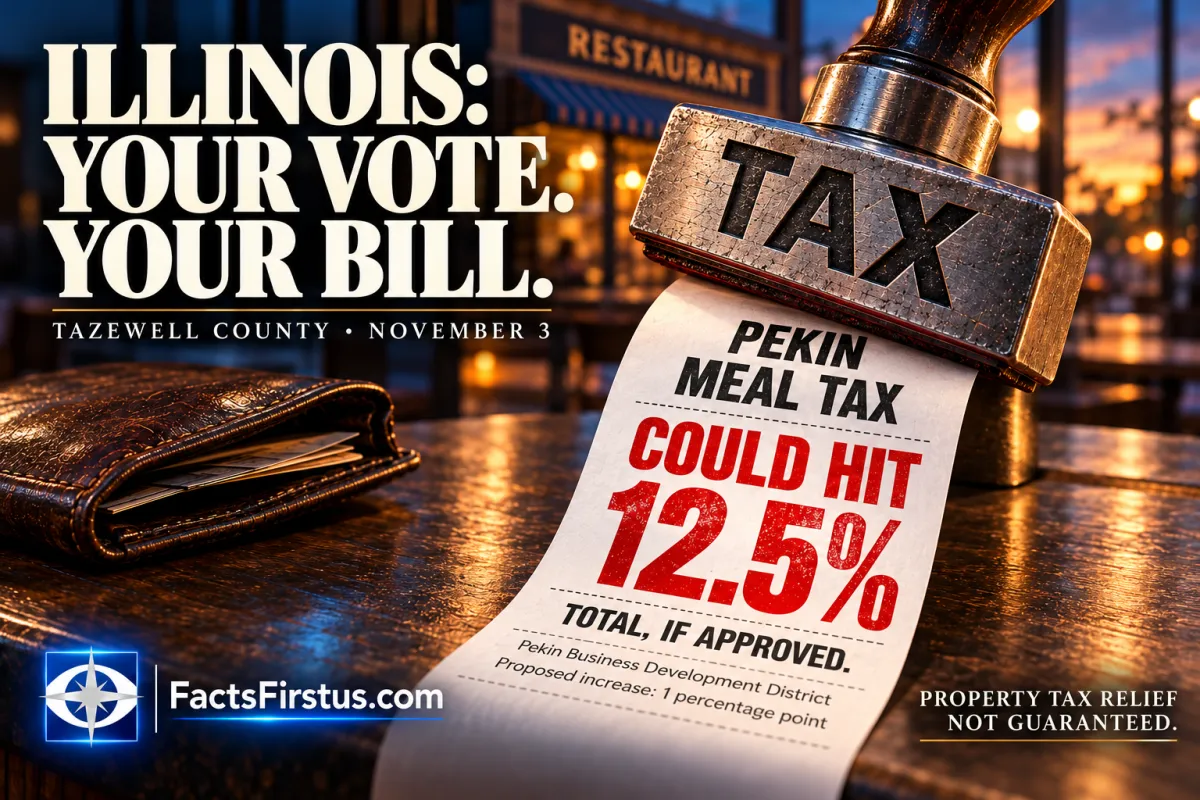
ILLINOIS’ NEXT TAX GRAB: YOU PAY MORE. THEY PROMISE RELIEF. NOTHING GUARANTEED.
ILLINOIS’ NEXT TAX PITCH: YOU PAY MORE. YOUR PROPERTY TAX BILL MAY NOT FALL.
In Tazewell County, a proposed school sales tax could push Pekin’s combined restaurant tax burden to 12.5%. Supporters suggest relief for property taxpayers, but the ballot question guarantees no specific reduction—and the campaign faces allegations of improper taxpayer-funded advocacy.
By Staff Writer | October 9, 2026
A parent reaches the restaurant register in Pekin, Illinois, and checks the bill. The family’s food costs $40. If Tazewell County’s proposed school sales tax passes and takes effect, a qualifying meal inside Pekin’s Business Development District could carry another $5 in combined taxes.
The new proposal would account for 40 cents of that tax bill. The rest is already there.
That is what another increase looks like in a community where taxes have accumulated one layer at a time. Each addition can sound modest when presented alone. Families must pay the total.
Behind the counter, the restaurant owner faces a different calculation. Customers see a more expensive meal, but the additional tax cannot pay the cook, cover the electric bill, or purchase ingredients. It must be remitted to government.
The customer pays more. The business collects more for someone else. Both must live with the consequences.
On November 3, Tazewell County voters will decide whether to authorize an additional 1% sales tax for school facilities, school resource officers, and mental health professionals.
Supporters call it a “one-cent tax.” They say it could ease schools’ reliance on property taxes and estimate that nearly 60% of the revenue would come from visitors, commuters, and nonresidents.
Before voters accept that pitch, they should examine the bargain.
The additional tax would be authorized. A specific reduction in their property tax bills would not.
In Pekin, general merchandise currently carries an 8.5% sales tax outside the Business Development District and 9.5% inside it. The city’s separate 2% food and beverage tax brings qualifying restaurant purchases to a combined 10.5% or 11.5%, depending on location.
The proposed school tax would add another percentage point. General merchandise would reach 9.5% outside the district and 10.5% inside it. Qualifying restaurant purchases would reach 11.5% and 12.5%.
Qualifying groceries, medicines, medical appliances, and titled vehicles generally follow different rules. But restaurant meals and many ordinary retail purchases would become more expensive.
This request comes in a state already near the top nationally for sales taxes. The Tax Foundation’s midyear 2026 analysis places Illinois’ average combined state and local sales tax at 8.98%, eighth highest in the country.
Pekin’s general merchandise rate inside its business district already exceeds that average. Its restaurant tax burden is higher still.
For households watching every dollar, another charge competes with everything else they need to buy. Some may spend less, postpone purchases, or visit restaurants less frequently.
For a struggling business, those decisions can matter.
Picture an owner reviewing receipts after closing, with payroll, insurance, utilities, and supplier invoices waiting. A higher checkout total makes keeping customers more difficult without increasing the business’s income from each sale.
The Tax Foundation notes that differences between jurisdictions’ sales tax rates can influence where consumers shop, particularly for major purchases. The proposed increase would add to the price of buying locally.
It would not explain every business failure. But when customer spending weakens, businesses can face pressure to reduce hours, delay hiring, or close if losses persist.
Children live in those households, too.
They are the students the proposal promises to help. They are also the children of restaurant employees who need steady shifts, parents managing tight budgets, and business owners trying to keep their doors open.
School needs deserve consideration. So does the financial stability of the families supporting those schools.
That is why the campaign’s claim about outsiders paying most of the tax deserves closer examination.
Pekin Public Schools published the estimate that nearly 60% of revenue would come from visitors, commuters, and nonresidents, attributing it to research using U.S. Bureau of Labor Statistics data.
The Illinois Policy Institute says its public-records requests did not produce the underlying analysis supporting that estimate.
Voters should be able to inspect the calculation. How were nonresident purchases identified? What geographic area did the data cover? Were exempt purchases excluded? What assumptions produced the percentage?
Naming a federal data source does not answer those questions.
Even if the estimate is accurate, it would not protect residents from paying the additional tax. A percentage describing total collections says nothing about whether the increase is affordable for a particular family.
An occasional visitor would pay during a visit. Residents who regularly patronize local businesses would pay throughout the year.
Outsiders’ purchases do not make residents’ purchases tax-free. Nor are visitors a source of painless revenue: they are customers whom local businesses work to attract.
The property tax message requires even greater scrutiny.
Supporters describe the proposal as an alternative funding source that can ease reliance on property taxes. Revenue can help pay eligible school building debt, potentially reducing what otherwise would be collected through property taxes.
But the ballot question does not guarantee a dollar reduction in homeowners’ bills, a percentage reduction, or a date when relief must occur.
If property tax relief helps sell the proposal, voters should ask why a specific, binding commitment is absent from the measure they are being asked to approve.
Which district would reduce which levy? By how much? For how long? Could later increases offset the reduction?
Reducing the property taxes needed for school building debt is also different from guaranteeing that a homeowner’s entire property tax bill will fall. Other levies and changes in assessed value can affect the total.
Without enforceable commitments, residents could pay the higher sales tax and continue receiving high property tax bills.
The payment would be definite. The relief would depend on subsequent decisions.
Supporters identify legitimate needs, including building repairs, security improvements, school resource officers, and mental health professionals. Those needs should be evaluated through detailed project lists, costs, debt schedules, available reserves, and alternative funding options.
Voters deserve to know which expenses are urgent, what existing resources can cover, and why another tax is necessary.
They also deserve a clear explanation of what this proposal would accomplish for children.
Illinois’ 2025 Report Card reported statewide proficiency of 38.4% in mathematics, 52.4% in English language arts, and 44.6% in science. Most tested students did not meet the state’s mathematics proficiency benchmark, and more than half did not meet its science benchmark.
Illinois changed assessment performance levels in 2025, so those percentages cannot be directly compared with earlier years. They also do not describe every Tazewell County district.
They nevertheless show substantial academic needs.
This tax has legally restricted purposes. It is not a general classroom instruction fund, and passage would not itself establish a plan to improve reading, mathematics, or science achievement.
A repaired roof or safer entrance can benefit students. Voters should still ask how each proposed expenditure would improve their children’s education or well-being, and how districts would measure that benefit.
They should also demand an accounting of recipients and expenses, including contractors, eligible employees, compensation, benefits, and outside services.
Any questions about union release time or other union-related expenses should be answered by identifying what the law permits and what districts actually propose to spend. Districts should disclose any such proposed expenditures, their recipients, and their legal authority before voters authorize another tax.
The spending plan should remove uncertainty before voters authorize collection.
Meanwhile, the campaign itself faces allegations that deserve a documented response.
On October 2, the Illinois Policy Institute announced cease-and-desist letters to 17 Tazewell County school districts, alleging that district-supported communications crossed from factual information into advocacy for the referendum.
Illinois law states:
“No public funds shall be used to urge any elector to vote for or against any candidate or proposition.”
— Illinois Election Code, Section 9-25.1(b)
The law permits publicly funded distribution of factual information about ballot questions. It prohibits using public funds to urge a particular vote.
The institute challenges the nonresident revenue estimate, property tax messaging, campaign branding, and coordinated communications. It has requested public relations contracts, emails, invoices, and printing and mailing expenses.
These are allegations, not an official finding that the districts violated the law. The districts should answer them with records explaining the expenditures and the basis for their claims.
The underlying issue is serious: taxpayers should not have to finance persuasion intended to convince them to approve higher taxes.
“We are demanding only that the Board cease using public funds to urge voters to vote one way or another.”
— Mailee R. Smith, Illinois Policy Institute
The organization said it would file an ethics complaint if the challenged conduct did not stop within ten business days. That deadline had not elapsed as of October 9.
Voters should receive the supporting calculations, spending records, and district explanations before Election Day.
They should also reject any suggestion that questioning the proposal means opposing students. Supporting children includes asking whether public money is spent effectively and whether another tax is justified.
Illinois taxpayers already contribute heavily. Another request should come with evidence, specific commitments, and accountability strong enough to survive scrutiny.
Before November 3, ask your school district one question: “What binding commitment guarantees that my property tax bill will fall if this passes?”
If the answer is a possibility, a projection, or a promise that can change, understand the bargain. You would be voting to authorize another tax, not to guarantee tax relief.
Children deserve investment. Taxpayers deserve evidence. Putting children in the sales pitch does not relieve the adults of their responsibility to provide it.
Official Sources
City of Pekin, Finance Department: citywide sales tax, Business Development District surcharge, and separate 2% food and beverage tax.www.ci.pekin.il.us
Illinois State Board of Elections, Tazewell County referendum language: proposed 1% tax and authorized purposes.www.elections.il.gov
Illinois General Assembly, 55 ILCS 5/5-1006.7: school facility tax authority and restricted revenue uses.www.ilga.gov
Illinois General Assembly, 10 ILCS 5/9-25.1: prohibition on publicly funded election advocacy and exception for factual ballot information.www.ilga.gov
Illinois Department of Revenue: county school facility tax guidance and exemptions for qualifying purchase categories.tax.illinois.gov
Pekin Public Schools, “Tazewell One Cent Tax Explainer”: proposed uses, nonresident revenue estimate, and property tax messaging.www.pekin.net
Illinois State Board of Education, Report Card and assessment resources; Edwardsville District 7’s official summary reproducing statewide 2025 proficiency figures.www.isbe.net
Secondary Sources
Illinois Policy Institute, Mailee Smith, October 2, 2026: cease-and-desist letter, allegations, records requests, and proposed complaint deadline. The institute is the organization bringing the allegations.www.illinoispolicy.org
Tax Foundation, “2026 Sales Tax Rates, Midyear Update”: Illinois’ average combined sales tax rate, national ranking, and discussion of shopping across tax jurisdictions.