
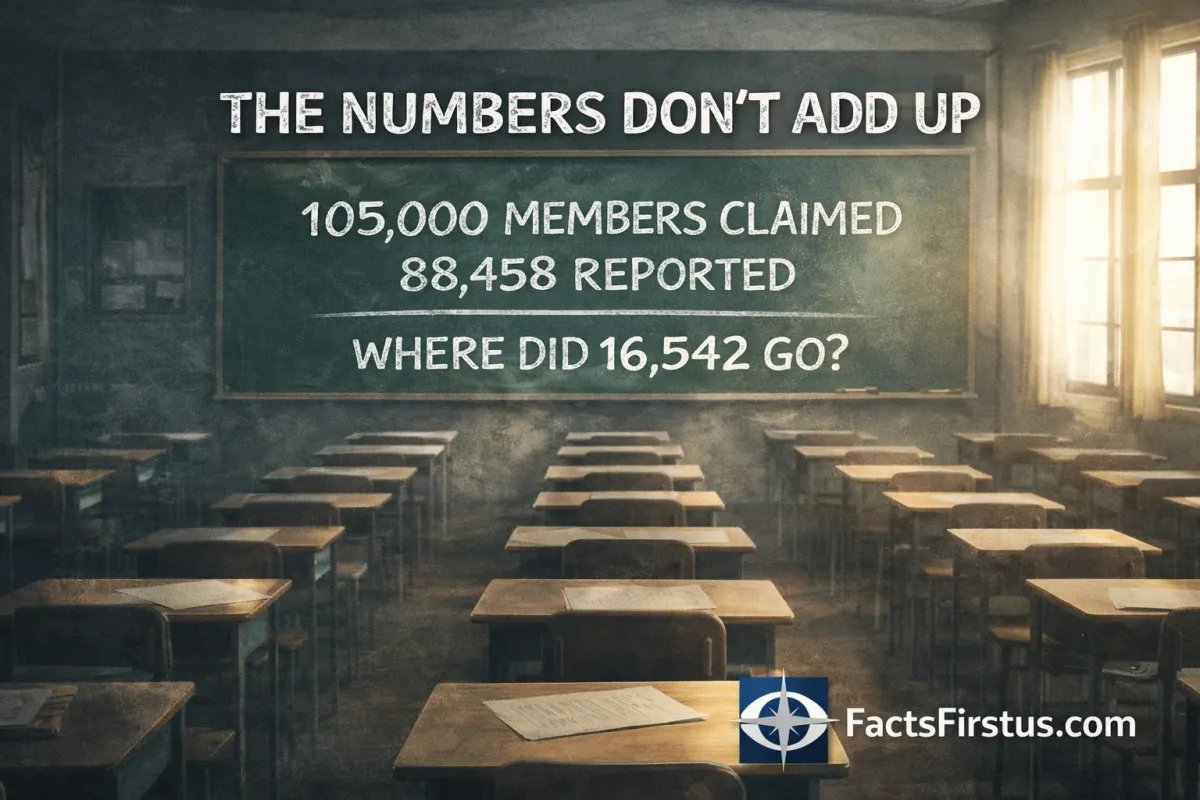
THE NUMBERS DO NOT MATCH: QUESTIONS GROW OVER ILLINOIS TEACHERS UNION CLAIMS
When the Numbers Do Not Add Up: Questions Surround Illinois Teachers Union Claims as Elections Approach
Federal filings and public statements show a 16,542-member discrepancy as Illinois voters prepare to head to the polls.
By Staff Writer
March 7, 2026
Across Illinois, the school year is winding down.
Spring is arriving quickly. Classrooms are counting the final weeks before summer break. Teachers are finishing lesson plans, parents are juggling busy schedules, and students are already dreaming about the long days of June.
But before the final bell rings for summer, a debate unfolding far beyond classroom walls is beginning to capture the attention of educators, parents, and taxpayers across the state.
It centers on a powerful organization, a set of numbers that do not match, and a question that could shape education policy in Illinois for years to come.
With Illinois elections approaching, the answers to that question may influence how voters across the state evaluate the role powerful education unions play in shaping public policy.
If the numbers do not add up, what else might not?
The discrepancy appears in official documents filed with the United States Department of Labor and in public statements issued by the Illinois Federation of Teachers.
The controversy began quietly, buried in paperwork most Illinois residents would never think to read.
In February 2025, the Illinois Federation of Teachers issued a press release announcing a rally at the Illinois State Capitol in Springfield. The statement described the union as representing “105,000 members.”
It was a powerful number, suggesting a vast network of educators and public employees united behind the organization.
But government records tell a different story.
Just one month later, the union submitted its required filing to the United States Department of Labor, a document signed under penalty of perjury. In that federal report, the Illinois Federation of Teachers listed 88,458 members.
The difference is not small.
It amounts to 16,542 people.
In other words, thousands of educators and school personnel across Illinois had already chosen not to belong to the union, despite public messaging suggesting a much larger membership base.
To understand the scale of that difference, consider this comparison. Sixteen thousand five hundred forty-two people is roughly the population of a small Illinois town.
In a debate about education, numbers matter. When those numbers conflict, trust becomes the real issue.
The discrepancy has sparked a simple but troubling question among critics and policy observers.
“If the public statements and official filings tell two different stories, which number should Illinois residents believe?”
Some observers say the concern goes beyond a simple discrepancy.
“If something as easily verified as membership numbers is inaccurate, it raises the question of what other claims deserve closer scrutiny.”
What the Records Show
Public statements and federal filings show a significant gap in reported membership.
IFT press release (February 2025): 105,000 members
U.S. Department of Labor filing (March 2025): 88,458 members
Difference: 16,542 members
Federal filings are submitted under penalty of perjury.
“Sixteen thousand five hundred forty-two people is not a rounding error. It is the size of an entire Illinois town. Yet that is the gap between the membership the Illinois Federation of Teachers publicly claimed and the number it reported to the federal government. When numbers that large do not match, voters have every reason to ask a simple question: Who is telling the truth?”
For many Illinois residents, debates about teachers unions often feel like a Chicago story shaped by big-city politics.
But the Illinois Federation of Teachers operates statewide. Its influence extends far beyond Chicago and reaches school districts in suburbs, small towns, and rural communities across Illinois.
The organization lobbies lawmakers in Springfield, advocates for legislation, and plays a significant role in shaping education policy.
That means its messaging and influence reach into every corner of the state.
Teachers unions also remain among the most influential political organizations in Illinois, contributing millions of dollars to campaigns and helping shape education legislation in Springfield.
The timing of the controversy is significant because Illinois lawmakers are currently debating whether the state should participate in a new federal education funding program that could bring additional resources to students and families.
At the center of that debate is the Federal Scholarship Tax Credit program, a proposal designed to expand educational support for students across the country.
Under the program, individuals who donate to approved scholarship organizations receive a dollar-for-dollar tax credit of up to $1,700 per year.
Those donations fund scholarships that can help students with tutoring, tuition assistance, dual-enrollment fees, and educational therapies for students with disabilities.
Supporters say the program creates a rare three-way benefit.
Students receive additional resources. Donors receive tax credits. Public school funding remains untouched.
The program is voluntary for states, meaning Illinois leaders must choose whether to allow students to benefit from the scholarships.
Illinois must opt into the program for students in the state to receive those funds.
If Illinois does not participate, taxpayers may still receive the federal tax credit for donations, but the scholarship money could flow to students in other states instead.
That decision ultimately rests with Governor J. B. Pritzker and lawmakers in Springfield.
Polling suggests many Illinois residents support participation.
A statewide survey conducted for the Illinois Policy Institute found that nearly 55 percent of Illinois voters support opting into the program, while about 22 percent oppose it.
Support was recorded across political affiliations, geographic regions, and demographic groups.
Despite that support, the Illinois Federation of Teachers has strongly opposed the program.
Critics say the union’s messaging focuses largely on the possibility that some scholarships could help families choose private schools.
Supporters of the program argue that this narrow focus overlooks a broader reality. The scholarships could also support public school students who need tutoring, therapy services, or specialized academic assistance.
“This is not simply about private schools. Public school students could benefit from these resources as well.”
Opponents warn that if Illinois refuses to participate, the consequences could be significant.
Illinois taxpayers could still fund the program through federal tax credits, but the benefits could flow to students in other states.
With many states already preparing to participate, some policy analysts worry that Illinois students could find themselves watching opportunities go elsewhere.
For many Illinois parents, these debates may sound like political arguments happening far away in Springfield.
But the consequences show up much closer to home.
They appear in classrooms where students struggle to find tutoring support. They appear in school districts searching for resources for children with learning disabilities. They appear in households where parents wonder whether their child will have access to the educational opportunities they need to succeed.
Education policy is often debated in legislation and statistics.
For families across Illinois, it is about opportunity.
The debate is unfolding at a politically sensitive moment.
Illinois voters will soon head to the polls in elections that could reshape the balance of power in Springfield.
Education policy, union influence, and state spending are all expected to play significant roles in those campaigns.
Teachers unions have historically been among the most influential political forces in Illinois politics, providing financial support and organizing power for candidates across the state.
That influence has helped shape decades of education policy.
But controversies like the membership discrepancy are prompting new conversations among voters.
Some see the issue as a technical dispute.
Others see it as a broader question of transparency and accountability.
For many families, the policy debates happening in Springfield may feel distant.
But the consequences reach directly into classrooms and homes across Illinois.
A tutoring program that never reaches a struggling student.
A scholarship that never materializes.
A child who could have received additional educational support but never had the opportunity.
Those consequences are not theoretical.
They affect real students sitting in classrooms across the state today.
Across Illinois, the final weeks of the school year are approaching.
Soon classrooms will empty, backpacks will be packed away, and students will step into the long days of summer.
But the decisions being debated in Springfield will not pause for summer break.
They will shape the policies, funding, and opportunities waiting for those students when they return to their classrooms in the fall.
And as Illinois voters prepare for another election season, the question may no longer be only about education policy.
It may be about something even more fundamental.
Whether the institutions and leaders shaping the future of Illinois children are being completely honest with the public.
Sources
Illinois Federation of Teachers press statement, February 2025
U.S. Department of Labor Labor-Management Reporting and Disclosure Act filings
Illinois Policy Institute statewide polling on the Federal Scholarship Tax Credit program
Federal Scholarship Tax Credit program legislative summaries