
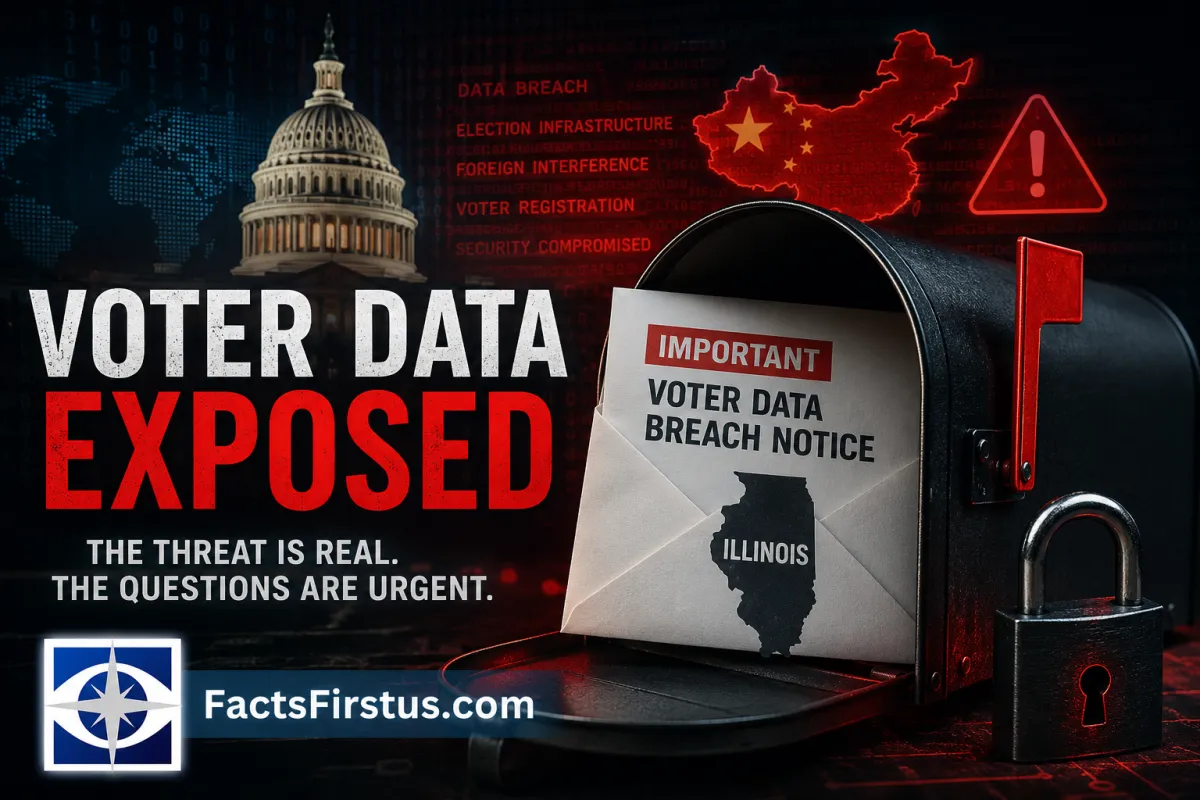
ILLINOIS VOTERS GET BREACH LETTERS AS TRUMP'S DECLASSIFIED INTELLIGENCE REVEALS A MUCH BIGGER THREAT
ILLINOIS VOTER DATA EXPOSED: TRUMP DROPS DECLASSIFIED BOMBSHELL ON CHINA'S 220 MILLION VOTER HACK AND DEEP STATE COVER-UP
As Illinois voters receive breach notifications, newly declassified intelligence connects local cybersecurity failures to sweeping warnings about foreign election threats and alleged government suppression.
By FactsFirstUS Staff Writer | July 18, 2026
For thousands of Illinois families, it started with a letter.
No flashing headlines.
No emergency alert.
Just an envelope arriving in the mailbox.
Inside was a notification from Platinum Technology Resource informing recipients that sensitive personal information tied to Illinois voter records may have been exposed. The company urged residents to monitor financial accounts, review their credit, and watch closely for signs of identity theft.
For many, it felt like an old story resurfacing.
But within hours, it became something much bigger.
On July 17, 2026, President Donald J. Trump ordered the release of newly declassified intelligence documents that he says reveal what Americans were never supposed to see: assessments describing foreign access to U.S. voter data, vulnerabilities throughout America's election infrastructure, and allegations that key intelligence was intentionally withheld from senior officials and the public.
Suddenly, the Illinois breach was no longer just an Illinois story.
It had become part of a much larger national conversation.
"We judge that U.S. adversaries, including at a minimum Russia, China, Iran, and North Korea, as well as non-state groups, have the capability to compromise U.S. election infrastructure."
— Newly Declassified U.S. Intelligence Assessment
The Illinois incident dates back to July 2024.
Security researcher Jeremiah Fowler discovered unsecured cloud databases connected to Platinum Technology Resource, a company providing election-related technology services to numerous Illinois counties.
What he found was staggering.
Approximately 4.6 million records had been exposed.
The databases reportedly contained voter registrations, voting histories, Social Security numbers, dates of birth, residential addresses, and even death certificates involving counties including Alexander, Boone, Champaign, DeKalb, Effingham, Gallatin, Hamilton, Henry, Jefferson, Ogle, Pike, Sangamon, St. Clair, Williamson, and Winnebago.
Fowler did not minimize what he was seeing.
"It's probably some of the most sensitive voter data I've seen."
— Jeremiah Fowler, Security Researcher
Election officials quickly moved to secure the databases after being notified, and authorities have said they found no evidence of widespread misuse.
Even so, the discovery exposed a troubling reality.
The information protecting millions of voters had been vulnerable.
Gallatin County Clerk Deanna Bryant acknowledged the challenge while defending the integrity of local elections.
"I can guarantee our elections are run correctly. But not everyone believes that. We don't need more scrutiny."
— Deanna Bryant, Gallatin County Clerk
The newly declassified intelligence suggests Illinois may represent only one piece of a much larger picture.
According to the released assessments, China obtained data on approximately 220 million American voters during the 2020 election cycle. The documents state the information included names, addresses, telephone numbers, and political party affiliations.
The intelligence further claims election-related breaches occurred in at least 18 states and alleges that significant portions of that information were never shared with either the President or Congress.
Perhaps the most striking warning centers on America's own election systems.
"We assess that centralized election-related data repositories, such as voter registration databases, pollbooks, and official election websites, are most vulnerable to exploitation."
— Newly Declassified Intelligence Assessment
The documents move beyond identifying vulnerabilities.
They describe the capabilities of foreign adversaries to target election infrastructure and include references to Venezuelan techniques allegedly capable of digitally altering vote totals without detection.
They also contain allegations of internal suppression within elements of the intelligence community.
According to the releases, one intelligence analyst admitted to altering information prepared for the President's Daily Brief. Another FBI official allegedly described efforts resembling a "shadow government" designed to prevent certain intelligence from reaching decision-makers.
Veteran investigative journalist Catherine Herridge said the significance extends beyond politics.
"There was clear evidence of political and personal bias, and intelligence is supposed to be neutral. What we heard tonight from the President is an allegation that this intelligence was suppressed in order to harm him, and now we're seeing documents already which back those claims."
— Catherine Herridge
Former Acting Undersecretary of Defense for Intelligence and Security Ezra Cohen described the disclosures as long overdue.
"The day has finally come. Americans can now see a portion of what we caught the permanent security state covering up in the winter of 2020 — CCP interference in our elections."
— Ezra Cohen
The declassified material also broadens the discussion beyond cybersecurity.
According to the released documents, investigators in Michigan uncovered an alleged operation during the 2020 election involving canvassers accused of forging voter registrations in exchange for financial incentives. The documents further allege that the investigation progressed slowly.
Separately, a Department of Homeland Security review identified approximately 278,000 non-citizens registered to vote across four cooperating states. Officials noted that the actual number could be higher because additional states declined to participate in the review.
The documents also revisit concerns surrounding absentee voting by citing findings from the bipartisan Commission on Federal Election Reform, which described mail-in ballots as the largest potential source of election fraud.
Illinois remains part of that broader debate.
While the state continues notifying residents affected by the Platinum Technology Resource breach, it has also faced criticism for resisting full participation in certain federal voter roll reviews. Meanwhile, officials report that states using the federal SAVE system have removed hundreds of thousands of ineligible registrations, including deceased individuals and non-citizens.
The newly released intelligence has generated sharply different reactions.
Many national media organizations devoted limited coverage to the disclosures, while officials including Vice President JD Vance and members of Congress called for renewed consideration of the SAVE America Act, legislation proposing proof of citizenship for federal voter registration, voter identification requirements, and additional election security measures.
For Illinois residents, however, the debate is no longer taking place only in Washington.
It's sitting on the kitchen counter.
It's the breach notification letter reminding them that their personal information may have been exposed.
And it's now accompanied by newly declassified intelligence describing foreign adversaries, vulnerabilities in America's election infrastructure, and allegations that critical information was withheld from the American people.
Whether those disclosures ultimately reshape public policy or simply deepen an already intense national debate, they have undeniably changed the context surrounding Illinois' voter data breach.
What once appeared to be an isolated cybersecurity incident is now being viewed by many through the lens of a much larger question:
If millions of voter records in one state could be exposed, what else might the newly declassified intelligence reveal about the security of America's election systems?
Official Sources
White House declassified intelligence releases and presidential address, July 17, 2026
U.S. Department of Homeland Security voter roll reviews and SAVE system reports
Capitol News Illinois reporting on the Platinum Technology Resource breach (2024)
Statements from Trump administration officials, members of Congress, and independent experts