
DUPLICATE BALLOTS AND LOCKED FILES: THE TRANSPARENCY CRISIS FACING ILLINOIS VOTERS
THREE BALLOTS. ONE VOTER. AND A STATE THAT WON’T OPEN ITS FILES.
In Illinois, where corruption is history—not legend—duplicate ballots and sealed voter rolls are colliding ahead of the 2026 midterm elections.
By Staff Writer
March 1, 2026
The first ballot felt ordinary.
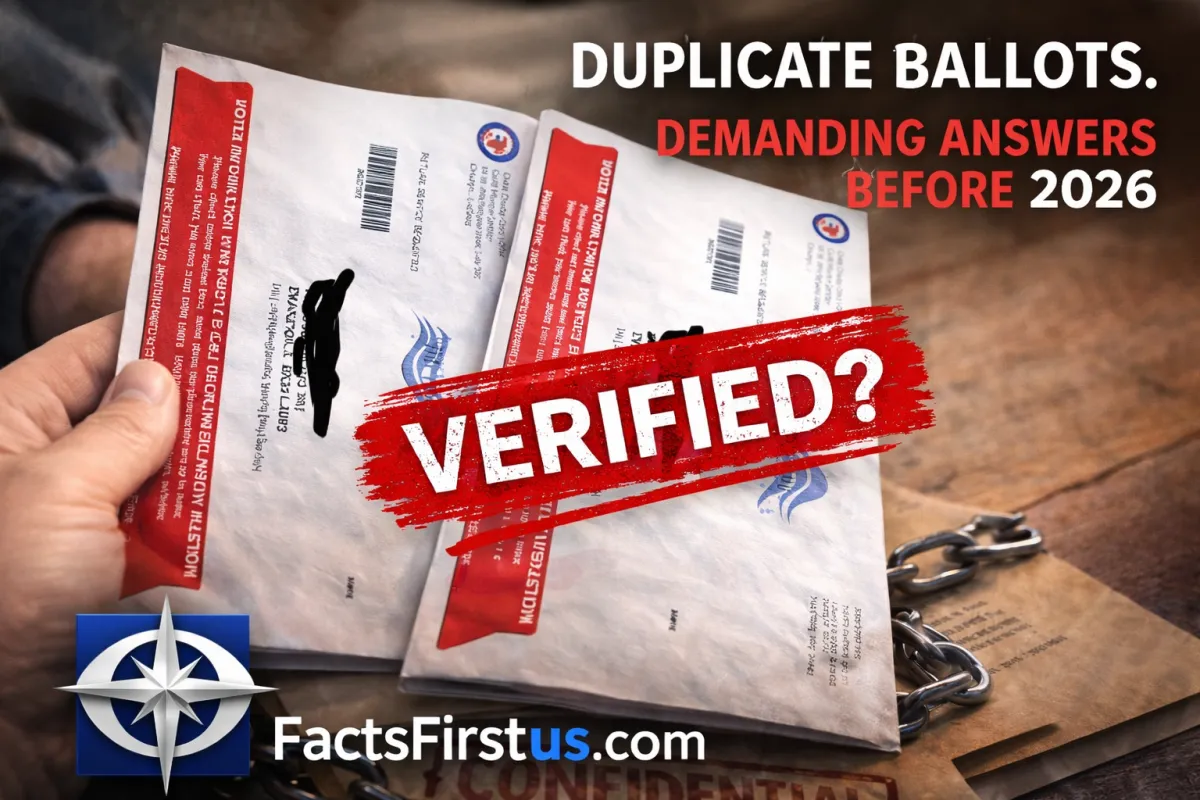
James Johnson opened it at his kitchen table in Aurora, filled it out carefully, sealed it, and mailed it back. His vote was cast for the upcoming 2026 midterm elections. Another citizen doing what citizens are supposed to do.
Then two more ballots arrived.
Same name. Same address. Same election.
He laid them side by side on the counter. Checked the envelopes. Checked the dates. Checked the return instructions.
“I received three Cook County mail-in ballots,” Johnson said. “One was received a week ago and I mailed it back with my vote. Today I received two more. I've never experienced receiving more than one mail-in ballot.”
Three ballots.
One voter.
In another state, maybe it would be brushed off as a clerical error. A harmless glitch.
But this is Illinois.
And Illinois carries a past.
This is the state that has sent governors to federal prison. The state where corruption trials have unfolded in federal courtrooms often enough to feel cyclical. The jokes about Illinois politics are not creative exaggerations. They are built on documented convictions.
Trust here is not automatic.
It is fragile.
So when duplicate ballots appear in mailboxes and, at the same time, state officials refuse to fully comply with a federal voter roll transparency request, the reaction is not indifference.
It is suspicion.
“I’m wondering if in fact the Democratic Party is in conspiracy of rigging the 2026 elections,” Johnson said.
That accusation is serious. It is also unproven.
But the existence of the suspicion is the real story.
Because confidence in elections does not collapse overnight. It erodes in moments — small ones at first.
Like holding two extra ballots you didn’t ask for.
While Johnson was staring at envelopes, a separate conflict was unfolding in government offices.
Under the National Voter Registration Act (NVRA), Congress required states to maintain accurate and current voter rolls. The same law explicitly assigns enforcement authority to the U.S. Attorney General. The Department of Justice is not an outside observer in this process — it is the agency Congress empowered to ensure compliance.
In 2025, the Department of Justice requested Illinois’ complete, unredacted statewide voter registration file to evaluate whether the state was meeting its federal list maintenance obligations.
Attorney General Pamela Bondi stated, “Accurate voter rolls are the cornerstone of fair and free elections, and too many states have fallen into a pattern of noncompliance with basic voter roll maintenance.”
Illinois declined.
Marni Malowitz, General Counsel for the Illinois State Board of Elections, responded that the Department of Justice was “not entitled to receive and not entitled to demand” certain information contained in the voter file. She added, “We take Illinoisans’ privacy very seriously; data breaches and hacking are unfortunately common.”
Privacy is not trivial. Voter databases contain sensitive personal information. Safeguards matter.
But so does enforcement.
The NVRA does not merely suggest compliance. It mandates it. And it places the authority to enforce that mandate in federal hands. If the agency charged by Congress with enforcing voter roll maintenance laws cannot review the underlying data, critics ask, how can compliance be verified?
That question grows sharper when paired with public data.
Reports submitted by Illinois to the U.S. Election Assistance Commission show that some counties reported minimal — and in certain cases zero — voter removals over multi-year reporting periods.
Zero.
In large counties.
In a state of nearly 13 million residents.
Every year, Americans move. They die. They change addresses. The U.S. Census Bureau documents significant annual mobility nationwide. Voter rolls require continuous maintenance to remain accurate reflections of who is eligible and where they reside.
Federal law rightly requires notice periods and safeguards before removing voters. No lawful voter should be improperly purged. Those protections are essential.
But safeguards are not stagnation.
If rolls are not regularly updated, outdated registrations accumulate. Ballots can be mailed to former addresses. Duplicate mailings can occur. Administrative complexity increases. Even without proven fraud, perception deteriorates.
And perception, in elections, matters.
Illinois has expanded mail-in voting and continues to debate further expansion. Mail voting depends entirely on the accuracy of the voter registration database. If the database is current and clean, transparency would quiet critics.
Instead, the state and federal government are now locked in litigation.
Governor JB Pritzker’s administration says it is protecting residents’ personal information. The Department of Justice says it is fulfilling its statutory duty under federal law.
Between those two positions stands the public.
Not politicians.
Not lawyers.
The public.
Everyday, law-abiding citizens who expect one thing from their government: that eligibility standards are enforced consistently and that their lawful vote carries equal weight.
This is not about suppressing voters.
It is about defining voters.
In a democracy, eligibility is not negotiable. It is definitional.
Only eligible voters should receive ballots. Every eligible voter should be protected. Those principles do not belong to a party. They belong to the Constitution.
Illinois has lived through enough political scandal to know that trust cannot be commanded. It must be demonstrated.
Open the records to lawful federal review.
Demonstrate compliance.
Allow scrutiny.
Because in a state where corruption has been prosecuted repeatedly in federal court, secrecy is not reassuring.
It is destabilizing.
James Johnson is not a statistic. He is not a talking point. He is a voter who followed the rules and now wonders whether the system is following them too.
Three ballots sat on his counter.
And a question hung in the air:
If everything is secure, why not prove it?
In Illinois, history demands more than promises.
It demands proof.
And until proof replaces resistance, doubt will not fade quietly.
It will spread — one envelope at a time.
Official Sources
National Voter Registration Act of 1993 (52 U.S.C. § 20507; 52 U.S.C. § 20510)
Help America Vote Act of 2002 (52 U.S.C. § 20901 et seq.)
U.S. Department of Justice public statements regarding NVRA enforcement authority
Illinois State Board of Elections official correspondence and public statements
U.S. Election Assistance Commission voter registration maintenance reports
U.S. Census Bureau annual geographic mobility data
Federal court records documenting public corruption convictions in Illinois