
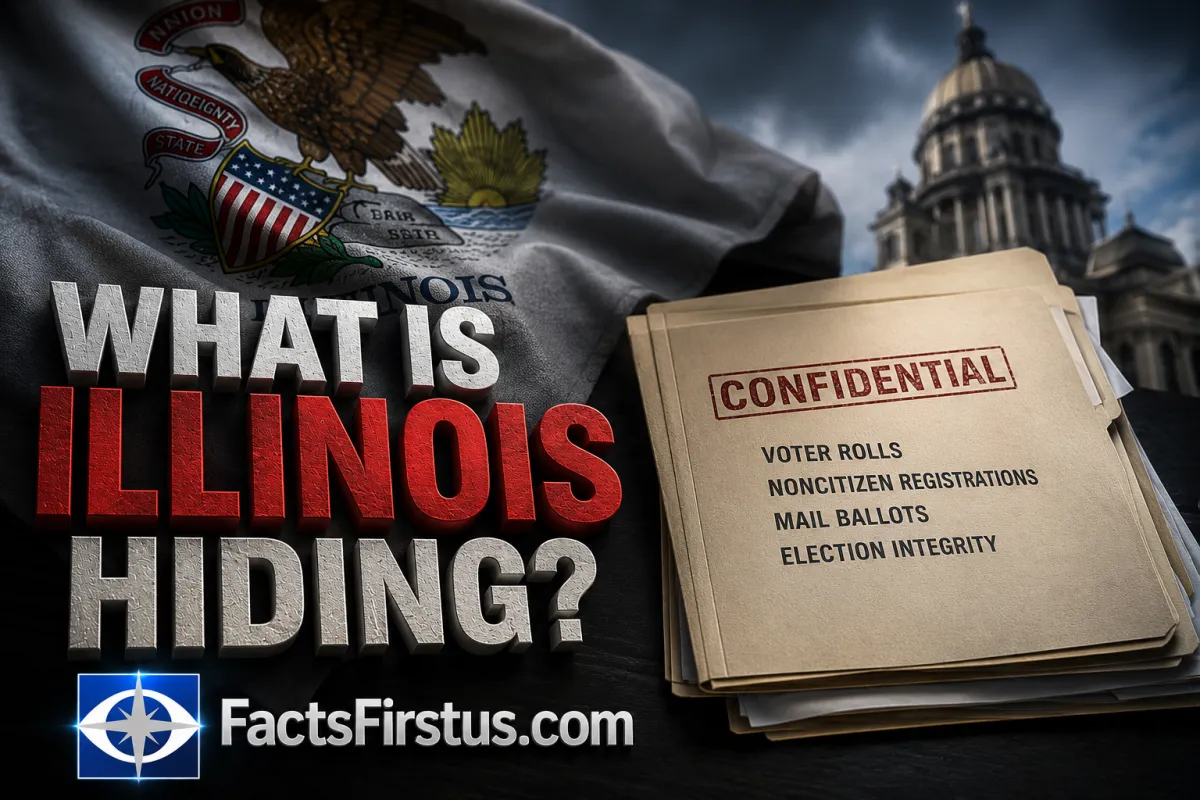
545 REGISTRATIONS. 15 BALLOTS. AND ONE QUESTION ILLINOIS CAN’T ESCAPE.
WHAT IS ILLINOIS HIDING?
Illinois says noncitizen voting is extraordinarily rare and its elections are secure. But Chicago openly allows noncitizens to participate in one category of local elections, Illinois once mistakenly registered hundreds of noncitizens, and now the state is fighting Trump's demand for greater voter verification.
By Staff Writer | August 24, 2026
545.
Remember that number.
Because it changes this story.
Illinois says its voter rolls are secure.
It says noncitizen voting is extraordinarily rare.
It says its safeguards work.
President Donald Trump wants the federal government to do more to independently verify those claims.
Illinois is fighting him.
And if this were simply another political battle between Trump and Democratic Gov. JB Pritzker's Illinois, it would be easy to dismiss as predictable.
It isn't.
Because Illinois has already learned what happens when a safeguard designed to separate citizens from noncitizens fails.
545 people identified at the time as noncitizens were mistakenly entered into Illinois' voter-registration system.
Fifteen cast ballots.
There is important context. Three of those 15 were later determined to actually be citizens, according to Illinois election officials, and the episode does not establish that 545 noncitizens illegally voted.
But that's not the part Illinois should want voters to forget.
The safeguard failed.
The registrations got through.
Government discovered the problem afterward.
Illinois says the software problem was fixed.
Good.
But fixing a failure doesn't erase what the failure taught us.
A safeguard isn't proven by its existence. It is proven by whether it works.
And now Trump is asking a question Illinois seems increasingly reluctant to entertain from Washington:
Who verifies the verifier?
That question becomes even more interesting when you look at something happening in Illinois that many voters probably don't know about.
There are elections in Chicago where you do not have to be an American citizen to vote.
That statement needs context.
Noncitizens cannot legally vote for President.
They cannot legally vote for Congress.
Illinois requires citizenship for its regular elections.
But Chicago Public Schools conducts Local School Council elections, and its official 2026 voting guide could hardly be clearer:
"US citizenship is not a requirement to vote."
Chicago Public Schools
These aren't elections for President, governor, mayor or the Illinois General Assembly.
But they are elections.
Voters go to designated locations.
They present identification.
They receive ballots.
They select candidates.
Votes are counted.
Representatives are chosen.
Chicago Public Schools describes Local School Councils as bodies giving parents, community members, educators and students an opportunity to make important decisions about how children in their communities will be educated. Community members who meet the residency and age requirements can participate, and citizenship is expressly not required.
That doesn't prove anything improper is happening.
It's legal.
And that's precisely what makes it relevant.
Illinois has already accepted the principle that citizenship does not have to be a qualification for participation in every election conducted within the state.
For regular state and federal elections, Illinois draws a different line.
Citizens only.
Which makes the integrity of that line enormously important.
How does Illinois make certain the two worlds never cross?
That is no longer a hypothetical question.
545.
Illinois' own Automatic Voter Registration system already demonstrated that the line can fail.
Illinois election officials say the 2019 software problem that caused those registrations was corrected. They also say noncitizen voting in the state is exceedingly rare. State Board of Elections spokesman Matt Dietrich recently said only 10 noncitizens have been found to have voted in Illinois elections since 1982.
That's an impressive statistic.
But it creates another question.
Does that number tell us how many noncitizens voted?
Or does it tell us how many Illinois found?
Those aren't necessarily the same thing.
And that distinction sits at the center of Trump's national election-integrity campaign.
Federal law already prohibits noncitizens from registering or voting in federal elections.
Trump isn't trying to make noncitizen voting illegal.
It already is.
His administration wants more tools to verify that the law is actually being followed.
Trump's March 31 executive order, Ensuring Citizenship Verification and Integrity in Federal Elections, explicitly starts there. It says voting in federal elections is reserved for U.S. citizens and directs federal agencies to use citizenship and identity records, including information available through the Department of Homeland Security and Social Security Administration, to assist with verification.
The concept is simple.
Don't ask one database to police itself.
Check one record against another.
Illinois says someone is registered.
Federal records indicate citizenship status.
Compare them.
Something doesn't match?
Look closer.
That does not mean automatically removing someone from a voter roll because one government database says something different from another.
Federal databases make mistakes, too.
Trump's order includes mechanisms for correcting records, and protecting eligible citizens from erroneous government information is just as important as identifying someone who is actually ineligible.
But verification is the point.
And that's when Trump's Justice Department came knocking on Illinois' door.
DOJ sought Illinois' statewide voter-registration information as part of an investigation into compliance with federal voter-list-maintenance requirements.
Illinois gave Washington a redacted file.
DOJ wanted more, including information Illinois withheld on privacy grounds.
Illinois refused.
DOJ sued.
Illinois won.
U.S. District Judge Colleen R. Lawless, appointed to the federal bench by President Joe Biden, dismissed the government's case on July 31.
Lawless concluded that the Justice Department could not use Title III of the Civil Rights Act of 1960 in the manner it attempted to compel Illinois to provide the unredacted voter-registration information.
And Lawless was hardly standing alone.
Her opinion noted that DOJ had brought similar Title III cases against election officials in 30 other states and the District of Columbia. At that point, 18 federal district courts had dismissed such cases, and an appellate court had affirmed a dismissal involving Michigan.
The Democratic National Committee, 18 states and the District of Columbia also filed briefs supporting dismissal in the Illinois case.
And this is part of a much larger political fight.
Democratic-led states have been prominent in challenging Trump's election initiatives, including his attempt to change federal mail-ballot procedures. Their argument is that Trump is exceeding presidential authority, invading powers belonging to states and Congress and potentially threatening voter privacy and access.
Those are serious legal questions.
But here is where Illinois' courtroom victory gets much more interesting.
Lawless did not audit Illinois' voter rolls.
She did not determine that every registered voter was eligible.
She did not determine that every deceased voter had been removed.
She did not determine that no noncitizen remained registered.
She did not independently certify Illinois' voter database as accurate.
Illinois won an argument over Washington's authority to demand the information.
It did not win a clean bill of health for the information itself.
That is a very different victory.
And the Justice Department is continuing the legal fight.
But Trump isn't stopping at voter rolls.
He wants to follow the ballot, too.
Not how you vote.
Where the ballot goes.
Whether it gets there.
Whether it comes back.
Whether the numbers match.
That is where this story suddenly reaches from Springfield and Washington directly into millions of American mailboxes.
Trump's March executive order directed the Postal Service toward a system using uniquely serialized Intelligent Mail barcodes for federal mail ballots.
USPS has now issued its final rule.
Under the new system, states using USPS for mail ballots would have to provide voter information and associate outbound and return ballot envelopes with unique barcodes. USPS says it would collect exterior mail information such as addressing and barcode data, not party affiliation or the contents of a voter's ballot.
Think of it like tracking a package.
Except what's inside remains secret.
Eligible voter.
Ballot issued.
Ballot mailed.
Ballot moves through USPS.
Return ballot moves back.
Numbers reconcile.
Nobody knows how you voted.
But government can account for the ballot's journey.
USPS says the purpose includes facilitating enforcement of federal law, reducing fraud risks and protecting federal election integrity.
And once again, Democratic-led states and other challengers are fighting the Trump administration in court.
A federal judge has blocked key portions of Trump's executive order, and the new USPS requirements cannot currently be implemented for the midterms unless the administration obtains relief from the injunctions. The Trump administration has taken the fight to the Supreme Court.
That legal battle matters.
Presidents have limits.
States have constitutional authority over elections.
Congress has authority over federal election rules.
Privacy matters.
Eligible voters cannot be stripped of their rights because some government database contains an error.
But none of that makes verification a bad idea.
In fact, Illinois' own history demonstrates why verification matters.
And then there are the dead.
That sounds sensational.
So let's be precise.
A 2016 CBS Chicago investigation identified voting histories associated with people who were deceased. Election officials attributed many of the cases to clerical errors, people with similar names and other recordkeeping problems.
That does not establish widespread voting by dead people.
But notice what the explanation itself acknowledges.
The records contained errors.
Then came another Illinois government-data embarrassment this year.
More than 60 deceased people appeared on a 200-person jury panel in Whiteside County.
One reportedly had been dead for roughly 35 years.
Again, that's not proof that 60 dead people were registered to vote. Jury lists draw from multiple government sources and separate problems with jury-management data were identified.
But once again:
The records were wrong.
Now put the pieces together.
545 questionable registrations.
A system failed.
15 ballots cast.
Some involved people later confirmed to be citizens, but ballots were nevertheless cast from a group the system itself had flagged as problematic.
Voting histories associated with deceased people.
Officials pointed partly to recordkeeping errors.
More than 60 deceased people summoned through another Illinois government process.
More bad data.
And in Chicago:
An election where citizenship is deliberately not required.
None of those facts, individually or collectively, proves widespread election fraud.
Let's make that unmistakably clear.
This story does not establish widespread election fraud in Illinois.
It establishes something else.
Government systems make mistakes.
Illinois government systems have made mistakes.
Illinois' voter-registration system has made a mistake involving citizenship.
And Illinois itself operates at least one category of election in which citizenship isn't required.
Against that backdrop, Trump's demand for greater citizenship verification doesn't sound quite as radical as his opponents sometimes portray it.
It sounds like a question worth answering.
If citizenship is already required to vote in federal elections, why should verifying citizenship be controversial?
Illinois' answer is that safeguards already exist and noncitizen voting is extraordinarily rare.
Perhaps Illinois is right.
But we're back to the same problem.
Who verifies that conclusion?
If Illinois says only 10 noncitizens have been found voting in 44 years, that's evidence worth considering.
But Trump's question remains.
How do you know you found everyone you were supposed to find?
And that question becomes particularly important when registration connects to mail voting.
Is the voter a citizen?
Is the registration current?
Is the voter alive?
Does the voter still reside where the record says?
Was a mail ballot issued?
Where was it sent?
Did USPS process it?
Did it return?
Was it accepted?
Do the numbers reconcile?
Those aren't Republican questions.
They aren't Democratic questions.
They're accounting questions.
And every secure election system should be able to answer them.
This is where the fight between Trump and Democratic-led states becomes bigger than either political party.
Trump could ultimately lose some of these cases.
Courts could conclude that portions of his executive order exceed presidential authority.
Judges could determine DOJ relied upon the wrong statute or demanded information it wasn't entitled to receive.
Trump could even be legally wrong about how he is trying to impose a safeguard while being right that the vulnerability deserves attention.
Those are two different questions.
Politics keeps treating them as one.
Illinois can defeat Donald Trump's Justice Department in court.
That does not prove Illinois' database is accurate.
Illinois can block Washington from obtaining sensitive voter information.
That does not prove every person in the database belongs there.
Illinois can point to extraordinarily low numbers of detected noncitizen voting.
That still doesn't independently establish how many cases the system may have failed to detect.
And Illinois' own history makes dismissing those questions particularly difficult.
545.
That's why we told you to remember the number.
Illinois already discovered what happens when government assumes the safeguard worked.
It didn't.
So maybe Illinois is right today.
Maybe its voter rolls are extraordinarily clean.
Maybe noncitizen voting is virtually nonexistent.
Maybe every vulnerability identified after 2019 has been corrected.
Maybe Trump's concerns are overstated.
Good.
Prove it.
Not to Donald Trump.
Not to Republicans.
Not to Democrats.
To Illinois voters.
Show that citizenship requirements are enforced.
Show how citizenship discrepancies are investigated.
Show that deceased voters are removed.
Show how voter rolls are maintained.
Show how many mail ballots are issued.
Show how many are undeliverable.
Show how many come back.
Show how many are accepted.
Show how many are rejected.
Reconcile the numbers.
Protect voters' personal information while doing it.
Protect eligible citizens from erroneous government databases.
Then let Democrats examine the results.
Let Republicans examine them.
Let independent experts examine them.
Let the evidence win the argument.
Because there is a temptation to make this entire story about Donald Trump.
Don't.
Trump will eventually leave office.
Gov. JB Pritzker will eventually leave office.
Judges will change.
Political parties will trade power.
Citizenship will still matter.
The voter rolls will still matter.
Mail ballots will still matter.
And the right of every lawful voter to trust the system will still matter.
Illinois does not have to prove Donald Trump right.
Illinois has to prove its system right.
Which leaves the state with a question that winning a lawsuit cannot answer.
WHAT IS ILLINOIS HIDING?
Maybe nothing.
Then prove nothing is there.
Sources:
White House, Executive Order 14399, Ensuring Citizenship Verification and Integrity in Federal Elections, March 31, 2026.
United States v. Matthews, U.S. District Court for the Central District of Illinois, July 31, 2026.
Chicago Public Schools, 2026 Local School Council Election Voting Guide.
Capitol News Illinois reporting on Illinois safeguards against noncitizen voting and the 2019 Automatic Voter Registration failure.
United States Postal Service, Ballot Mail for Federal Elections, Final Rule, August 2026.
Associated Press reporting on the USPS rule, Trump's executive order and litigation by Democratic-led states and civil-rights groups