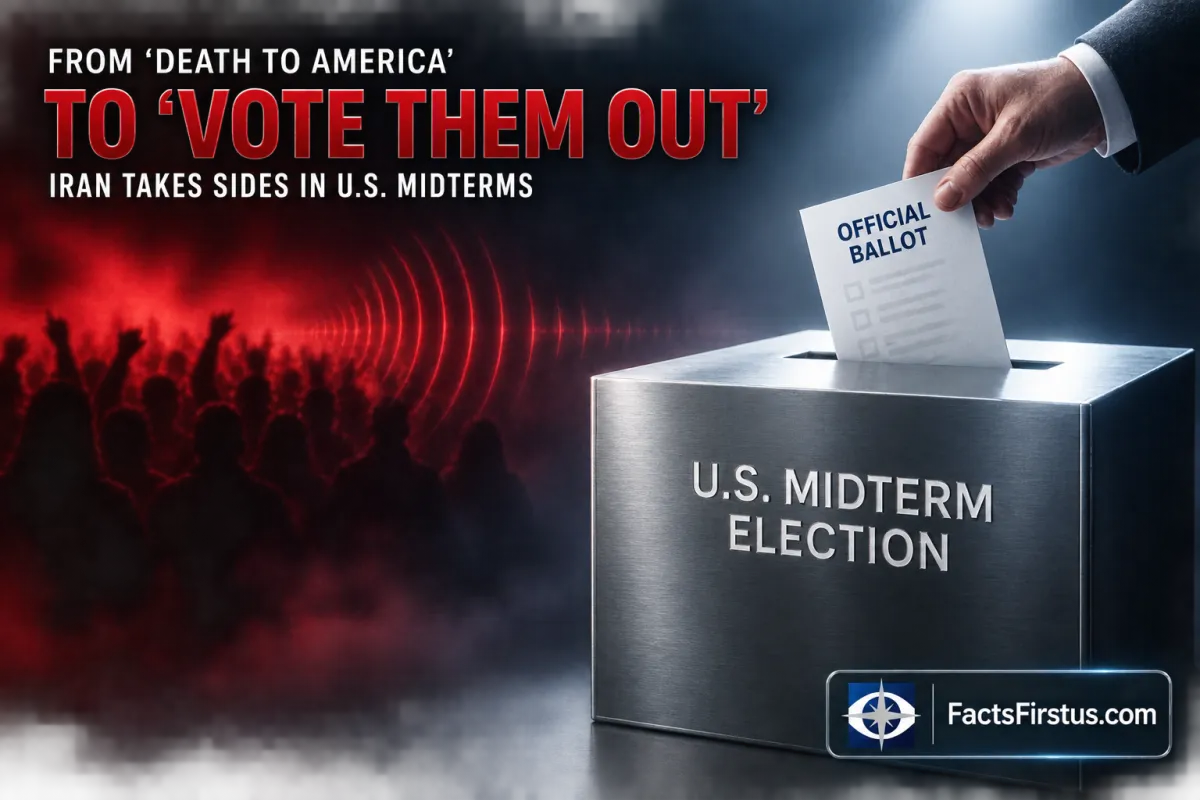
FROM “DEATH TO AMERICA” TO “VOTE THEM OUT” IRAN’S TERROR REGIME TAKES SIDES IN U.S. MIDTERMS
Iran’s Terror Guard Targets America’s Ballot Box and Wants Voters to Forget the Stakes
Iran’s Revolutionary Guard is urging Americans to remove President Trump’s allies from office while Tehran faces pressure over its nuclear ambitions, threats to global energy routes and its long record of hostility toward the United States
By Staff Writer
October 1, 2026
Iran’s Islamic Revolutionary Guard Corps wants Americans to focus on higher prices, political division and the strain of conflict and then blame President Donald Trump and the Republicans who support his approach to Tehran
That is the purpose of its extraordinary letter to American voters
The IRGC, a U.S. designated Foreign Terrorist Organization, is urging Americans to remove from power the leaders it blames for the direction of the United States
Its central target is President Trump, his policies and the Republican candidates who support them
“Remove from power the evil, deceitful and violent politicians who are responsible for America’s current state”
— Islamic Revolutionary Guard Corps, in its letter to American voters
The demand is not subtle
Iran wants Trump’s allies defeated
It wants Republican candidates who support a tougher approach toward Tehran pushed out of office
The IRGC did not issue a formal list of Democratic candidates it supports
It did not print the words “Vote Democrat” in a campaign style endorsement
But the practical political message is clear
If Americans vote to remove Trump aligned Republicans, the people who benefit are the Democrats and allied candidates running against them
That is the outcome Tehran wants
Americans should ask why
The answer begins with the nuclear threat
The Trump administration has argued that Iran’s nuclear program posed an urgent danger and that Tehran could not be permitted to obtain a nuclear weapon
The administration said its military operation aimed to destroy Iran’s missile, drone, naval and security infrastructure and cut off Iran’s path toward a nuclear weapon
“The mission is laser focused to obliterate Iran’s missiles and drones and facilities that produce them, annihilate its navy and critical security infrastructure, and sever their pathway to nuclear weapons”
— Secretary of War Pete Hegseth, quoted in a White House release
A nuclear armed Iran would not be an ordinary foreign policy problem
It would give a regime that has threatened the United States and supported terror networks the ultimate weapon of intimidation
Imagine downtown Chicago on an ordinary workday
Commuters crowd train platforms
Parents bring children to school
Nurses and paramedics begin their shifts
Police officers report for duty
Restaurant workers unlock their doors
Office workers arrive downtown
Then imagine a nuclear detonation
The initial blast could destroy buildings, bridges, roads, rail lines and critical infrastructure across a wide area
The fireball and shock wave could kill and severely injure people far from the center of the explosion
Fires could spread rapidly
Hospitals could be overwhelmed
Power, water, transportation and emergency communications could fail
Radioactive fallout could contaminate communities beyond the immediate blast zone, forcing families to flee or shelter in fear
No responsible leader should casually predict an attack on Chicago, New York or Los Angeles
But no responsible American should dismiss the stakes of keeping nuclear weapons out of the hands of a regime that has used violence, threats and coercion to advance its power
Iran’s Revolutionary Guard wants Americans focused on short term anger
It wants voters angry about costs at the gas pump, worried about instability and frustrated by the effects of a conflict Tehran has helped create
But Iran has also used the global energy system as leverage
The Strait of Hormuz is among the world’s most important energy chokepoints
Before the current conflict, it carried roughly one fifth of the world’s oil and liquefied natural gas shipments
Disruption in the strait has tightened global energy supplies and placed upward pressure on fuel prices
“The Strait of Hormuz handled about one fifth of global oil and liquefied natural gas supplies before the war”
— Reuters reporting on the global importance of the Strait of Hormuz
Iran has attempted to use access through the strait as a bargaining tool
Tehran proposed reopening the waterway only if the United States eased military pressure, lifted restrictions and agreed to additional demands
That is not peace
It is economic coercion
It is a hostile regime using a major artery of world commerce as leverage while asking Americans to punish the leaders who refused to surrender to its demands
“You are the ones who empower, with your votes, the government and allow it to do what it does”
— Islamic Revolutionary Guard Corps, in its appeal to American voters
The IRGC wants voters to believe that America’s response created the danger
It wants them to forget Tehran’s nuclear ambitions, threats to shipping, support for armed proxies and decades of hostility toward the United States
The reality is simpler
Iran did not become dangerous because America pushed back
America pushed back because Iran had become dangerous
The Iranian regime held 52 Americans hostage for 444 days after the seizure of the U.S. Embassy in Tehran in 1979
Iran backed Hezbollah, which carried out the 1983 bombing of the U.S. Marine barracks in Beirut and killed 241 American service members
The United States has designated the IRGC as a Foreign Terrorist Organization
“Iran backed Hezbollah terrorists killed 241 U.S. military personnel”
— U.S. government account of the Beirut Marine barracks bombing
For Illinois families, these threats are not distant or abstract
Middle East instability reaches Illinois through the cost of gasoline, groceries, transportation and household necessities
Military families live with the consequences when hostile regimes threaten Americans overseas
Veterans understand the cost when adversaries believe the United States lacks resolve
Businesses and workers feel it when rising fuel costs increase the cost of transporting goods
Gas prices matter
Household budgets matter
Families should not be told otherwise
But Americans should not be manipulated into believing that temporary pain at the pump is a reason to allow Tehran to dictate U.S. national security policy
The question is not whether Americans should care about fuel prices
They should
The question is whether temporary economic hardship is worth preventing a hostile regime from gaining the leverage, protection and destructive capability that a nuclear weapon could provide
That is the question Iran’s Revolutionary Guard wants voters to avoid
It wants Americans to see only the price posted at the gas station
It does not want them to see the danger behind the conflict
It wants Americans to see only partisan anger
It does not want them to see a foreign terrorist organization openly urging the removal of its political opponents in the United States
The midterm election belongs to Americans
Not to Iran’s Revolutionary Guard
Not to a regime that has threatened the United States, attacked American interests and tried to use the world’s energy supply as leverage
And not to any foreign power that believes an American election can be used to advance its own interests
Official sources
The White House, “President Trump’s Clear and Unchanging Objectives Drive Decisive Success Against Iranian Regime,” including Secretary of War Pete Hegseth’s statement that the mission was to sever Iran’s pathway to nuclear weapons
U.S. Department of State, “Foreign Terrorist Organizations,” listing the Islamic Revolutionary Guard Corps as a designated Foreign Terrorist Organization
U.S. Department of the Treasury, Office of Foreign Assets Control, “IRGC Foreign Terrorist Organization Designation,” April 15, 2019
Congressional Research Service, “The Strait of Hormuz: Security Developments and Impacts on Oil and Natural Gas Markets,” describing the strategic importance of the waterway and the effects of the 2026 disruption
U.S. Embassy statement, “The Iranian Regime’s Decades of Terrorism Against American Citizens,” documenting Iran backed attacks, including the 1983 Beirut Marine barracks bombing
Secondary sources
Reuters reporting on the importance of the Strait of Hormuz, which handled roughly one fifth of global oil and liquefied natural gas supply before the conflict
CNBC reporting on Iran’s proposal to reopen the Strait of Hormuz in exchange for U.S. concessions and on sharply reduced traffic through the waterway
CBS News reporting that Iran conditioned a phased reopening of the Strait of Hormuz on U.S. acceptance of Tehran’s stated demands
Fox News reporting on national gasoline price increases during the Strait of Hormuz disruption