
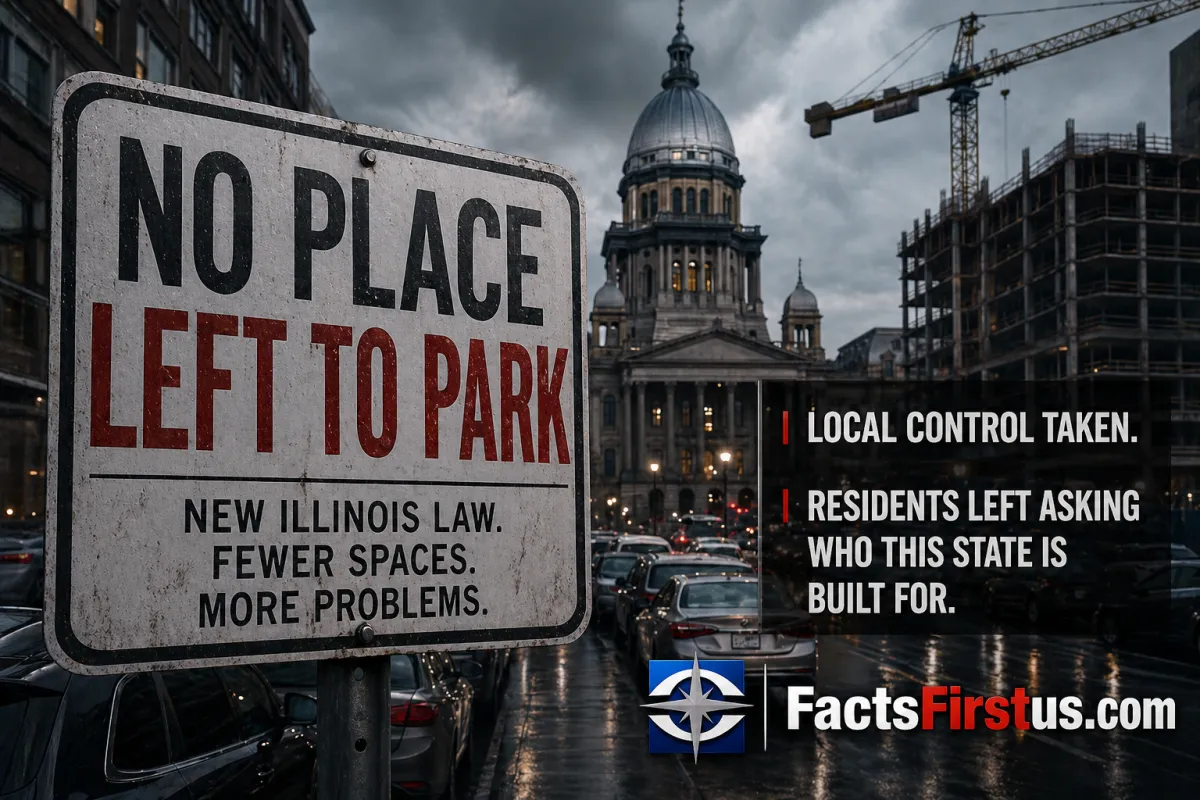
NO PLACE LEFT TO PARK
“Nowhere to Park”: Illinois Law Sparks Backlash as Residents Question State Leadership
Less parking. More people. Same number of cars. What could possibly go wrong?
By Staff Writer, April 29, 2026
Imagine pulling into your own neighborhood after a long day.
You slow down. You scan the street.
Every spot is taken.
You circle once. Twice. Maybe three times.
Now imagine that is not bad luck.
It is policy.
Starting June 1, a new Illinois law will make it easier than ever for developers to build apartments, stores, and restaurants with little or even no parking at all in areas near public transit. The law, part of Senate Bill 2111, removes the ability of local governments to require minimum parking spaces for new developments within one half mile of train stations or one eighth mile of frequent bus routes.
Supporters call it progress. They say it will reduce what they describe as “car dependency” and create more housing.
But for millions of Illinois residents, it raises a much more immediate question.
Where are we supposed to park?
“Wait, are they serious? Because I would love to see them carry groceries three blocks in January.”
Sarah M., Naperville
The reality is simple.
Developers save money by building less parking and squeezing in more units.
More people. Fewer spaces.
This is not a theory. It is a tradeoff.
And in Illinois, most workers still rely on a personal vehicle to get to work, making changes like this feel disconnected from daily life.
“So the plan is fewer parking spots but the same number of cars. What are these lawmakers thinking?”
Mike R., Aurora
In a state where winters can stretch for months and temperatures regularly drop below freezing, driving is not a luxury. It is how people live.
Families. Commuters. Tradespeople. Seniors.
They are not giving up their cars because a new building skipped a parking lot.
“I guess I will just teleport to work now. Problem solved.”
Dave L., Springfield
Supporters say the goal is to reduce what they call “car dependency” and move more people toward public transportation.
But that shift is raising another question that goes beyond parking.
Safety.
For many residents, their vehicle is not just transportation. It is a controlled, personal space. A place where they feel secure, especially during early morning or late-night commutes.
Now, some are asking what happens when that choice starts to disappear.
“It is not just about convenience. My car is where I feel safe. You are asking people to give that up without addressing what happens next.”
Jennifer K., DuPage County
In communities already concerned about crime and enforcement, the idea of pushing more people toward public transit is not landing the way lawmakers may have intended.
“You want more people on buses and trains. Fine. But are those systems ready? Are they safe? Because people are paying attention to that.”
Brian T., Elmhurst
Critics argue that before reshaping how millions of people travel, the state should be addressing the conditions that make residents hesitant to leave their cars in the first place.
“If the goal is to get people out of their cars, then make them feel just as safe without them. Right now, a lot of people do not.”
Angela P., Peoria
But for many, the frustration runs deeper than parking.
This law does not just change how buildings are built. Critics say it changes who gets to decide.
Local governments, the people closest to their communities, will no longer have the authority to require parking that fits their town’s needs. That decision now comes from the state.
More state control. Less local control.
“We elect local leaders to make local decisions. Now the state is stepping in and telling every town how to operate. That is not representation.”
Kevin S., Kane County
Cary Mayor Mark Kownick addressed the issue directly in his State of the Village address.
“Our main thing right now is loss of local control. They want to take away all of our authority, and that just cannot happen.”
Mayor Mark Kownick, Cary, Illinois
And for many residents, this is where frustration turns into something bigger.
They say this law is not being viewed in isolation.
They see it as part of a broader pattern coming out of Springfield under Governor J. B. Pritzker and the Democratic supermajority.
More sweeping statewide decisions.
Less local input.
More policies that critics say feel disconnected from everyday life.
“It feels like it never stops. New rules, new costs, new ideas that sound good in theory but do not match how people actually live.”
Tom H., McHenry County
Residents point to other proposals gaining attention across the state, including the so-called mega project bill tied to stadium development, which critics warn could increase property tax pressure, as well as discussions around raising the minimum wage to twenty-seven dollars an hour.
To them, this parking law is not just one decision.
It is one more example.
“At some point people are going to say enough. A lot of us are already there.”
Lisa P., Bloomington
There is also growing concern about what this shift could mean for Illinois businesses that depend on drivers.
Car dealerships. Repair shops. Tire stores. Parts suppliers. Independent mechanics.
Entire industries built around the reality that people drive.
Critics warn that policies designed to reduce car use could ripple through those businesses, impacting jobs, local economies, and communities that rely on them.
“You start making it harder to own and use a car, you are not just changing transportation. You are putting real jobs at risk.”
Mark D., Will County
For many, the concern is not just about inconvenience or even cost.
It is about direction.
“Between higher costs, more control, and decisions like this, it just keeps getting harder to live and work here.”
Daniel R., Rockford
Supporters argue the law will lower housing costs and push Illinois toward a more transit focused future.
Opponents are not convinced.
They see crowded streets. Longer walks. More tickets. More frustration.
They see neighborhoods changing without their input.
They see a pattern they no longer recognize.
That is the question more and more residents are starting to ask.
It is one thing to redesign how people move. It is another to do it before they feel safe doing it.
And if you still need a car to live your life, but the state is planning as if you do not, who exactly is this state being built for?
Sources
Illinois General Assembly, Senate Bill 2111
Office of Governor J. B. Pritzker, Legislative Signings, December 2025
State of the Village Address, Mayor Mark Kownick, Cary, Illinois
Illinois Department of Transportation, Transit Oriented Development Guidelines