
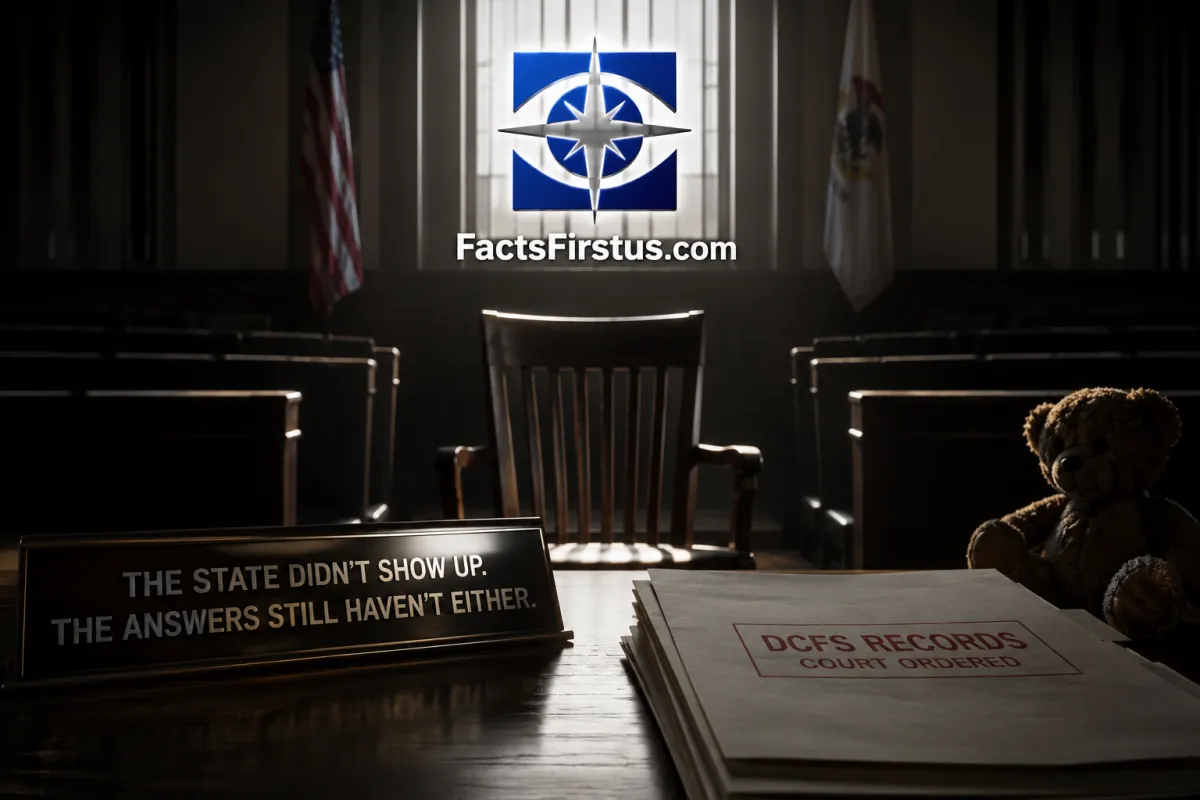
WHEN THE STATE FAILS TO SHOW UP, WHO ANSWERS FOR THE FAILURE?
THE EMPTY CHAIR IN SPRINGFIELD
Illinois government has plenty of explanations. What taxpayers should be demanding now are answers, accountability and consequences.
August 14, 2026 | Staff Writer
There was an empty chair in a Sangamon County courtroom.
Then there was another one.
That may sound like a small thing in a state government with billions of dollars in spending, thousands of employees and enough bureaucracy to fill buildings across Illinois.
It isn't.
The empty chair belonged, figuratively, to the Illinois Department of Children and Family Services, the agency entrusted with protecting some of the most vulnerable children in this state.
DCFS missed a court hearing.
Then it missed another.
The case wasn't about a parking ticket, an obscure administrative dispute or some insignificant piece of government paperwork.
It involved public records connected to Mackenzi Felmlee, an 18-year-old who died while in foster care.
And when Illinoisans ask how an agency responsible for protecting children could fail to appear in court twice in a case involving the death of a young woman in foster care, the explanation from DCFS is almost as troubling as the absences themselves.
“Unfortunately, there was significant miscommunication within the department regarding this matter.”
— Heather Tarczan, DCFS spokesperson
Read that again.
Significant miscommunication within the department.
That isn't an explanation Illinois taxpayers should simply accept.
It is a warning.
Because when the agency responsible for the safety and welfare of vulnerable children admits to “significant miscommunication” serious enough to contribute to missed court appearances, the obvious question is not merely what went wrong in the legal department.
The question is: Where else is communication breaking down?
That is the question the Pritzker administration should be answering.
Instead, Governor JB Pritzker offered reassurance.
“It’s not like they’re avoiding it.”
— Gov. JB Pritzker
Perhaps they weren't.
But think about what that defense actually leaves taxpayers with.
Either DCFS knew about the court proceedings and failed to appear, or the internal operation of a major Illinois agency was dysfunctional enough that properly served legal notices did not result in the agency showing up in court.
Neither possibility should inspire confidence.
And neither should be waved away as a mix-up.
The underlying facts make that impossible.
The records being sought concern DCFS personnel responsible for monitoring Felmlee before her death in May 2024.
After DCFS declined to release the personnel records, Capitol News Illinois sued the department under the Illinois Freedom of Information Act.
DCFS was served.
It did not respond.
The matter went before Sangamon County Judge Jack Davis II.
DCFS did not appear.
On June 10, Davis found that DCFS had “willfully and intentionally violated” the Illinois Freedom of Information Act. The judge ordered the agency to produce the records, pay costs and attorney fees, and pay a $5,000 civil penalty.
Then came another hearing on August 11.
The department was served again.
DCFS failed to appear again.
This time, the judge ordered DCFS Director Heidi Mueller and the agency to appear on September 9 and threatened daily fines if the noncompliance continues.
One missed court appearance can perhaps be explained as a mistake.
Two begins to look like a management problem.
And management is where Governor Pritzker enters this story.
The governor runs Illinois' executive branch. His administration appoints agency leadership. His administration oversees the machinery of state government. His administration has had years to confront the longstanding problems at DCFS.
No reasonable person should pretend DCFS became troubled the day JB Pritzker took office.
It didn't.
The agency's problems stretch across administrations.
But there comes a point when blaming history becomes an excuse for failing to change the present.
Pritzker has been governor since January 2019.
This is his administration.
This is his DCFS leadership.
And these failures are occurring on his watch.
A governor cannot claim ownership of an administration's accomplishments while treating its failures as somebody else's inheritance.
Leadership doesn't work that way.
Neither should accountability.
And nowhere should that accountability be more relentless than at an agency charged with protecting children.
The story of Mackenzi Felmlee explains why.
Felmlee was 18 years old when she died in a Fairview Heights foster home.
She was found struggling to breathe near the bottom of basement stairs. Doctors determined that a blood clot had traveled to her lungs. Reporting on the case described bruising on her neck, shoulders, legs and face, signs of dehydration, and a body weighing approximately 90 pounds.
Her foster mother, Shemeka Williams, and foster grandmother, Cornelia Reid, have been charged with murder in connection with her death. The charges against them are allegations unless and until proven in court.
But there is another part of this story that should stop every Illinois taxpayer cold.
According to a timeline released by DCFS, Williams reportedly told a caseworker two days before Felmlee died that the young woman was “struggling.”
That conversation reportedly wasn't documented until five days after Felmlee's death.
There was also a discrepancy over whether the contact occurred in person or by telephone.
Now put those facts next to the agency's explanation for its court failures.
“Significant miscommunication.”
Suddenly, those words don't sound bureaucratic.
They sound consequential.
This does not prove that the communication failure surrounding the court case had anything to do with the circumstances surrounding Felmlee's death. It would be irresponsible to claim otherwise.
But it absolutely justifies asking whether communication, documentation, supervision and accountability problems exist elsewhere within the system.
Illinois taxpayers shouldn't apologize for asking those questions.
They should insist on answers.
Who received the court notices?
Where were they sent?
Who was responsible for acting on them?
Why wasn't the lawsuit answered?
Why was the first hearing missed?
Why was the second hearing missed?
When did Director Mueller learn about the failures?
When did the governor's office learn?
What has changed since?
And has anyone been held accountable?
These aren't “gotcha” questions.
They are the questions competent management asks after a serious failure.
And to date, neither DCFS nor Governor Pritzker's administration has publicly answered them in any meaningful detail.
Illinois has heard that there was “significant miscommunication.” It has heard assurances that the agency intends to appear at the next hearing.
What taxpayers have not received is a clear accounting of how the breakdown happened, who was responsible for it, when senior leadership became aware of it, or what consequences, if any, followed.
That silence matters.
Because when government asks the public to accept a failure without explaining it, accountability becomes little more than a promise that things will be better next time.
And Illinois has heard promises before.
State Representative Blaine Wilhour sees the problem as part of something larger within Illinois government.
“Illinois state agencies have been plagued by a lack of transparency and accountability under the Pritzker administration, resulting in failure after failure.”
— State Rep. Blaine Wilhour
His next sentence is even more direct.
“The dysfunction cannot be allowed to continue.”
— State Rep. Blaine Wilhour
The Pritzker administration may disagree with Wilhour's assessment.
Fine.
Then prove him wrong.
Don't do it with another press conference.
Don't do it with another promise to improve communication.
Don't do it with another carefully worded statement from an agency spokesperson.
Do it with accountability.
Tell taxpayers what happened.
Identify what failed.
Explain who was responsible.
Correct it.
And tell the public what safeguards have been put in place to prevent it from happening again.
Because the public has heard the language of reform before.
Illinois' own Auditor General has repeatedly examined serious areas of DCFS operations. Follow-up reports released in 2025 dealt with the agency's handling of missing children, placement of children, investigations of abuse and neglect, and other aspects of its responsibilities.
That history matters because this isn't about one missed calendar notification.
It is about confidence in an institution.
And confidence is earned through performance.
To be clear, this is not an indictment of every DCFS employee.
There are caseworkers, investigators, supervisors and other professionals doing difficult work every day, often in circumstances most people would find overwhelming.
Those employees deserve something better too.
They deserve leadership that works.
They deserve systems that communicate.
They deserve clear procedures.
They deserve management that identifies failures before those failures become tragedies, lawsuits or headlines.
Accountability at the top protects good employees at the bottom.
And it protects taxpayers.
That brings us to the question every Illinois resident should be asking:
Why should I care?
Because you're paying for it.
The $5,000 civil penalty doesn't materialize from thin air.
Attorney fees aren't imaginary.
Litigation isn't free.
Corrective programs aren't free.
Outside contractors aren't free.
Government dysfunction has a price tag, and eventually that bill finds its way back to the public.
But money isn't even the biggest reason taxpayers should care.
Trust is.
DCFS has extraordinary authority over Illinois families and extraordinary responsibility for Illinois children.
It investigates allegations of abuse.
It makes decisions that can profoundly affect parents and children.
It oversees foster care.
It contracts with private providers.
It maintains sensitive records.
And it operates a system intended to protect children when the adults and institutions around them cannot.
With that power comes an obligation to be extraordinarily competent and extraordinarily accountable.
Not occasionally.
Not when the cameras are rolling.
Not after a judge threatens additional fines.
Every day.
There is an almost unbelievable irony unfolding alongside this controversy.
Illinois lawmakers have advanced House Bill 4242, legislation aimed at providing clearer information in certain DCFS notices and giving families better information concerning their rights and the appeals process.
In other words, Springfield itself recognizes that communication and transparency inside the child-welfare system matter.
Yet the agency now finds itself explaining missed court appearances by citing “significant miscommunication.”
You almost couldn't invent the contradiction.
Governor Pritzker says he believes the department will appear at the next hearing.
“They will show up.”
— Gov. JB Pritzker
Of course they should show up.
Showing up isn't an accomplishment.
It is the minimum expected of a state agency ordered into court.
September 9 should therefore not become a victory lap because somebody from DCFS finally walks through the courthouse doors.
The real question is what happens afterward.
Will taxpayers get an explanation?
Will the records be produced as ordered?
Will the internal failure be documented?
Will corrective action be made public?
Will anyone be accountable?
Or will Illinois get another statement, another promise, another internal review and another assurance that procedures have been improved?
That is the larger challenge facing the Pritzker administration.
After more than seven years in office, “we're working on it” becomes a harder answer to sell.
At some point, an administration has to be judged not by what it says it intends to fix, but by what actually gets fixed.
That isn't partisan.
That's management.
And Illinois taxpayers are not merely spectators to that management.
They are financing it.
They pay the salaries.
They fund the agencies.
They pay the legal bills.
They absorb the penalties.
And they are repeatedly asked to trust that the enormous machinery of state government is functioning behind doors most citizens will never walk through.
Transparency is how government earns that trust.
Accountability is how government keeps it.
Consequences are how government proves those words mean something.
The tragedy at the center of this story should make those principles impossible to ignore.
Mackenzi Felmlee was 18.
She cannot demand her records.
She cannot ask what her caseworkers knew.
She cannot ask why something was or wasn't documented.
She cannot walk into a courtroom and demand answers.
Others now have to ask those questions for her.
Journalists are asking.
A judge is asking.
Lawmakers are asking.
Illinois taxpayers should be asking too.
Because there is something deeply symbolic about that empty chair in Springfield.
It isn't simply about a missed hearing.
It represents a question hanging over an agency, an administration and ultimately the governor responsible for managing Illinois' executive branch:
When government fails, who answers for it?
For too long, Illinois has been comfortable answering that question with another investigation, another explanation or another promise.
Maybe this time taxpayers should demand something different.
An answer.
A name.
A correction.
A consequence.
And the next time Illinois government is ordered to account for itself, there shouldn't be an empty chair waiting for it.
There should be someone sitting in it, answering the questions Illinois taxpayers have every right to ask.
Sources
Capitol News Illinois, Jerry Nowicki, “DCFS: ‘Significant miscommunication’ within the agency led to missed court dates,” Aug. 13, 2026; republished by Northern Public Radio and WQAD.
Illinois Auditor General, Department of Children and Family Services Audit Reports, including DCFS performance audit follow-up reports and compliance examinations.
Illinois Auditor General, State of Illinois Single Audit for the year ended June 30, 2024, including findings and recommendations involving DCFS.
Illinois Department of Children and Family Services, official agency information, reports, statistics and Director Heidi Mueller biography.
Illinois DCFS, Freedom of Information Act: Access to DCFS Records, regarding public access to agency records and the department's stated commitments concerning transparency and accountability.
Illinois General Assembly, House Bill 4242, concerning DCFS notices and the appeals process.
Injustice Watch, reporting concerning historical DCFS oversight and accountability issues involving Illinois foster care.
State Rep. Blaine Wilhour, public statement regarding transparency, accountability and management of Illinois state agencies, as provided for this article.