
THE PRITZKER PROBLEM: EVERYONE’S LOOKING SOMEWHERE ELSE
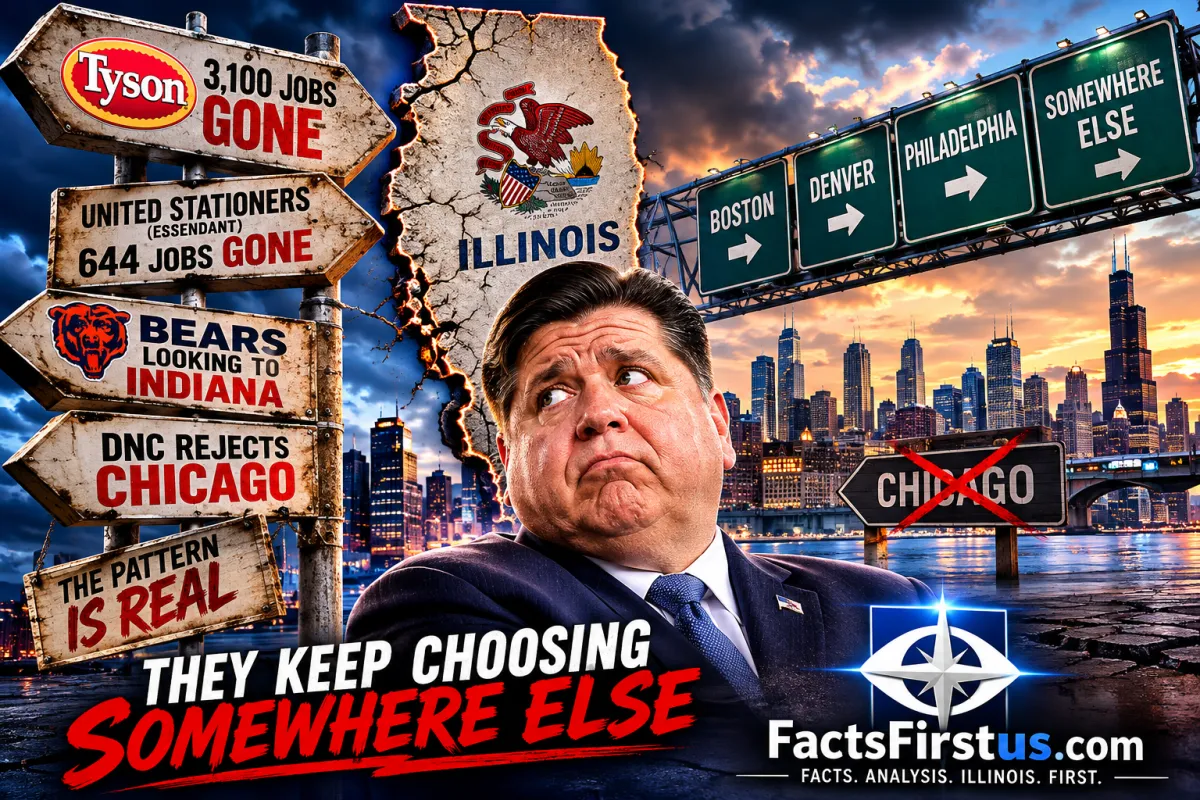
THEY KEEP CHOOSING SOMEWHERE ELSE
Thousands of jobs. The Chicago Bears. Now the Democratic National Convention. Illinois keeps getting explanations for its losses while JB Pritzker looks toward Washington.
By Staff Writer | August 20, 2026
Something is going badly wrong in Illinois.
You can argue over the reasons. You can debate who deserves the blame. You can take every plant closing, every lost job and every opportunity looking across the state line and find an explanation for each one.
But eventually, the explanations start piling up almost as quickly as the losses.
And Illinois has had one hell of a week.
Tyson Foods is closing its massive beef operation in Joslin, with Illinois and regional reporting putting the employment impact at approximately 3,100 jobs.
Essendant, the company generations of Illinoisans knew as United Stationers, is shutting down its Illinois operations, eliminating another 644 jobs.
The Chicago Bears say their stadium project's "sole focus" is now Hammond, Indiana.
And Thursday brought perhaps the most politically embarrassing headline of all.
The Democratic National Committee eliminated Chicago from consideration for its 2028 national convention.
Read that again.
The Democratic National Committee rejected Chicago.
Not Republicans.
Not Donald Trump.
Not some conservative organization looking for another reason to criticize Illinois.
Democrats.
JB Pritzker's own national party.
The same party Pritzker has championed while building himself into one of its most visible governors evaluated Chicago and decided its biggest political event in 2028 should happen somewhere else.
Boston advanced.
Denver advanced.
Philadelphia advanced.
Chicago did not.
The DNC has not publicly explained why Chicago was eliminated, and nobody should invent a reason it has not provided.
But Illinois residents are entitled to ask one.
Why?
Chicago hosted the Democratic National Convention in 2024.
The DNC knows the city.
It knows Illinois.
It knows Pritzker.
It knows exactly what Chicago can offer because Democrats held their convention here just four years earlier.
Chicago has O'Hare and Midway. It has McCormick Place. It has enormous hotel capacity, transportation infrastructure, union labor, corporate resources and decades of experience hosting major events.
The DNC evaluated Chicago again.
Then it moved on.
"Boston, Denver, and Philadelphia all presented incredibly strong bids to host the convention."
DNC Chairman Ken Martin
Chicago apparently did not present one strong enough to advance.
Maybe the DNC simply wanted a different city after 2024.
Maybe geography mattered.
Maybe fundraising mattered.
Maybe logistics mattered.
Maybe something else mattered.
We do not know.
But that unanswered question is becoming uncomfortably familiar in Illinois.
Because the DNC is hardly the only organization making a consequential decision that leaves Illinois on the losing side.
Consider Tyson Foods.
The company announced that it will end operations at its massive beef facility in Joslin, Illinois, with Illinois and regional reporting putting the employment impact at approximately 3,100 jobs.
That is an economic gut punch.
Tyson has cited a historic cattle shortage and continuing supply constraints as reasons for restructuring its beef business.
That explains why Tyson believed restructuring was necessary.
It does not answer the Illinois question.
Why Joslin?
Tyson did not eliminate its entire beef operation.
It made choices about where its remaining production would be concentrated.
Tyson said its beef production would be consolidated around remaining facilities in Lexington, Nebraska; Holcomb, Kansas; and Amarillo, Texas.
Nebraska remained.
Kansas remained.
Texas remained.
Illinois did not.
That is the question Governor Pritzker and his economic development team should be asking.
Why was Illinois on the losing side of that decision?
What made those other facilities more important to Tyson's future?
What could Illinois have done, if anything, to make Joslin more competitive?
And what did the administration do before approximately 3,100 Illinois jobs were put on the chopping block?
Those questions are not about blaming Pritzker for America's cattle shortage.
They are about something governors are absolutely supposed to care about.
When companies decide where their future will be, does Illinois win?
For thousands of workers and their families, this is not an academic discussion about economic policy.
It is a paycheck.
A mortgage.
A car payment.
Groceries.
College tuition.
A restaurant customer.
A small business customer.
A taxpayer.
When an operation this large disappears, the economic damage does not stop at the factory gate.
It spreads.
And explanations do not replace 3,100 jobs.
Then there is Essendant.
Many Illinoisans remember it by another name.
United Stationers.
Its roots in Illinois reach back generations.
Now Essendant is shutting down its Illinois operations, eliminating 644 jobs connected to Lincolnshire and Carol Stream.
That is not a company threatening to leave.
It is not a hypothetical closure.
The Illinois operations are shutting down.
Another 644 paychecks.
Another 644 workers and their families facing uncertainty.
Another piece of Illinois' business history disappearing.
Put Tyson and Essendant together and roughly 3,700 jobs are affected by just two developments.
And once again, Illinois should be asking more than what happened.
It should be asking what could have been done differently.
Then there are the Chicago Bears.
Perhaps nothing illustrates Illinois' current predicament more vividly.
One of the most recognizable brands in Chicago history is now openly concentrating its stadium effort in Hammond, Indiana.
Bears President and CEO Kevin Warren could hardly have been clearer.
"Our sole focus at this point in time is working on a world-class stadium and mixed-use development in Hammond, Indiana."
Kevin Warren, President and CEO, Chicago Bears
Hammond.
Indiana.
The Bears have not announced that they are leaving Illinois.
But Illinois should be alarmed that the conversation has reached the point where the president of the Chicago Bears can describe another state's city as the organization's "sole focus."
This is not simply about football.
A stadium and surrounding mixed-use development could represent billions of dollars of investment and decades of construction, restaurants, hotels, entertainment, tourism and economic activity.
Indiana knows what it is competing for.
The question is whether Illinois acted like it did.
And once again, the same question appears.
Why is somewhere else looking better?
Why Indiana?
Why are Illinois leaders fighting to retain something that for generations seemed inseparable from Chicago?
The Bears story, the Tyson closure and the DNC decision are obviously different.
They have different circumstances.
Different decision-makers.
Different economics.
But they share something Illinois government cannot afford to ignore.
Choice.
Tyson had choices about which operations to retain.
The Bears have choices about where to build.
The DNC had choices about where to hold its convention.
And in each of these decisions, Illinois did not get the outcome it wanted.
That is the larger issue.
States compete.
Governors compete.
Legislatures compete.
Communities compete.
Indiana wants Illinois investment.
Texas wants it.
Wisconsin wants it.
Tennessee wants it.
Every state wants employers, jobs, development and taxpayers.
Illinois is not entitled to any of them simply because they have historically been here.
It has to compete for them.
And this is where the Pritzker administration deserves serious scrutiny.
Taxes matter.
Energy costs matter.
Regulation matters.
Infrastructure matters.
Public safety matters.
Workforce quality matters.
Government efficiency matters.
The cost of doing business matters.
And perception matters.
Not every one of those factors necessarily played a role in every decision discussed here.
But together they help determine whether a state is a place where businesses, families and investors want to put their futures.
That is part of a governor's job.
And Illinois government does not get to pretend otherwise only when the outcome is bad.
When a company announces a major Illinois investment, politicians race to the microphone.
When jobs are created, press releases appear.
When a major event comes to Chicago, politicians calculate the economic impact and celebrate what it says about the state.
When Illinois wins, government officials understand perfectly well that government policy and leadership matter.
But when Illinois loses, suddenly every decision exists in isolation.
The company had problems.
The industry changed.
The franchise wanted something different.
The convention committee made its own decision.
Every loss has context.
Every victory has a politician standing beside it.
It cannot work both ways.
JB Pritzker took office in January 2019.
This is no longer someone else's Illinois.
Democrats control the governor's office.
They control the Illinois House.
They control the Illinois Senate.
They hold every statewide constitutional office.
Pritzker has enjoyed enormous political power to implement his agenda.
There is no Republican legislature preventing him from doing it.
There is no Republican governor vetoing Democratic legislation.
Illinois Democrats wanted the responsibility to govern.
Illinois voters gave it to them.
After nearly eight years, they also own the responsibility for the results.
That does not mean Pritzker personally caused every lost job or failed bid.
It means he can be judged on a much more reasonable standard.
Is Illinois more competitive because of his leadership?
That question should not be partisan.
It matters to the worker whose job disappears.
It matters to the small business that depends on those workers spending money.
It matters to the homeowner whose community depends on a healthy tax base.
It matters to parents wondering whether their children will find opportunities here.
And it matters to every Illinois taxpayer watching other states compete aggressively for businesses and investments that Illinois once assumed were ours to keep.
The frustrating part is that Illinois should be exceptionally difficult to beat.
Chicago remains one of the world's great cities.
O'Hare is one of America's most important airports.
Illinois sits at the center of the nation's rail and highway systems.
We have world-class universities, agriculture, manufacturing, finance, technology, medicine and logistics.
We have an enormous workforce and one of America's largest metropolitan economies.
Other governors would love to start with the hand Illinois has been dealt.
Illinois should be winning.
That is what makes this week so difficult for the Pritzker administration to dismiss.
And it becomes even more uncomfortable when you consider where Pritzker himself appears to be looking.
Washington.
The governor has spent years building a national political profile.
He has become one of the Democratic Party's most visible governors, inserting himself into national political battles, appearing regularly in national media and becoming a frequently discussed potential presidential candidate for 2028.
There is just one problem with all that national positioning.
So far, Democratic voters do not appear particularly interested.
A national Center Square Voters' Voice Poll conducted by Noble Predictive Insights in June put Pritzker at just 2 percent among potential Democratic presidential candidates.
Two percent.
Former Vice President Kamala Harris received 27 percent.
California Governor Gavin Newsom received 14 percent.
Pete Buttigieg received 11 percent.
Representative Alexandria Ocasio-Cortez received 8 percent.
JB Pritzker received 2 percent.
One early poll does not determine a presidential nomination years in advance. The field is unsettled and political fortunes can change dramatically.
But the number matters because of the contrast.
Pritzker is investing considerable political energy in becoming a national Democratic figure.
Yet he remains near the bottom of that prospective field in this survey.
And now the national Democratic Party has looked at Chicago and decided its 2028 convention should go somewhere else too.
That is a brutal political combination.
The governor increasingly looks like a politician thinking beyond Springfield.
That is his right.
But before America is asked to evaluate the Pritzker model, Illinois should evaluate it first.
Look at what has happened.
Tyson decided where to consolidate its beef production.
Nebraska remained.
Kansas remained.
Texas remained.
Illinois did not.
The Chicago Bears considered where to focus their stadium development.
Right now, their "sole focus" is Indiana.
The DNC considered where to hold its 2028 convention.
Boston advanced.
Denver advanced.
Philadelphia advanced.
Chicago did not.
Essendant is shutting down its Illinois operations.
And after years of building a national profile, Pritzker sits at just 2 percent in one recent national Democratic presidential poll.
Each fact has its own circumstances.
Each deserves its own context.
But taken together, they demand something more than explanations.
They demand accountability.
Because leadership is not merely the ability to explain why something was lost.
Leadership is producing enough victories that the losses become the exception.
And lately Illinois seems to be doing an awful lot of explaining.
Before selling America on his leadership, Pritzker should show Illinois the results.
Keep the jobs.
Win the investments.
Keep the Bears.
Attract the conventions.
Make employers want to expand here.
Make businesses choose Illinois when they have somewhere else to go.
Make Illinois the state other governors fear competing against.
Then sell the model to America.
Because perhaps the most uncomfortable verdict of this entire week did not come from Republicans.
It did not come from Donald Trump.
It did not come from one of Pritzker's political enemies.
It came from his own party.
Democrats know Chicago.
They held their convention here in 2024.
They know Illinois.
They know JB Pritzker.
They evaluated Chicago again for 2028.
And they chose somewhere else.
For a governor sitting at 2 percent while contemplating a much bigger political future, Illinois deserves an answer to one question before he asks America for a promotion.
Has JB Pritzker earned one here?
Sources
Democratic National Committee, official materials and statements concerning the selection process for the 2028 Democratic National Convention and the advancement of Boston, Denver and Philadelphia as finalists.
Associated Press, August 20, 2026. Reporting on the Democratic National Committee narrowing its 2028 convention field to Boston, Denver and Philadelphia and eliminating Chicago and Atlanta.
CBS News, August 20, 2026. Reporting on Chicago's elimination from the 2028 convention competition and DNC Chairman Ken Martin's statement concerning the strength of the three advancing bids.
WTTW Chicago, August 20, 2026. Illinois reporting concerning Chicago's elimination from consideration for the 2028 Democratic National Convention and the absence of a publicly stated reason for the decision.
Noble Predictive Insights and The Center Square Voters' Voice Poll, June 1-4, 2026. National polling of Democratic respondents concerning a hypothetical 2028 presidential field, in which Gov. JB Pritzker received 2 percent.
Tyson Foods, August 13, 2026. Official announcement concerning restructuring of Tyson's beef business, closure of the Joslin, Illinois, operation, continuing cattle supply constraints and consolidation of production around remaining beef facilities in Lexington, Nebraska; Holcomb, Kansas; and Amarillo, Texas.
Illinois and Quad Cities regional reporting concerning the Tyson Foods Joslin closure and an employment impact of approximately 3,100 jobs.
Illinois Worker Adjustment and Retraining Notification records and Illinois reporting concerning Essendant's shutdown of Illinois operations and the elimination of 644 jobs connected to Lincolnshire and Carol Stream.
Chicago Bears, August 13, 2026. Official team statement quoting President and CEO Kevin Warren describing Hammond, Indiana, as the organization's "sole focus" for a world-class stadium and mixed-use development.