
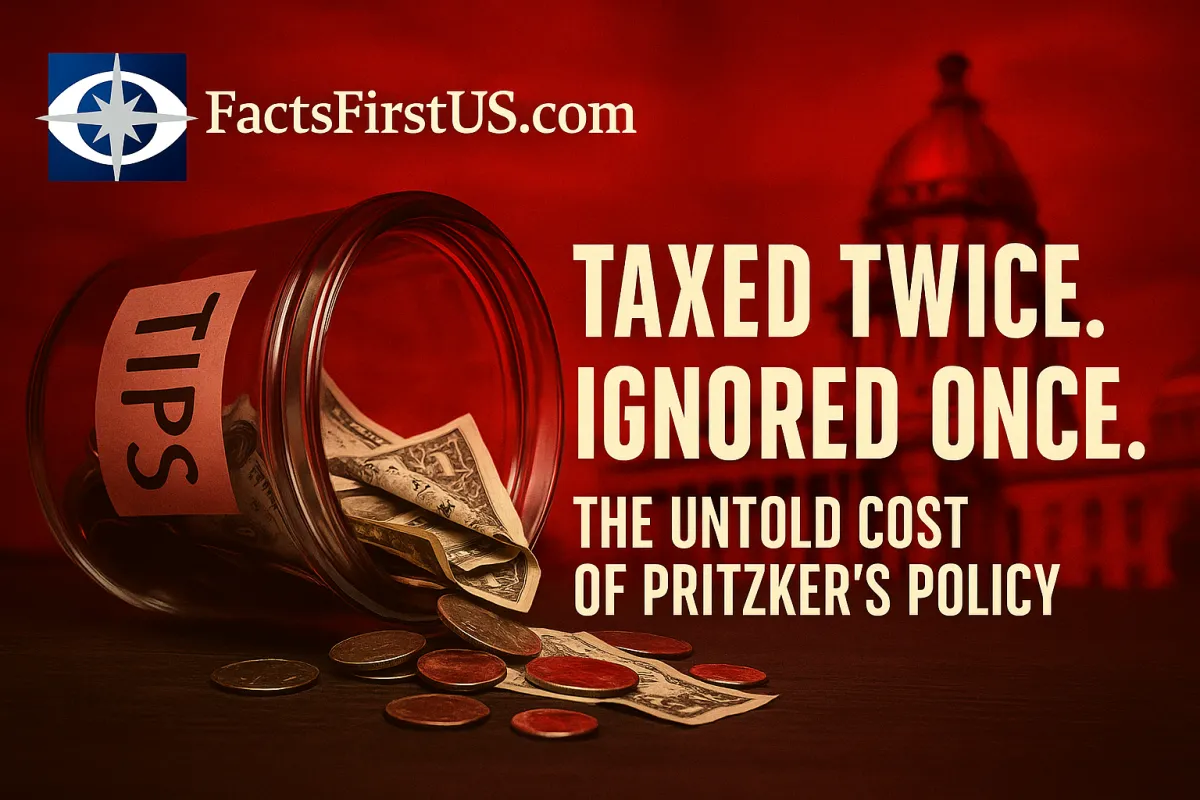
INSIDE ILLINOIS’ TIP TAX TRAP: WHY WORKERS ARE FLEEING THE STATE
**PRITZKER’S PETTY REVENGE:
How Illinois’ Tipped Workers Became Casualties in a Governor’s War Against Donald Trump**
EDITOR’S NOTE
Editor’s Note:
This report examines a sweeping tax policy decision affecting more than 300,000 tipped workers across Illinois. It is based on state revenue records, federal policy changes, public testimony, interviews with service-industry employees, and analysis from nonpartisan tax experts. Names and identifying details of workers are used with permission. Their experiences, though personal, reflect a larger and deeply troubling reality facing working-class Illinoisans.
We believe it is important to explain to readers why this Editor’s Note is necessary.
At FactsFirstUS.com, our commitment is simple: facts, transparency, and accountability, regardless of political power or party affiliation. When a sitting governor—especially one seeking a third term—enacts or preserves policies that materially harm the very people he claims to champion, it becomes our responsibility to report those consequences clearly, thoroughly, and without hesitation.
Illinois is now the only state in the Midwest still taxing tips after the federal government and every surrounding state ended the practice. That decision is not an abstraction. It is not a talking point. It is a direct hit on the income of the lowest-paid workers in the state. The people paying the price are single parents, bartenders, waitresses, delivery drivers, students working nights, retirees supplementing Social Security, and tens of thousands of Illinoisans already living one slow shift away from a missed rent payment.
As Governor J.B. Pritzker seeks a third term, his continued refusal to align Illinois with federal and regional relief measures carries real financial consequences for working families. This investigation is not about political rivalry. It is about economic harm, policy neglect, and the lived experiences of people whose voices are too often dismissed in high-level debates.
This story is necessary because facts are necessary—especially when those facts reveal that the people keeping Illinois’ service industry alive are being taxed twice on money their customers already paid them for doing exceptional work.
Our mission is to present those facts fully, fairly, and fearlessly.
This report does exactly that.
By Staff Writer
November 30, 2025
They earn every single dollar the hardest way possible—on their feet, on the clock, on the edge.
On a Friday night in Bloomington, the sports bar roars with 200 strangers who all want to be served now. And in the middle of it, Sarah glides between tables like a seamstress stitching chaos into order. She remembers the 12-top’s beers by heart, jokes with the Cubs fans, breaks up an argument between two old rivals, and does it all with a practiced smile—one that hides the snug little compression sleeve she wears under her black apron to steady a worn-out ankle, and the pain that shoots up her leg with every pivot.
Two hundred miles south in Marion, Jake the bartender works through last call. A heartbroken regular unloads his life story, the bar lights glow like a confession booth, and Jake listens, nods, wipes the counter, and pours the perfect Old Fashioned—the one the man ordered three weeks ago. He remembers. That’s how bartenders survive. That’s how customers return.
And in Rockford, where the neon of the casino never sleeps, a cocktail server threads her way through the crowded casino floor, past slot machines, cheers, and near-collisions, balancing eight heavy drinks across her forearms while dodging elbows and spilled drinks. One bad night means the rent goes late. One good night buys groceries and gas.
This—the hustle, the memorization, the empathy, the charm, the muscle and mental endurance—is the invisible economy that has held America’s service industry together for generations.
These tips aren’t charity.
They are payment—for speed, for grace, for emotional labor, for knowing your beer before you finish the sentence.
When the service worker wins, everyone wins:
The customer gets a better night out.
The business earns a repeat customer, a higher check, a five-star review.
The state gains sales-tax revenue, economic activity, and jobs.
That cycle has worked for decades.
And then, suddenly, the biggest tectonic shift in tipping policy in modern history arrived.
Donald Trump signed the One Big Beautiful Bill, and for the first time in U.S. history, tips became federally tax-free.
It was a simple idea with seismic impact:
If a customer already paid taxes on the money they tip, why should a server pay again?
Indiana saw the logic. Wisconsin nodded.
Missouri, Iowa, Kentucky—they all joined.
Every state touching Illinois said, “Yes. Let’s help the workers who rely on tips.”
Every state except one.
A Tax Kept Alive for No Reason—Except Revenge
Governor J.B. Pritzker looked at a policy that undeniably helps the poorest service workers—the bartenders, valets, stylists, servers, delivery drivers—and instead of saying yes, he said nothing.
And then he kept the tax.
Not for fiscal necessity.
Not for fairness.
Not even for ideological principle.
But because giving Donald Trump credit for something good was simply unacceptable.
Manish Bhatt, a senior policy analyst at the nonpartisan Tax Foundation, doesn’t mince words:
“Illinois remains one of the few states refusing to step up for its tipped workers. This refusal means waitstaff, bartenders, and other service workers are being taxed twice on the same money—money customers already rewarded them for outstanding service.”
Twice-taxed tips.
A punishment dressed up as policy.
A server earning $20,000 in tips now owes the state about $990—on money the IRS doesn’t even touch anymore.
That’s not theory.
That’s a week of groceries.
That’s a month of daycare.
That’s insulin.
That’s the brake repair the single mom keeps postponing.
And in border towns—from Galena to Danville—restaurant owners now report losing staff to neighboring states. A server can cross into Wisconsin or Indiana and take home $3,000 to $5,000 more a year simply because those states chose to stop punishing tipped workers.
Bhatt explains the real cruelty:
“Low-wage workers are now trapped in a compliance nightmare. If they don’t know to add those tax-free federal tips back into their state income tax, they risk penalties. If they do know, they lose money they need to survive.”
For people living on razor-thin margins, this isn’t an inconvenience.
It’s a crisis.
The Human Cost: Tears, Lost Refunds, and Fear of Audits
In Quincy, a waitress sat in her car in the parking lot—cold engine, dark lot, the kind of silence that scares you—and cried when TurboTax said she owed $687 on tips she’d already used to buy school clothes.
In Joliet, a single dad expecting a refund instead watched the screen turn red: Illinois had taken it all because the state insists on taxing income the federal government now exempts.
In Champaign, a delivery driver who makes barely enough to keep his car running now prays each spring that an audit letter never arrives.
Restaurants feel it too.
Owners describe burnout, chronic understaffing, reduced hours, and applicants demanding: “Can I work in Indiana instead?”
Illinois’ service industry is bleeding talent—not because people want to leave, but because they can’t afford to stay.
These are not political operatives.
These are not activists.
These are not people trying to send a message.
These are people trying to pay rent.
The Fix Is One Page Long
Senator Craig Wilcox drafted Senate Bill 140—a bill barely longer than a grocery receipt.
It does one thing:
Treat tips the same way the federal government does—zero state income tax.
It has passed committee.
Restaurant associations, hotel workers, lounge owners, veterans groups—they’re all begging for relief.
Pritzker’s response?
Silence.
A silence that feels less like uncertainty and more like punishment.
Bhatt says the quiet part aloud:
“Refusing to follow the federal lead on tips punishes the very workers who create the customer loyalty that keeps Illinois businesses alive.”
And new polling shows a bipartisan majority—Democrats, Republicans, and Independents alike—support tax-free tips.
But Illinois’ governor still refuses.
This Isn’t About Budget Holes. It’s About Ego.
Illinois isn’t keeping lights on with its tip tax.
Roughly $100 million a year flows in from double-taxing service workers—couch-cushion change in a state that hemorrhages billions on failed programs, sweetheart contracts, pension deals nobody can explain without an actuarial dictionary, and ever-expanding state-funded services for illegal immigrants that taxpayers never voted on.
Illinois isn’t broke.
It’s broken—broken enough to sacrifice bartenders and waitresses on the altar of political bitterness.
Because when you strip away the talking points and the quiet press shop memos and the rehearsed lines about “broad tax reform” and “comprehensive approaches,” one truth remains:
Governor J.B. Pritzker would rather watch servers go broke than let Donald Trump help a single Illinois citizen.
And until he proves otherwise, every jar of crumpled singles, every envelope of end-of-shift cash, every whispered prayer that tonight is a good night—
All of it becomes a monument to political pettiness.
A petty feud paid for not by politicians, not by billionaires, not by the people protected by lobbyists and legal teams—
But by the workers counting tips at 2 a.m., exhausted, hopeful, rolling quarters on their kitchen counter, now doubly taxed for reasons that have nothing to do with them.
They are paying the price for a billionaire governor’s grudge.
OFFICIAL SOURCES
Federal Sources
White House — Service Workers Rally Behind President Trump’s NO TAX ON TIPS (June 2025)
White House — President Trump’s One Big Beautiful Bill Is Now the Law (July 2025)
Tax Policy Analysis
Tax Foundation — No Tax on Tips and Overtime Proposals Gain Steam Across States, but Remain a Bad Idea (2025)
Illinois State Government
Illinois General Assembly — Bill Status for SB 140, 104th General Assembly (2025)
Illinois Department of Revenue — Income Tax Guidelines on Tipped Income (Publication IT-2000)