
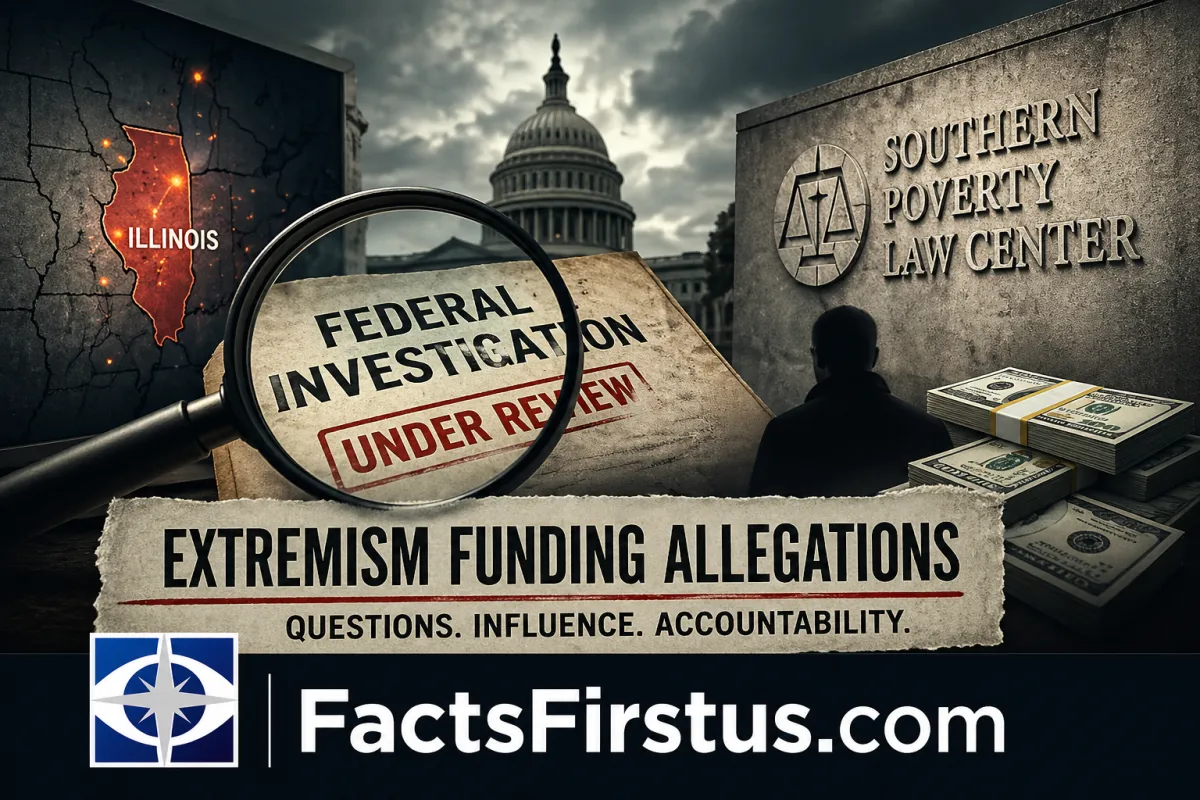
ILLINOIS AT CENTER OF EXPLOSIVE FEDERAL CASE RAISING QUESTIONS ABOUT ANTI-HATE GROUP AND EXTREMISM FUNDING
FROM ILLINOIS TO WASHINGTON: FEDS ACCUSE ANTI-HATE GROUP WITH DEEP POLITICAL TIES OF FUNDING EXTREMISTS IT FLAGGED
An explosive federal case collides with Illinois communities and a national narrative shaped at the highest levels of American politics.
By Staff Writer | April 25, 2026
NAPERVILLE, Ill. By Friday afternoon, the reaction was immediate.
Phones lit up. Messages spread. Screens filled with headlines few expected to see.
The organization that had labeled groups across Illinois as “extremist” was now under federal indictment, accused of secretly funding the very hate it claimed to fight.
Hundreds of miles away in Montgomery, Alabama, federal prosecutors were laying out a case that is now rippling into communities across the country and into the political landscape in Washington.
For decades, the Southern Poverty Law Center built its reputation on a single promise. It exposed hate. It tracked it. It warned the public about it.
Now, the federal government says it may have been financially entangled with it.
“They lied to their donors and actually turned around and paid the leaders of these very extremist groups.”
— FBI Director Kash Patel
The allegation at the center of the case is as stark as it is difficult to process.
In an 11-count indictment, prosecutors allege that between 2014 and 2023, the organization directed more than three million dollars in donor funds to individuals connected to extremist groups it publicly condemned.
Those connections, according to federal filings, include individuals tied to the Ku Klux Klan, neo-Nazi organizations, and other white supremacist networks operating in the United States.
Some of those individuals, prosecutors say, were embedded inside those movements while receiving payments. The money was allegedly routed through shell entities and concealed from donors.
The accusation is not just failure. It is reversal.
It is the kind of allegation that, if proven true, does not just challenge an organization. It rewrites everything built around it.
The very organization that built its identity on fighting groups like the Klan is now accused of financially supporting individuals connected to them.
For critics, the comparison is blunt. It is like a fire department setting a house on fire, then waiting to be called to put it out, and raising money along the way.
“The SPLC was not dismantling these groups. It was manufacturing the extremism it claims to oppose.”
— Acting Attorney General Todd Blanche
To understand the weight of the allegation, you have to understand the scale.
Over the past decade, the organization accumulated hundreds of millions of dollars in donations.
That funding came from some of the most powerful institutions and public figures in the country. Among them were George Soros’ Open Society Foundations, a far-reaching global funding network that supports progressive political and social causes and has drawn sustained criticism from opponents who argue its influence extends deeply into activist movements and public policy debates, along with major corporations and financial institutions including Apple, JPMorgan, MGM Resorts, OpenAI, and the foundation associated with actor George Clooney.
Those contributions were made with a clear belief that they were funding the fight against extremism.
Federal prosecutors now say some of that money may have flowed in the opposite direction, into networks and individuals connected to the very movements the organization claimed to expose.
In some cases, into the very ecosystem it claimed to expose.
Critics argue that some of those same networks were deeply embedded in far-left activist circles, raising questions about whether the organization was defining extremism or operating within a particular political framework.
That gap is where the story changes.
It becomes a question of trust.
The organization’s influence extended well beyond research and advocacy.
Its data and classifications were frequently cited by political leaders, particularly within Democratic circles, where warnings about rising extremism became a central theme in national messaging.
Critics have long argued that the group’s work aligned closely with the priorities of the political left, shaping how threats were defined and discussed in public life. Supporters, however, have maintained that its focus reflected documented trends in extremism.
The indictment is not the first time concerns have surfaced.
According to statements by Acting Attorney General Todd Blanche, a prior investigation into the organization during the Biden administration was shut down before reaching a conclusion.
Blanche has claimed the inquiry involved allegations that the group was paying individuals connected to staged hate incidents. Those claims have not been tested in court, but their existence raises new questions about oversight and accountability.
The story becomes even more complicated when placed alongside one of the most defining moments in modern American politics.
The 2017 Unite the Right rally in Charlottesville.
Images of torch-bearing marchers. Violence in the streets. A young woman killed.
President Joe Biden later described that moment in stark, emotional terms, saying he saw “people coming out of fields, carrying torches… their veins bulging,” and cited Charlottesville as a reason he chose to run for president.
That moment became a defining political turning point and was cited repeatedly by Democratic leaders as evidence of a growing national threat.
Organizations like the Southern Poverty Law Center helped inform that narrative. Their data and classifications shaped how the public understood extremism.
Now, the indictment introduces a detail that did not exist in that earlier telling.
According to prosecutors, one individual involved in organizing discussions and activity surrounding the Charlottesville rally was also a paid source connected to the organization.
The Justice Department does not allege that the organization orchestrated the rally.
But the overlap raises a difficult question.
It also challenges one of the most widely accepted narratives in modern political history.
If an organization helping define the threat had financial ties to individuals inside those movements, how should that moment be understood now.
That influence was not limited to national politics. It reached into communities.
In Illinois, it became part of everyday life.
At the center of that influence was the Hate Map, a widely circulated tool that labeled organizations across the country. For years, it became a reference point for journalists, institutions, and advocacy groups.
Groups in Illinois, including Moms for Liberty and Awake Illinois, found themselves listed.
Those labels did not remain abstract.
They appeared in media coverage. They were cited in school board debates. They were used to challenge speakers and organizations. They shaped how people were seen in their own communities.
“They posted incredibly inflammatory rhetoric against us as parents simply for standing up for our parental rights.”
— Shannon Adcock, Awake Illinois
The stakes of that kind of labeling have moved beyond debate.
They have entered real life.
And for some, they have carried consequences that cannot be undone.
In 2025, Turning Point USA founder Charlie Kirk was shot and killed in an attack that drew national attention and remains part of an ongoing legal case.
Months earlier, Turning Point USA had been placed under scrutiny and publicly criticized by organizations including the Southern Poverty Law Center, which tracked and categorized groups it deemed extremist.
For supporters, the timing was impossible to ignore.
They argue that labels do more than describe. They define.
They can isolate, stigmatize, and, in their view, place individuals and organizations into a category that invites hostility.
No direct link has been established between the criticism and the attack.
But the question has not gone away.
When an organization has the power to define who is considered outside the bounds of acceptable public life, what responsibility comes with that power, and what are the consequences when that line is drawn.
In Illinois, the impact is not theoretical.
The organization’s classifications influenced public perception, institutional decisions, and community relationships. Its materials were referenced not only by law enforcement but also by political figures and officials across government, where they became part of the broader debate over extremism, policy, and public messaging.
For years, its authority went largely unquestioned.
Now, that authority is under scrutiny.
“What happens when the referee is caught rigging the game.”
— CharityWatch analysis
The legal case will take time.
No individuals have been charged at this stage. Only the organization itself is named.
There will be motions, arguments, and appeals.
But outside the courtroom, another silence has taken hold.
Despite the scale of the allegations, there have been no widely reported public statements from several of the organization’s most prominent donors addressing the indictment or outlining what steps, if any, they may take if the allegations are proven true.
For decades, the story was simple.
The Southern Poverty Law Center exposed hate.
Now, federal prosecutors are presenting something very different.
An organization that defined extremism is now being accused of financial ties to individuals within it.
And as the case unfolds, one question now sits at the center of it all.
They told the country where to find hate.
Now they are being asked to explain how close they may have been to it all along.
Official Sources
U.S. Department of Justice indictment materials
Statements by Acting Attorney General Todd Blanche
Federal documentation on SPLC and DOJ coordination