
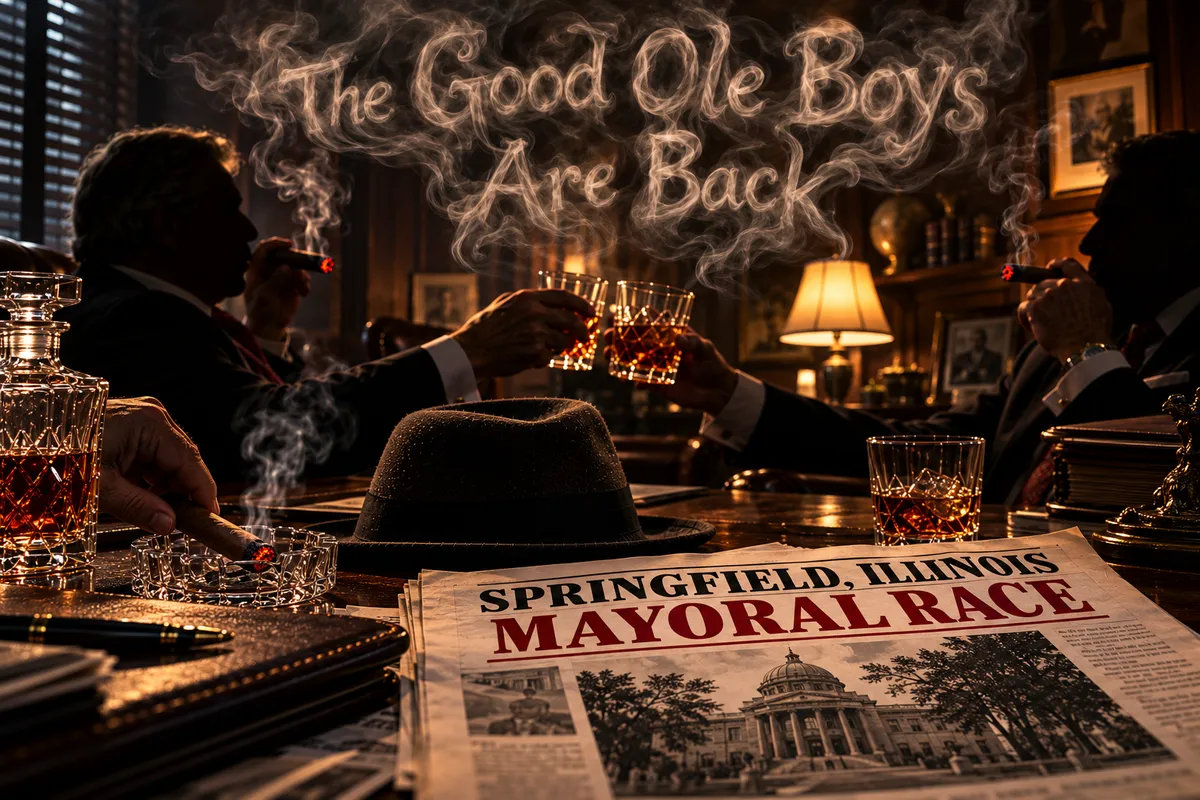
POLITICS, REVENGE AND BITTERNESS: THE LANGFELDER LEGACY AND MCCARTY’S RETURN
POLITICS, REVENGE AND BITTERNESS
An old political dynasty loses its grip on Springfield City Hall. Three years later, the former mayor recruits a familiar face to challenge the woman who defeated him. But behind the new campaign lies a federal courtroom, a costly discrimination verdict, and a former budget director whose own history is becoming part of the story.
By Staff Writer | October 27, 2026
SPRINGFIELD, Ill. — In politics, losing an election does not always mean the fight is over.
Sometimes the campaign signs disappear, the offices change hands, and the public moves on.
But the people who lost power remember.
And sometimes, years later, they find another way back into the fight.
That possibility now hangs over Springfield, Illinois, where a former mayor, a former budget director, and a federal discrimination lawsuit have become part of a developing political story in the capital city.
It began Monday afternoon, October 26, as the deadline approached for candidates to file their petitions for Springfield's April 2027 municipal election.
William “Bill” McCarty, the city's former budget director, arrived at the city clerk's office and entered the race against incumbent Mayor Misty Buscher.
He was not alone politically.
Standing behind his candidacy was a familiar name.
Jim Langfelder.
The former mayor whom Buscher defeated in 2023.
The man who once worked alongside McCarty at City Hall.
And the former mayor whose administration became the subject of a federal discrimination lawsuit that ultimately produced a substantial judgment against the City of Springfield.
McCarty acknowledged that Langfelder had recruited him to run.
That admission may turn out to be one of the most revealing statements of the early campaign.
Because this was not simply a former mayor encouraging someone to seek public office.
There was history here.
Generations of it.
The Langfelder name had been part of Springfield politics for decades. Jim's father, Ossie Langfelder, served as mayor from 1987 to 1995. Jim later held the same office from 2015 until 2023, after serving as city treasurer.
The family had built a political legacy that stretched across generations, even though its control of the mayor's office had not been continuous.
Then came April 2023.
Misty Buscher defeated Jim Langfelder, denying him another term and bringing the latest chapter of Langfelder leadership at City Hall to an end.
For a family so closely identified with Springfield government, it was a consequential political defeat.
The office was gone.
The administration was gone.
And the former mayor was left watching someone else govern the city he had once led.
Whether bitterness followed that defeat is something only Langfelder can explain.
But the political rivalry did not disappear.
Now, three years later, the man who lost City Hall has recruited a former member of his administration to challenge the woman who defeated him.
And the former budget director has accepted.
Is Springfield witnessing the beginning of a campaign for change, or the continuation of a political fight that never really ended?
The answer may require looking beyond the campaign announcements and returning to a chapter of Springfield's political history that neither man can simply erase.
It is a chapter involving City Hall, allegations of racial discrimination, sworn testimony, a federal jury, and a judgment approaching three-quarters of a million dollars before separately assessed legal expenses.
And it connects two men who are now returning to the center of Springfield politics.
McCarty presented his candidacy as an opportunity to serve the community again.
“Running for mayor would give me the opportunity to do that again.”
William McCarty, October 26, 2026
He described Springfield as a city moving in the wrong direction under Buscher and in need of a fresh start.
But when reporters asked about the city's direction, McCarty did not provide specific examples of the failures he believed justified replacing the mayor.
He did, however, identify one person who had encouraged his return to the political arena.
Langfelder.
That connection is important.
Buscher's victory in 2023 ended Langfelder's administration and McCarty's tenure as Springfield's budget director. Now, three years later, the former budget chief is challenging the woman who replaced his former boss.
There is nothing improper about a former mayor recruiting a candidate. Political alliances routinely survive electoral defeats.
But those alliances also invite scrutiny, particularly when the people involved share a government record that includes difficult questions about decisions made while they held power.
And for Langfelder and McCarty, some of those questions lead directly to a federal courtroom.
The story began years before Buscher became mayor.
In 2018, Diane Runkel, a white employee serving as Springfield's assistant purchasing agent, wanted a promotion.
The purchasing agent position was opening, and Runkel had made her interest known.
Among the people she informed was McCarty, then director of Springfield's Office of Budget and Management.
The purchasing operation fell within the department he oversaw.
But Runkel did not receive the promotion.
Langfelder selected Kassandra Wilkin, a Black employee who had previously worked under Runkel's supervision.
Runkel believed race had influenced the hiring decision.
She complained.
What followed was not simply a disappointed employee leaving City Hall.
Runkel faced disciplinary action, and a previously offered $5,000 annual raise was rescinded.
She eventually retired and filed a federal lawsuit against the City of Springfield and Langfelder personally.
The allegations were serious.
Race discrimination.
Retaliation.
A municipal government accused of violating the civil rights of one of its own employees.
The case began working its way through the federal court system, exposing internal decisions and communications that would eventually become part of a public legal record.
And McCarty's name appeared in that record.
He had known Runkel wanted the position.
He had been involved in discussions concerning the selection.
He had communicated with Runkel after the decision.
And he would eventually testify about what he knew.
The lawsuit initially appeared to have ended in the city's favor when a federal judge granted summary judgment.
But the story was not finished.
In October 2022, the Seventh Circuit Court of Appeals reversed that decision, concluding that the evidence was sufficient for a jury to consider Runkel's discrimination and retaliation claims.
The appellate court examined the city's explanations for the hiring decision and evidence concerning the role race may have played.
The case returned to federal court.
This time, it would reach a jury.
And the outcome would be very different.
In December 2023, after a four-day trial, a federal jury found the City of Springfield liable for racial discrimination and unlawful retaliation.
The jury found in favor of Langfelder personally on the separate constitutional discrimination claim brought against him.
McCarty was not a defendant, and the jury made no finding of personal liability against him.
Those distinctions matter.
But so does what the jury concluded about the city itself.
Springfield's municipal government had violated federal employment law.
The jury initially awarded Runkel $100,000 in compensatory damages.
Then came the financial consequences.
On May 21, 2024, U.S. District Judge Sue E. Myerscough amended the judgment to $745,816, including lost wages, interest, health insurance differences, pension contributions, and tax-related compensation.
Attorney fees were addressed separately.
The final amount ultimately paid by the city, including all legal expenses and any later proceedings, requires additional verification.
But the amended judgment alone was substantial.
And the case left Springfield with something more enduring than a financial obligation.
It left a public record.
A record of how a hiring decision inside City Hall became a federal civil rights dispute.
A record of how an employee's discrimination complaint was followed by disciplinary action.
And a record that includes the testimony of the man now asking Springfield voters to make him mayor.
William McCarty.
During the December 2023 trial, McCarty testified that he had told Langfelder both Runkel and Wilkin could perform the purchasing agent's job.
He said he had not formally recommended one over the other.
That testimony places McCarty within the decision-making history without establishing that he personally discriminated against Runkel or participated in unlawful retaliation.
Yet it raises a question worth examining.
What authority did Springfield's budget director actually possess over the appointment, and how was that authority exercised?
The municipal code assigned responsibilities concerning the purchasing agent's appointment to the budget director, subject to the required approvals.
The distinction between formal authority and the decision ultimately made by Langfelder deserves careful examination.
There is another detail in the court record.
In July 2021, the district court struck a supplemental affidavit submitted by McCarty from the defendants' summary judgment reply materials.
That was an evidentiary ruling, not a finding that McCarty had testified falsely.
Still, the affidavit, his deposition, and his subsequent trial testimony are documents that deserve comparison as part of a complete examination of the case.
The record establishes McCarty's involvement in the events. It does not establish personal wrongdoing by him.
But it also makes his role a legitimate subject of scrutiny as he seeks to return to City Hall in its highest office.
And now the two men are politically connected again.
One is a former mayor who lost his office.
The other is a former budget director seeking that same office.
And the woman standing between them and a return to City Hall is the mayor who defeated Langfelder.
The political history becomes more complicated when the focus returns to Monday's filing deadline.
The Langfelder name appeared elsewhere on the candidate list.
Josh Langfelder, Jim Langfelder's brother and a former Sangamon County recorder, entered the race for Springfield city clerk.
Josh Langfelder lost his 2024 reelection bid for county recorder by just 31 votes.
He has described public service as something deeply connected to his family and said he chose the clerk's race in part because it would leave more time for family.
His candidacy has its own stated purpose.
But the timing was striking.
On the final filing day, a former mayor's brother sought the clerk's office while a former mayor's political ally entered the race for mayor.
The Langfelder name and political network were once again part of the conversation about Springfield's future.
And there was another effort underway.
One that did not make it onto the ballot.
Jim Langfelder had also attempted to recruit an opponent to challenge incumbent City Treasurer Colleen Redpath Feger.
The person he was recruiting failed to file the required petitions before Monday's deadline.
The recruitment effort ended without a candidate.
Redpath Feger remained unopposed.
That outcome is notable because Redpath Feger has established a visible political presence in Springfield and has earned support among residents who value her work in the treasurer's office. Her electoral standing is reflected in her 2023 victory and the absence of a challenger in the current filing period.
And there is another family connection.
Redpath Feger is the daughter of Chuck Redpath, the longtime Ward 1 alderman who later served as Springfield city clerk.
Chuck Redpath and Jim Langfelder had political disagreements during Langfelder's administration.
Whether those disagreements influenced Langfelder's effort to recruit an opponent against Redpath Feger has not been established.
But the political history is difficult to overlook.
Langfelder recruited McCarty to challenge the mayor who defeated him.
He also attempted to recruit an opponent against the daughter of a former city official with whom he had clashed.
One recruitment produced a mayoral candidate.
The other ended when the filing deadline passed.
For a former mayor whose family's name has been associated with Springfield government for generations, the activity illustrates that his involvement in local politics did not end with his 2023 defeat.
And it adds another dimension to the contest now developing around City Hall.
McCarty's political history is not new.
He ran for Springfield mayor in 2011 and failed to advance beyond the primary.
He sought the Republican nomination for Sangamon County treasurer in 2018 and lost.
In 2023, he ran for Springfield city treasurer and finished with approximately 29 percent of the vote in a three-candidate contest.
That election was won by Redpath Feger.
Now he is trying again, this time with the public support of the former mayor under whom he served.
But McCarty's past is not limited to election results.
For approximately 12 years, he helped oversee Springfield's municipal finances.
That history makes his current criticism of Buscher's financial management especially relevant.
Earlier this year, McCarty warned that Springfield's reserves could be depleted around 2029 or 2030 if projected spending continued.
The warning attracted attention.
Yet the city's actual financial performance presented a more complicated picture.
Illinois Times reported that one recent fiscal year had projected using approximately $14 million in reserves, but the city instead added roughly $3.2 million to its surplus.
Buscher and Budget Director Ramona Metzger disputed McCarty's interpretation, pointing to conservative budget assumptions and unfilled positions.
McCarty acknowledged that projected reserve spending might not fully materialize while maintaining that the city faced longer-term financial challenges.
It is a disagreement that should be settled through audited statements, multiyear projections, and an examination of the financial commitments inherited from previous administrations.
But there is an additional layer to this dispute.
McCarty is not an outsider examining Springfield's finances for the first time.
He helped manage them.
For more than a decade, he occupied one of the most influential financial positions in city government.
He worked through multiple budgets, spending decisions, revenue projections, and long-term obligations.
Now he is warning that the city is headed toward serious financial trouble.
His warnings may deserve examination. So does his own record.
The financial conditions confronting Springfield did not begin the day Buscher took office.
Some developed over many years, across multiple administrations.
And McCarty was part of the city's financial leadership during a substantial portion of that history.
That makes his responsibility for past financial planning, and his proposed solutions for the future, central to the credibility of his campaign.
McCarty has some explaining to do.
Not simply about the city's current financial condition.
But about the decisions made during his own years in government, the role he played in the events that became a federal discrimination case, and the record he now brings back before Springfield voters.
Those are matters he can address directly.
For now, Springfield has the outline of an unusually complicated political contest.
Mayor Misty Buscher is seeking another term.
Former Alderman Gail Simpson is also running.
McCarty has entered the race with Langfelder's support.
And behind that latest political alliance is a shared history that includes a consequential federal employment case involving Springfield's municipal government.
There is a temptation in politics to treat every new election as though history begins when the petitions are filed.
But government does not work that way.
The decisions made in one administration can produce consequences years after its officials leave office.
Court judgments do not disappear with a change in mayor.
Neither do financial obligations, sworn testimony, or the public's right to ask questions.
McCarty has every right to run for mayor.
Langfelder has every right to support him.
And Springfield voters have every right to examine the record they built together.
The central mystery is not whether the former mayor wants to see Buscher defeated. His support for a challenger makes his political preference apparent.
The deeper question is what McCarty's candidacy represents.
An independent effort to address Springfield's future?
A return to the governing philosophy of the previous administration?
Or a political alliance shaped, at least in part, by unfinished disagreements from the 2023 election?
Those possibilities require evidence, not assumptions.
The federal discrimination case offers another test of accountability.
It provides documented findings against the city, while also establishing that Langfelder prevailed on the individual claim and McCarty was never a defendant.
A complete account must include all three facts.
But the questions surrounding the officials' respective roles, the city's legal expenses, and the financial consequences remain legitimate subjects for public scrutiny.
Springfield is Illinois' capital city.
It is where state government operates, where political alliances are made, and where the consequences of public decisions can linger long after the people responsible have left office.
Now, with another municipal election approaching, some familiar names are returning.
The petitions have been filed.
The campaigns are beginning.
And somewhere in the federal court records sits the history of a previous administration that has suddenly become relevant again.
Politics has brought Langfelder and McCarty back together.
The election will determine whether McCarty returns to City Hall.
But before voters make that decision, there are questions that deserve answers.
About the past.
About the money.
About the courtroom.
And about the relationship between the man who lost power and the man he recruited to challenge his successor.
In Springfield, the race for City Hall has begun. But the story behind it started years before anyone filed a petition.
Sources
Official Sources
U.S. District Court for the Central District of Illinois, Runkel v. City of Springfield and James O. Langfelder, Case No. 3:18-cv-03206, jury verdict, December 2023.
U.S. District Court for the Central District of Illinois, amended judgment order, May 21, 2024, reported judgment of $745,816.
U.S. Court of Appeals for the Seventh Circuit, Runkel v. City of Springfield, 51 F.4th 736 (2022), reversing summary judgment.
U.S. District Court for the Central District of Illinois, July 14, 2021, order addressing McCarty's supplemental affidavit.
Illinois State Board of Elections, Citizens for McCarty campaign committee records, committee ID 23186.
Secondary Sources
Capitol City Now, “McCarty, Josh Langfelder are final-day filers in Springfield,” October 27, 2026.
Illinois Times, “Bill McCarty joins Springfield mayoral race,” October 26, 2026.
State Journal-Register, coverage of McCarty and Josh Langfelder filing for municipal office, October 27, 2026.
Illinois Times, reporting on Springfield's municipal budget projections and McCarty's warnings concerning city reserves.
Illinois Times and State Journal-Register, historical coverage of McCarty's previous campaigns and the 2023 Springfield mayoral election.
FactsFirstus.com reporting information concerning Jim Langfelder's recruitment effort against City Treasurer Colleen Redpath Feger.