
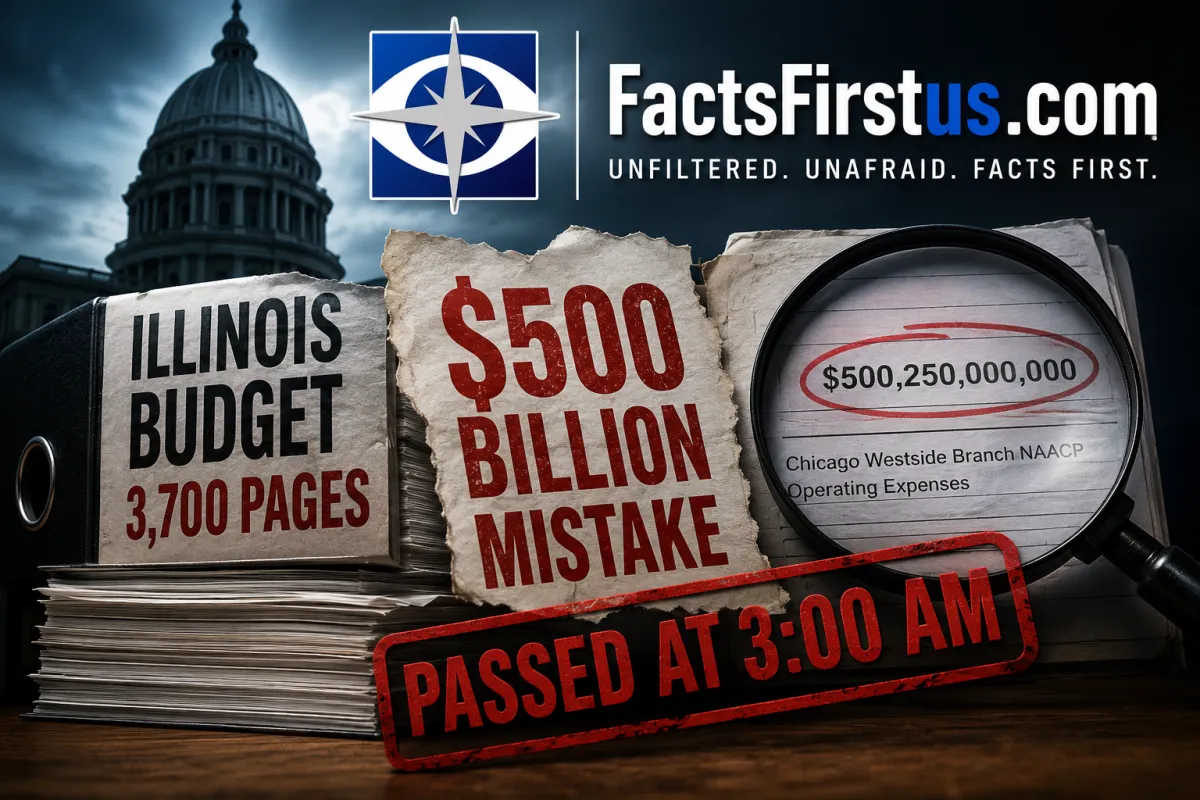
THE $500 BILLION TYPO THAT EXPOSED HOW SPRINGFIELD REALLY WORKS
NOBODY CAUGHT THE $500 BILLION MISTAKE
Illinois lawmakers approved thousands of pages in the middle of the night. Then came the budget blunder that exposed Springfield's rushed process.
By Staff Writer
June 19, 2026
SPRINGFIELD — Somewhere inside nearly 3,700 pages of budget language approved by Illinois lawmakers in the middle of the night sat a mistake so large it would have accidentally sent more than $500 billion to a single organization.
Nobody caught it before the vote.
Not lawmakers.
Not budget negotiators.
Not legislative staff.
Not the Democratic supermajority that controls state government.
The error survived the entire legislative process.
Only after the budget passed both chambers did Gov. JB Pritzker use his item and reduction veto powers to remove more than $500.4 billion in spending errors and duplicative appropriations from the fiscal year 2027 budget.
The largest mistake was almost unbelievable.
$500,250,000,000.
Half a trillion dollars.
For operating expenses.
To the Chicago Westside Branch NAACP.
Inside a state budget.
The figure was so large it would have made the Illinois budget nearly nine times larger than intended.
But the typo is not the real story.
The real story is how it got there.
"A half trillion-dollar mistake is not simply a typo. It is evidence of a system that moved too fast for lawmakers to do their jobs."
The Illinois Senate approved the spending plan shortly after 3 a.m. on June 1.
The House followed roughly an hour later.
Most Illinois residents were asleep.
Lawmakers were still voting.
Thousands of pages sat before them.
Major portions of the final budget language had been filed only hours earlier.
Republican lawmakers said they were given far too little time to review the massive spending plan before being asked to vote on it.
Then came the number.
Budget records show the appropriation did not begin as a half trillion-dollar line item.
In an earlier version, the grant appeared as $500,000.
A later amendment appears to have attempted to reduce the amount to $250,000.
But the old digits were not fully removed.
The result was $500,250,000,000.
The mistake did not appear in the original budget.
It appeared later.
During the final chaotic hours before lawmakers were asked to vote.
That is when things started to unravel.
The error survived multiple revisions.
It survived legislative drafting.
It survived budget negotiations.
It survived the House.
It survived the Senate.
It landed on the governor's desk.
"The troubling question is not who eventually found the error. The troubling question is how a $500 billion mistake survived the legislative process in the first place."
Imagine signing a mortgage agreement without reading it.
Imagine buying a business without reviewing the books.
Imagine approving a family budget without knowing what it was inside.
Yet Illinois lawmakers were asked to vote on nearly 3,700 pages of spending language after receiving major portions of it only hours before final passage.
That is the issue now confronting Springfield.
Not just the typo.
The process.
For years, critics have accused Illinois Democratic leaders of assembling major budget bills behind closed doors, releasing final language late, and pushing votes through with little time for public review or meaningful debate.
This year's budget has given those critics a half trillion-dollar exhibit.
Democrats control the governor's office, the Illinois House, and the Illinois Senate.
Republicans have long argued that the supermajority structure gives the minority party little ability to slow down major legislation, demand fuller review, or force deeper debate.
The budget error has turned that complaint into a statewide question.
If lawmakers did not have time to read the budget, how could they know what they were voting on?
"When 3,700 pages are dropped on legislators in the final hours before a vote, oversight becomes impossible and accountability disappears."
The $500.25 billion mistake was not the only error.
Pritzker's veto message identified numerous spending lines that contained errors or duplicated appropriations already included elsewhere in the budget.
Dozens of items were eliminated or reduced after the General Assembly had already passed the spending plan.
The corrected items included grants, operating expenses, youth employment programs, education spending, administrative costs, and other appropriations spread throughout the budget.
Some were reduced.
Others were removed entirely.
The scope of the corrections raised a troubling possibility.
The half trillion dollar mistake may have been the most obvious error.
It may not have been the only meaningful one.
What If Nobody Had Caught It?
The most unsettling question may be the simplest.
What if nobody noticed?
What if the mistake had remained buried inside nearly 3,700 pages of legislation?
What if the error had taken effect before anyone realized what had happened?
And what else might be hiding in bills lawmakers never had time to fully review?
Illinois taxpayers have reason to ask.
The state already faces serious long term fiscal challenges, including one of the nation's largest unfunded pension liabilities, high property tax burdens, concerns about business competitiveness, and years of population loss.
Those pressures should make careful budget review more important, not less.
Families are expected to live within their means.
Small businesses are expected to check every line before signing a contract.
Local governments are expected to scrutinize spending before approving projects.
But in Springfield, one of the most important bills of the year moved through the legislature in the early morning hours after major language changes were filed in the final stretch.
That is how mistakes happen.
That is how accountability slips.
And that is how taxpayers lose trust.
Pritzker's vetoes corrected the spending errors before the budget took effect.
But the corrections do not erase the larger issue.
The budget passed.
The mistakes made it through.
The process worked only after it failed.
The $500 billion blunder is now gone from the budget.
The rushed system that produced it remains.
Unless Springfield changes how it does business, critics warn the next mistake may not be discovered before taxpayers pay the price.
Official Sources
Illinois Governor JB Pritzker Item and Reduction Veto Message to the Illinois General Assembly, June 2026.
Illinois House Bill 111 and Fiscal Year 2027 Illinois Budget Documents.
Illinois General Assembly budget amendments filed May 30 through June 1, 2026.
Capitol News Illinois reporting by Ben Szalinski, June 18, 2026.
Illinois Constitution, Article IV, Section 9, Governor's Item and Reduction Veto Authority.