
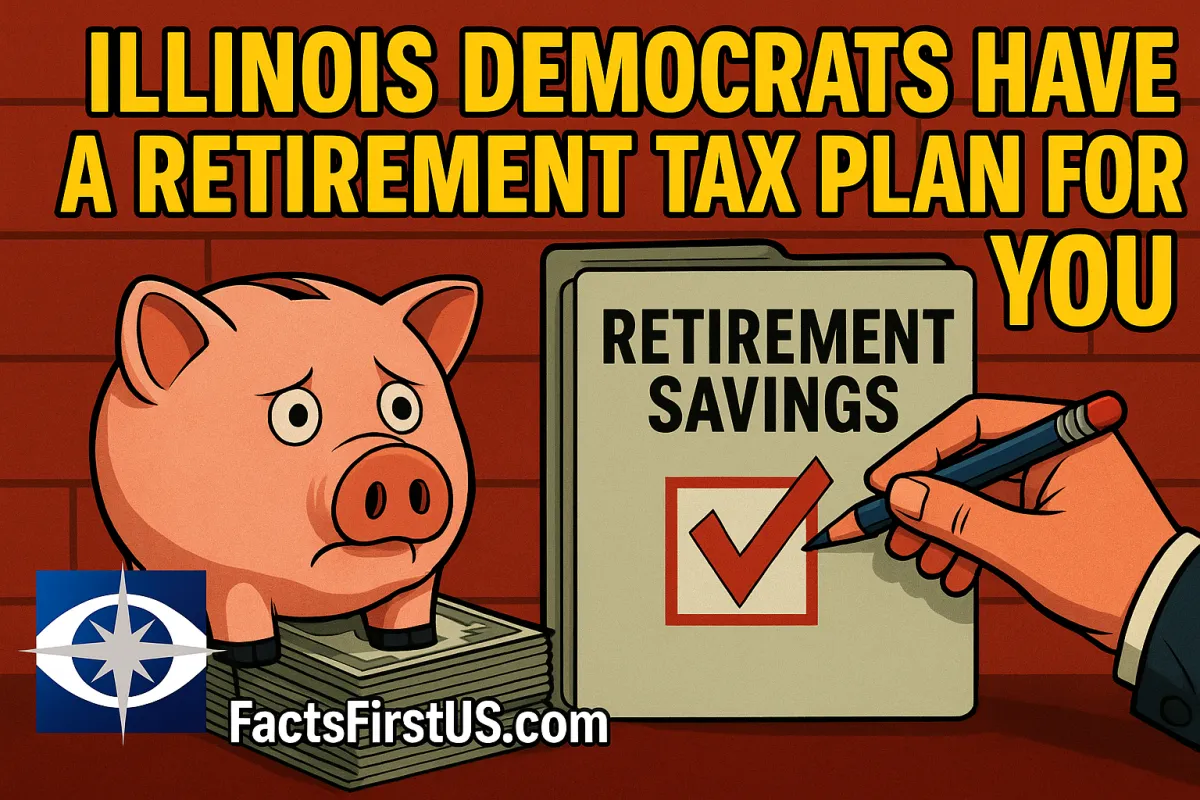
THE BILLIONAIRE GOVERNOR’S PLAN TO DRAIN YOUR LIFE SAVINGS
THE GREAT ILLINOIS TAX AMBUSH
A Billionaire Governor, a Broken Promise, and the State That Keeps Moving the Goalposts on Its Own People
By Staff Writer — November 22, 2025
Imagine spending forty years grinding through double shifts, missing holidays, and scraping together a lifetime of careful savings — not to get rich, but simply to buy peace. A little security. A few quiet years where the rules finally stop changing and you get to breathe.
Now imagine this: just as you approach the finish line, Illinois lawmakers quietly move it.
And the moment you step across, they’re waiting with a ledger.
Not because the state is collapsing.
Not because a crisis forced their hand.
But because your nest egg has become the most tempting untapped revenue stream left in a state that spends faster than it earns.
This is Illinois in 2025: a place where the progressive tax scheme voters crushed five years ago has been resurrected, repackaged, and dressed in softer language — but the target is the same.
Your retirement.
And this time, the push has the full weight of Governor J.B. Pritzker behind it.
A billionaire heir who will never live under the tax system he’s trying to impose on you.
The Branding Machine: How Lawmakers Sell Tax Hikes as “Compassion”
Illinois Democrats have perfected a tactic: hide tax hikes behind comforting, therapeutic names.
“Fair Tax” — the 2020 proposal critics warned would open the door to taxing retirement income.
“Safe Roads Act” — which ushered in one of the highest gas tax burdens in the nation.
“Living Wage Enhancement Act” — which raised employer mandates and consumer prices.
“Community Investment Fee” — property-adjacent taxes wrapped in feel-good messaging.
“Millionaire’s Adjustment Bracket” — a term designed to obscure a soon-to-be middle-class rate.
It’s political packaging:
Make it sound noble. Make it sound protective. Count on voters not reading the fine print.
The revived progressive tax proposal follows the same script, now branded a “justice-based modernization.”
But the mechanics are unchanged.
Remove the flat tax, and every stream of income — including retirement — becomes fair game.
The Quiet Mechanism: How a Progressive Tax Opens the Door to Taxing Retirement Income
The bill doesn’t say “retirement tax” anywhere.
It doesn’t have to.
Illinois’ current flat income tax prevents lawmakers from applying different tax treatment to different types of income. Once that barrier falls:
401(k) withdrawals
IRA distributions
Pensions
Social Security
become taxable with the stroke of a legislative pen.
This isn’t speculation — it’s precedent.
All 32 states with progressive income taxes also tax retirement income in some form.
Pull Quote:
“Illinois voters soundly rejected a progressive state income tax because it was a path to tax retirees.”
— Illinois Policy Institute, 2025
In 2020, State Treasurer Michael Frerichs admitted it openly:
taxing retirement income “becomes possible” under a progressive system.
That wasn’t a gaffe.
It was an admission.
A progressive tax is the legal doorway.
Retirement income is what walks through it.
Enter Pritzker: A Billionaire Governor Pushing Taxes He’ll Never Personally Feel
Gov. J.B. Pritzker — Hyatt hotel fortune heir — has presided over:
50 tax and fee hikes since 2019
Record-high revenues ($54 billion)
Record-high spending levels
A 35% jump in state intake despite stagnant economic growth
He championed the “Fair Tax” in 2020.
Now he’s championing its revival.
Not because experts demand it — many warn the opposite — but because Illinois’ spending model depends on constantly expanding revenue sources.
Yet Pritzker’s personal wealth remains insulated behind trusts and structures designed to minimize exposure.
His assets won’t be touched.
Your assets will.
Pull Quote:
“Illinois has the highest combined state and local tax burden in the nation.”
— Tax Foundation, 2025
It’s difficult to ignore the contrast:
A billionaire governor who will never outlive his money, pushing policies that will keep retirees from outliving theirs.
Who Pays First? The People Who Played by the Rules
Consider a very real, very common scenario:
A retired Illinois public school worker with a modest IRA.
A former machinist with a rental home.
A retired nurse with $300,000 saved over 40 years.
Under a progressive model similar to surrounding states:
They could face 5–7% state tax on withdrawals.
A retiree pulling $100,000 annually from savings could owe $5,000–$7,000 in state taxes alone.
Over a 20-year retirement, that’s $120,000–$140,000 lost.
That’s not theory — that’s what retirees pay just across the border in Minnesota.
And Illinois already resembles high-tax states far more than its Midwestern neighbors.
Pull Quote:
“Since 2020, Illinois has lost more residents than any state in the Midwest.”
— U.S. Census Bureau, 2025
Taxes aren’t an abstraction.
They’re an exit sign.
The Spiral: How High-Tax States Decline — and How Illinois Fits the Pattern
Economists track the same sequence in states that adopt progressive taxes:
Stage 1: Progressive tax introduced
Stage 2: Retirement income added to the tax base
Stage 3: Wealth taxes or unrealized gain taxes introduced
Stage 4: Outmigration accelerates
Stage 5: Shrinking tax base → more tax hikes
Stage 6: Declining services, rising debt, deteriorating competitiveness
Illinois is already in Stages 3–4.
Lawmakers have openly floated a Market-to-Market Tax — taxing unrealized gains — one of the most aggressive forms of wealth taxation proposed anywhere in the country.
Sold as a billionaire tax.
But it establishes a precedent for taxing assets based on theoretical value — a mechanism that inevitably extends downward.
Every state that implemented similar structures expanded them within five years.
Every one.
Illinois is not the exception.
It is the textbook.
What This Means in Plain English
If Illinois taxes retirement income the way progressive-tax states already do:
A middle-income retiree could lose 6–12% of their withdrawals annually.
A $500,000 nest egg could shrink by $120,000–$240,000 over a retirement.
Seniors on fixed incomes could face yearly surprises based on bracket shifts.
Social Security — currently untaxed — could become taxable during fiscal emergencies.
This is the reality in other progressive-tax states.
So when Illinois lawmakers say, “We would never tax retirement,” what they really mean is:
“We won’t do it today.”
Once the structure is in place, the money always follows.
A Closing Thought — What Illinois Is Choosing to Become
Retirement is supposed to be the one part of life where the rules stay put.
Where the state steps back, and the years you already paid into the system come back to you in the form of stability.
But in Illinois, the rules change the moment you get close enough to benefit from them.
A billionaire governor who insulates his wealth behind trusts insists ordinary people must “contribute more.”
The lawmakers who overspent for years now eye the savings of people who lived within their means.
And the future that retirees planned for is treated as an available balance on a government ledger.
A state reveals its character not by how it treats the wealthy, but by how it treats the people who built their lives within its borders.
And right now, Illinois is telling its retirees something unmistakable:
Your lifetime of sacrifice is not a legacy.
It is a liability.
And the state sees it not as something to honor —
but something to harvest.
Sources
Illinois Policy Institute — “Illinois lawmakers again push disguised ‘retirement tax’” (Nov. 21, 2025).
Tax Foundation — Illinois Tax Data Explorer (2025).
U.S. Census Bureau via Capitol News Illinois — “Illinois continues to lose population” (2025).
Illinois General Assembly — Senate Resolution 114 (2025–2026).
Edelman Financial Engines — “How Illinois Taxes Social Security and Retirement Income” (Oct. 27, 2025).