
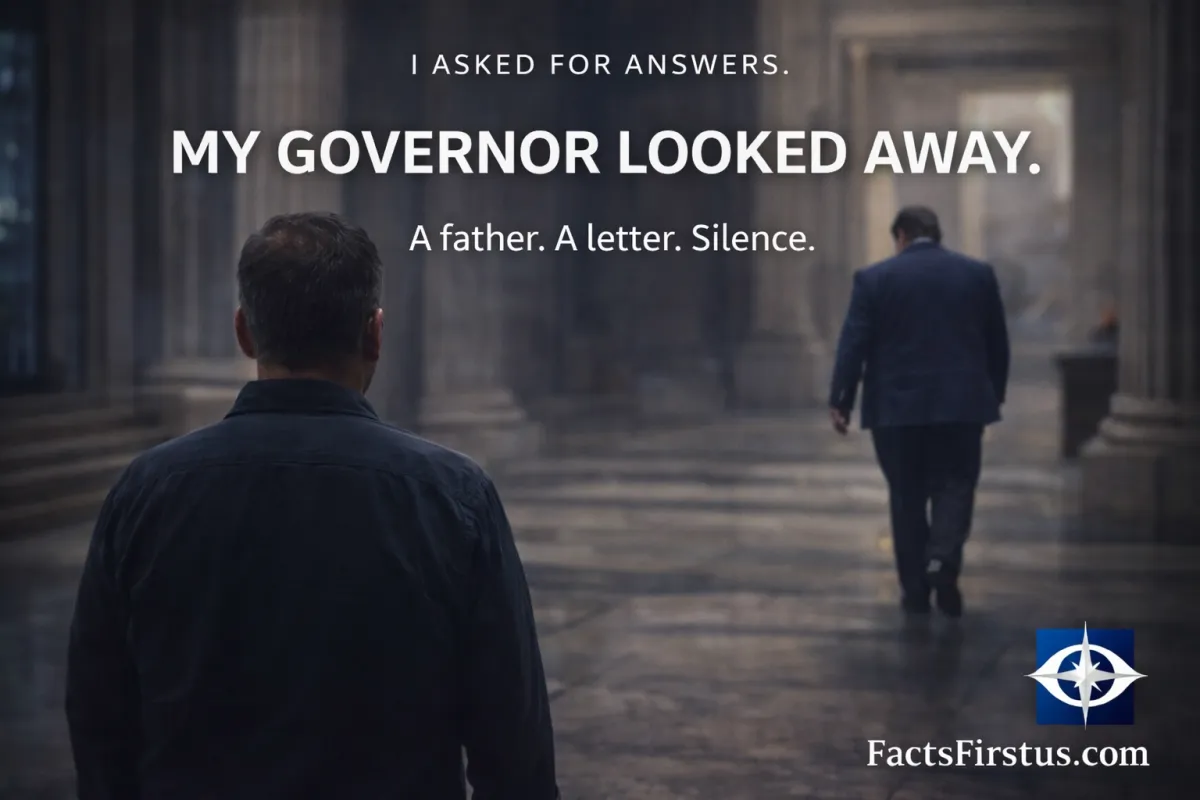
I BURIED MY DAUGHTER. MY GOVERNOR IGNORED ME.
“I Did Everything Right. My Daughter Still Died.”
When a father’s unanswered letter exposes the cost of political silence.
By Staff Writer
February 16, 2026
“I upheld my side of the social contract. I did everything right. The State of Illinois did not.”
— Joe Abraham
On the morning of January 19, 2026, Joe Abraham woke up already knowing the phone would not ring.
Still, he checked it. He checked again. The house was quiet in the way only grief can make it quiet—heavy, unmoving, filled with the memory of everything that had already been lost. Ten days earlier, Joe had sent a letter to Illinois Governor JB Pritzker. He had chosen his words carefully. Eleven questions. No accusations. No slogans. No anger spilling onto the page. Just facts, timelines, and a father asking how the system that promised to protect his family had instead buried his daughter.
He asked the governor to respond by January 19. The date was not symbolic. It was unbearable. One year earlier, to the day, Joe’s youngest child, Katie Abraham, had been killed.
The deadline passed. The phone stayed silent.
Grief does not arrive as a single moment. It stretches. It lingers. It resurfaces when you least expect it. Joe says the past year has been measured not in months, but in absences—each one cutting deeper than the last. Katie’s 21st birthday. Family birthdays. Thanksgiving. Christmas. New Year’s. Every “first” without her reopening the wound, reminding him that the future he imagined for his daughter no longer exists.
“I would give anything,” Joe has said. “Anything. The rest of my days. For one more hour with her.”
Katie Abraham was 20 years old on January 19, 2025. She was riding with friends in Urbana, Illinois, stopped at a red light in front of a hospital in the early morning hours. The world was still. Ordinary. Safe.
Then a car slammed into them from behind at nearly 80 miles per hour.
The driver was drunk. He never slowed. He never stayed. He fled the scene.
First responders had to tear open the Honda Civic to reach Katie. Joe would later describe it as being ripped apart “like a tuna can.” She died at the scene. Another young woman, Chloe Polzin, died the following day. Three others were injured. Five lives were shattered in seconds.
The man who killed them, Julio Cucul-Bol, was in the United States illegally.
Joe knows how that sentence lands. He knows some readers will recoil, others will brace, some will stop reading altogether. He insists that reaction is part of the tragedy. His questions, he says, were never about ideology. They were about responsibility. About whether a government can absolve itself of blame by isolating one reckless act while ignoring the long chain of failures that made it possible.
What Joe learned in the months that followed only deepened that question.
Cucul-Bol was a Guatemalan national using a Mexican alias—Juan Jahaziel Saenz-Suarez. Federal authorities were aware of the identity fraud. He had previously been deported and made his way back into Illinois. He possessed an Illinois driver’s license despite being unable to read or write in any language. His primary language was K’iche’, an Indigenous Mayan language not mutually intelligible with Spanish. He did not speak English. He had no formal education. He had prior encounters with law enforcement. He had been cited for violations, failed to appear in court, and continued driving anyway.
No meaningful intervention came.
In federal court testimony later that year, it was stated that Cucul-Bol was receiving treatment through the Illinois Department of Corrections for HIV, an incurable communicable disease.
Each fact landed like another blow. Each one raised a question Joe could not silence.
How does someone who cannot read pass a written driver’s exam?
What safeguards existed to verify his identity?
Why did repeated warning signs trigger no escalation?
What screening—medical, linguistic, educational—was in place before he was released into Illinois communities?
Joe Abraham is the son of immigrants. He does not oppose immigration. He opposes chaos disguised as compassion, policies without guardrails, and a government that welcomes responsibility until the consequences arrive.
“Drunkenness cannot be separated from presence,” he says. “If he wasn’t here, my daughter would still be alive.”
Governor JB Pritzker has described Katie’s death as a drunk-driving tragedy and has said immigration enforcement is the responsibility of the federal government. Joe does not dispute the role of alcohol. He disputes the attempt to end the story there. He believes policy decisions matter precisely because they determine who is present—and whether preventable failures are allowed to compound until tragedy becomes inevitable.
Joe remembers sitting in a congressional hearing room in 2025, only a few feet from Governor Pritzker, listening as sanctuary-state governors testified. The governor knew who he was. He knew why Joe was there. There were photographs. Staff had been informed.
“He didn’t give me two seconds,” Joe said. “Didn’t even look in our direction. Father to father, I expected him to care.”
Later, Joe turned to his wife.
“I looked at her and said, ‘Oh. I get it now. Governor JB Pritzker doesn’t want anything to do with us.’”
It wasn’t anger in that moment. It was recognition.
And recognition can be colder than rage.
The Department of Homeland Security later launched Operation Midway Blitz in Katie’s honor. President Donald Trump invited the family to the White House, looked Joe in the eye, and held up Katie’s photograph.
Joe noticed the contrast—not as a political statement, but as a human one.
Cucul-Bol eventually pleaded guilty and received a 30-year prison sentence for killing two young women and injuring three others. Some called it justice.
Joe did the math.
“When you divide that sentence among five shattered lives,” he said, “Katie’s life is worth about ten years.”
Because Illinois is a sanctuary state, he worries even that sentence may not be fully served.
Katie was not a statistic. She was vibrant, funny, quick-witted, athletic, deeply loved. She had a way of making people feel seen. She was planning a life that ended at a red light because a system failed to stop a man who should never have been there, driving a car he should never have been licensed to operate.
Joe’s letter to the governor reads less like an accusation than a ledger—an accounting of where responsibility failed and who chose not to answer. “This was not an abstract policy failure,” he wrote. “It was catastrophic, permanent, and preventable.”
He asked why no one from the state had reached out. Why his daughter’s life merited no acknowledgment. Why silence had become the official response.
The anniversary passed.
No call came.
No letter arrived.
Silence, Joe has learned, is not neutral. It is a choice.
And it tells grieving families exactly where they stand.
“My daughter’s death was not inevitable,” Joe Abraham says. “It was the foreseeable result of ignored warnings and abandoned safeguards. The State of Illinois owes us answers. Anything less is an abdication of duty.”