
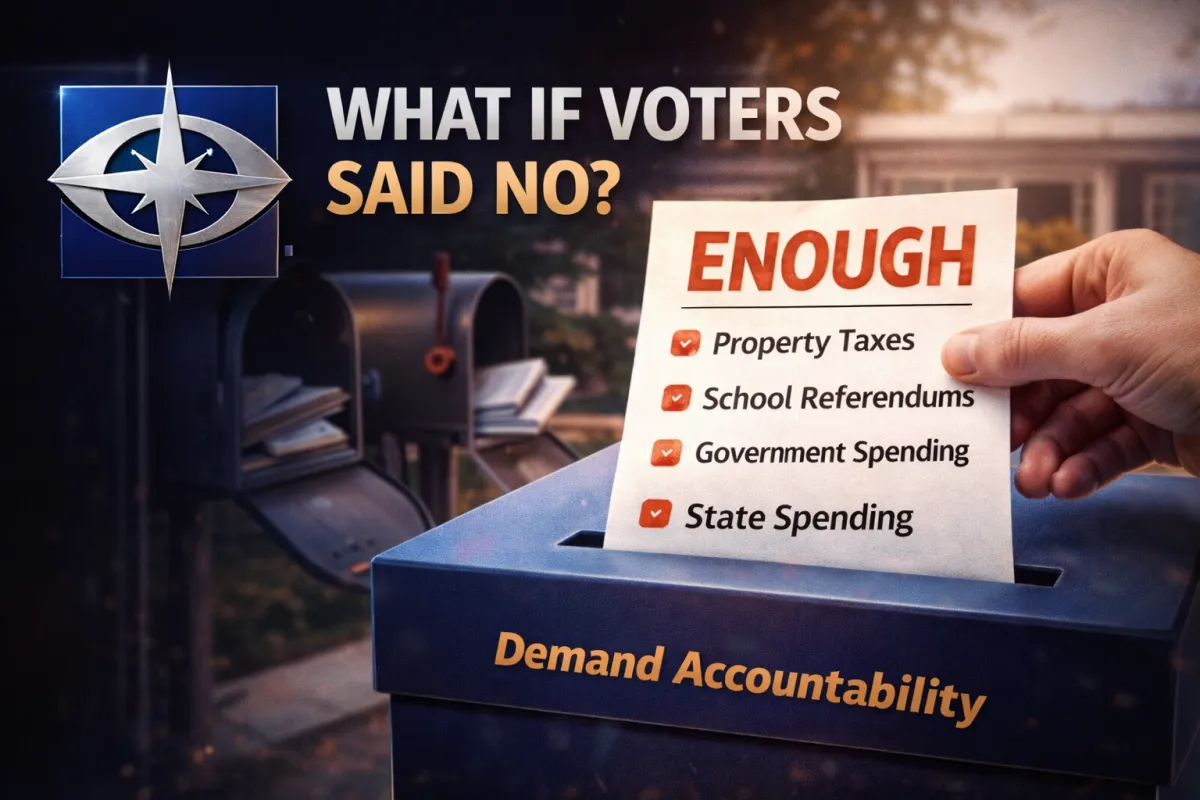
ENOUGH: Illinois Voters Are Paying More, Getting Less, and the Bill Could Soon Double
THE MAILBOX. THE BALLOT BOX. THE PENSION WARNING
Property taxes climbing. School districts asking for more. A pension system carrying more than $143 billion in debt. Across Illinois, voters are confronting a difficult question. Are taxpayers paying more each year while receiving less in return?
By Staff Writer
March 14, 2026
The envelope arrives like any other piece of mail.
It sits in the mailbox between grocery coupons and a utility bill until the homeowner opens it later that evening at the kitchen table.
Inside is the property tax statement.
The number is higher than last year. Significantly higher.
Mark Jensen, a homeowner outside Springfield, studies the bill for several seconds before speaking.
“I knew it would go up,” he says quietly. “But not like this.”
Across Illinois, scenes like this have become increasingly common. Property taxes in the state rank among the highest in the nation, and for many families the annual bill has become one of the largest financial obligations they face.
For many Illinois voters, the frustration is no longer just about higher taxes. It is about paying more each year while feeling like they are getting less in return.
Roads still need repair. Local governments still face financial pressure. School districts continue returning to voters asking for more funding through referendums.
Now some policy analysts warn that proposals under discussion in Springfield could eventually push property taxes even higher. In some situations the increases could approach 100%, effectively doubling what homeowners pay.
The tax bill in the envelope is not the result of a single decision.
It is the accumulation of years of decisions made in Springfield.
A few days later another moment arrives.
Inside a polling place in Sangamon County, a voter steps into the booth and reads the final question on the ballot. It asks residents to approve another school tax referendum seeking millions of dollars in additional borrowing for the local district.
The voter hesitates.
She believes strongly in public education. Her children attend the district.
But she also knows where the money ultimately comes from.
The same property tax bill waiting in the mailbox.
The third moment arrives quietly.
Linda Alvarez, a retired elementary school teacher, reads a newspaper article about Illinois’ pension system while drinking coffee one morning. She spent three decades teaching and now relies on the pension she earned.
“I trust the promise,” she says. “But the numbers worry you.”
Illinois carries one of the largest unfunded pension burdens in the United States. Reports cited by the Illinois Policy Institute estimate the liability at more than $143 billion.
That equals roughly $11,000 for every man, woman, and child living in Illinois.
These pressures did not appear overnight. They developed over years as spending grew, reforms were delayed, and difficult financial decisions were pushed further into the future.
Three moments.
The mailbox.
The ballot box.
The pension warning.
Individually they seem unrelated.
Together they reveal a deeper concern shared by many Illinois residents.
How did the state reach a point where so many financial warning lights are flashing at the same time?
Those concerns are now colliding with one of the most controversial proposals currently being debated in Springfield.
Lawmakers are considering legislation tied to the future of the Chicago Bears and a potential stadium development.
The team, like any major private organization, is negotiating aggressively to secure the most favorable financial arrangement possible.
The controversy centers on how Illinois might respond.
Several legislative proposals would allow certain large developments to receive long term property tax assessment adjustments. Critics say the structure could dramatically reduce the taxes paid by the project itself while local governments continue calculating levies based on the full value of the development.
The difference would not disappear.
It would shift.
To other taxpayers.
Economists say the math can be stark. If roughly one third of a district’s assessed value is removed from the tax base through such adjustments, the remaining taxpayers could see property taxes rise by nearly fifty percent.
If half of the tax base is effectively removed, property taxes for homeowners and businesses could increase by as much as 100%.
In practical terms, the bill arriving in the mailbox could double.
“This is not really about football,” said one policy analyst familiar with the issue. “It is about how the cost of large projects gets redistributed.”
Illinois’ broader financial picture provides additional context.
Governor J. B. Pritzker recently proposed a state budget totaling $56 billion, the largest in Illinois history.
According to the Illinois Policy Institute, six of the seven budgets enacted during his administration ultimately exceeded the governor’s original proposal.
The average increase was nearly $939 million.
Illinois has also been governed for years by a Democratic supermajority in the General Assembly.
Supporters of current leadership argue that increased spending reflects necessary investments in education, healthcare, and infrastructure.
Critics argue that the approach has allowed structural financial problems to grow while delaying reforms that could reduce long term pressure on taxpayers.
Those debates now unfold against the backdrop of Illinois’ pension obligations.
The state’s pension systems remain less than fifty percent funded and consume roughly one fifth of the annual state budget.
“Those payments cannot simply disappear,” said one fiscal analyst. “They must be made.”
Education funding has become one of the clearest examples of the tension between rising costs and uncertain results.
Illinois public schools receive roughly $23,000 per student when federal, state, and local funding are combined.
Yet performance outcomes remain uneven.
State report card data shows slightly more than half of Illinois students meet reading benchmarks. Fewer than four in ten demonstrate proficiency in mathematics.
Despite those results, school districts across Illinois continue asking voters to approve new revenue through property tax referendums.
The Ball Chatham School District is currently seeking approximately $110 million in bonds for facility upgrades.
District officials say the improvements are necessary to maintain buildings and support students.
But some voters say the question is no longer simply whether schools deserve investment.
The question is whether taxpayers are seeing results that match the growing cost.
“We support our schools,” said local voter David Ramirez. “But when taxes keep going up and performance stays the same, people start asking whether the system is working.”
Population trends add another layer to the issue.
Illinois has experienced years of population decline. Since 2000 the state has lost roughly 1.6 million residents as families move to other states.
Many cite housing costs, taxes, and economic opportunity elsewhere.
As the population shrinks, the tax base supporting government services also shrinks.
At the same time long term financial obligations remain.
Higher costs and fewer taxpayers.
Another area of debate involves spending on migrant services.
Reports cited by the Illinois Policy Institute estimate Illinois could spend more than $2.5 billion on healthcare, housing, and related assistance by the end of 2025.
Supporters argue the spending reflects humanitarian commitments.
Critics say it illustrates the challenge Illinois faces balancing urgent priorities with long term fiscal stability.
Regardless of perspective, the spending adds another layer of pressure to an already complex financial landscape.
Illinois by the Numbers
State budget: $56 billion
Unfunded pension debt: $143 billion
Estimated pension debt per resident: $11,000
School spending per student: about $23,000
Potential property tax increase from stadium tax shift: up to 100%
Taken together, these issues explain why the Bears stadium debate has drawn such attention.
For many residents it represents something larger than sports.
It reflects a belief that financial problems often grow quietly until leaders must confront them under pressure.
“This is what people are reacting to,” said one policy researcher. “They feel like the system waits too long and then asks taxpayers to solve the problem.”
The next moment will arrive soon.
Another envelope in the mailbox.
Another referendum on a ballot.
Another report about the state’s pension obligations.
For years many Illinois voters said yes.
Yes to school funding.
Yes to economic development.
Yes to promises made to workers who earned their pensions.
But the costs have continued to rise.
And the warning signs have continued to grow.
Now some voters are beginning to ask a different question.
What happens if they say no?
Not because they oppose schools.
Not because they want the Chicago Bears to leave Illinois.
Not because they want to break the promises made to teachers, police officers, firefighters, and other public workers.
But because they want something else first.
Accountability.
Across Illinois, families already live under financial limits. They make difficult decisions about mortgages, groceries, childcare, and retirement.
When money runs short, households adjust. They delay purchases. They reduce spending.
They live within their means.
Increasingly voters are asking why government should operate under a different standard.
A wave of “no” votes would not end the conversation about schools, pensions, or economic development.
It would begin a different one.
A conversation that forces politicians, school districts, and local governments to examine spending, adjust priorities, and bring costs under control.
In other words, it could force the same financial discipline families practice every day.
The next property tax bill is already being calculated.
The next referendum is already being written.
And the next opportunity for voters to send a message is approaching.
The envelope will arrive first.
The ballot box will follow.
And Illinois voters will decide whether this is the moment they finally say enough and demand that the people running the state live under the same financial limits families already face.
Reporting for this article relied on public financial reports, state data, policy analysis, and interviews with Illinois residents and analysts.
Sources
Illinois Policy Institute
https://www.illinoispolicy.org/pritzkers-record-budget-proposal-likely-to-grow-before-its-enacted/
Illinois Policy Institute
https://www.illinoispolicy.org/pritzkers-56-billion-budget-relies-on-700-million-in-new-revenue/
Illinois Policy Institute
https://www.illinoispolicy.org/illinois-alone-lets-state-pension-debt-top-100b/
Illinois Policy Institute
https://www.illinoispolicy.org/think-illinois-spends-millions-on-migrants-wrong-it-spends-billions/
Illinois State Board of Education
https://www.illinoisreportcard.com
Commission on Government Forecasting and Accountability
https://cgfa.ilga.gov
U.S. Census Bureau
https://www.census.gov/quickfacts/IL
U.S. Bureau of Economic Analysis
https://www.bea.gov
FactsFirstUS
https://factsfirstus.com/post/the-bears-bailout-the-springfield-deal-that-could-double-your-property-taxes
FactsFirstUS
https://factsfirstus.com/post/the-trust-gap-why-illinois-voters-are-questioning-school-tax-requests
Ball-Chatham Community Unit School District
https://www.chathamschools.org