
ILLINOIS’ QUIET WAR ON EVERYDAY LIFE
THE PRICE OF A BAG
How Illinois learned to take just a little more—and why the cost keeps falling on the people who stayed
By Staff Writer
February 7, 2026
SPRINGFIELD, Ill. — Mary Thompson folds her grocery bags at the kitchen counter the way she always has.
Slowly. Carefully. One smooths out the creases with the side of her hand. Another gets tucked inside it. She knows where each will go. The bathroom trash can. The cupboard under the sink. A drawer for later.
Mary is 72 years old. She lives alone on Springfield’s east side. She wastes nothing—not food, not money, not patience.
Soon, she may have to pay for every bag she touches.
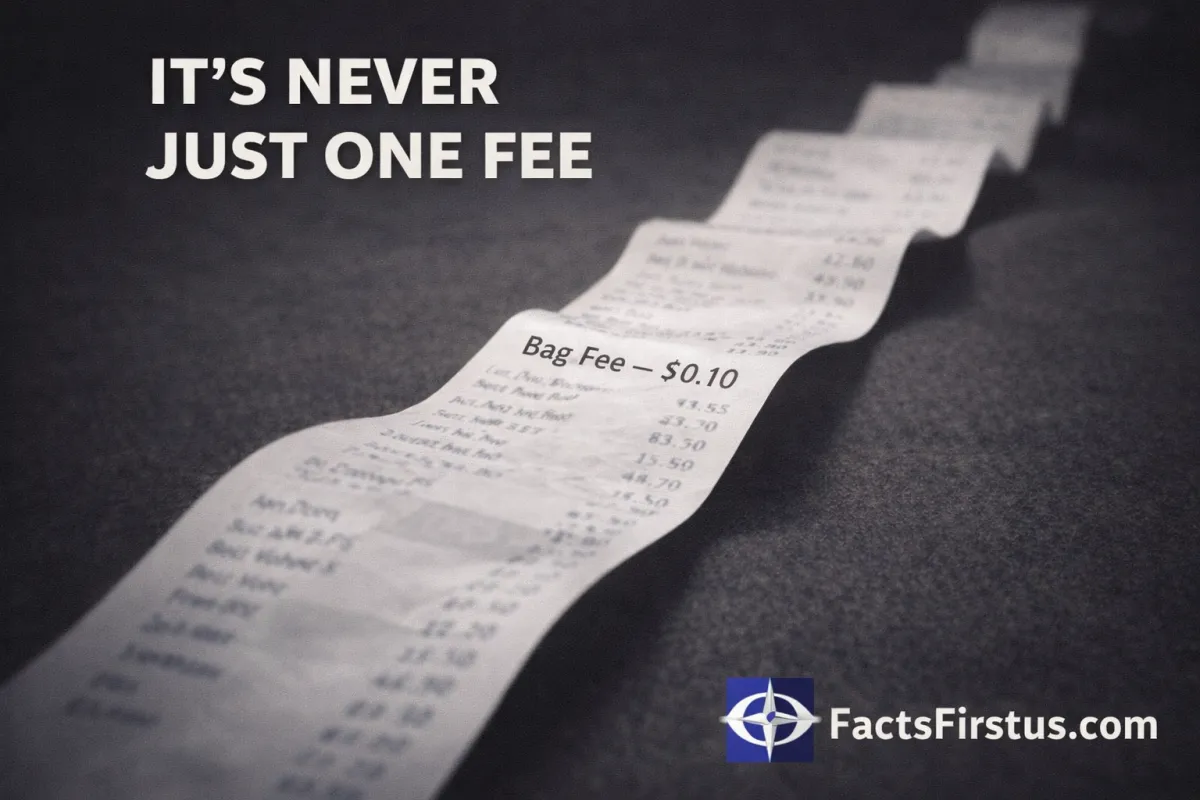
A proposal now moving through the Illinois General Assembly—House Bill 5112, known as the Carryout Bag Reduction Act—would charge residents 10 cents for every carryout bag—paper or reusable—used at checkout. If enacted, the fee would rise to 25 cents per bag by 2030, with no limit on future increases if state-defined environmental benchmarks are not met. Plastic delivery bags would be banned outright.
The bill has not yet become law. But it is being actively advanced.
For lawmakers backing the proposal, it is framed as environmental responsibility.
For Mary, it feels personal.
“I already reuse them,” she says. “So what exactly am I paying for?”
In Illinois, that question has been asked before.
HB 5112 was filed quietly in a state where Democrats control the governor’s office and hold supermajorities in both chambers of the General Assembly. No Republican votes are required for passage. No bipartisan compromise is necessary. There is no procedural barrier standing in the bill’s way should party leadership choose to move it forward.
That matters, because the proposal does not exist in isolation. It follows a governing pattern Illinois residents know well: identify a small, universal behavior; label the charge a fee rather than a tax; avoid voter approval; and let the revenue flow indefinitely.
Under the bill, retailers would keep 2 cents per bag. The remainder would be sent to the state and deposited into a newly created Carryout Bag Fee Fund. Through 2030, portions of that revenue would supplement Illinois’ General Revenue Fund. Afterward, proceeds would be distributed to counties and large municipalities for loosely defined environmental purposes.
Enforcement authority would rest with the Attorney General. Civil penalties could reach $1,000 per violation.
Restaurants are exempt.
SNAP purchases are exempt.
Everyone else pays.
If enacted, a household using five bags a week would see costs begin at $26 per year. By 2030, that figure would rise to $65 annually—and potentially more if bag usage fails to drop by 90 percent, a threshold written directly into the proposal.
On paper, the numbers appear modest.
That is the design.
Illinois residents already shoulder the highest overall tax burden in the nation, according to WalletHub. Property taxes rank second-highest nationwide. Gas taxes have doubled in recent years. Utility bills carry fees few residents can name but all must pay. Insurance costs climb under a legal system widely cited as one of the most expensive in the country.
Each charge is defended individually. Together, they form a system—one shaped not by environmental outcomes or affordability, but by longstanding fiscal mismanagement.
Illinois did not drift into a $143 billion pension liability by accident. It arrived there through decades of skipped payments, optimistic assumptions, short-term budgeting, and political avoidance. Rather than confront those failures directly, lawmakers have increasingly leaned on fees—quiet, permanent, and broadly applied—to stabilize a structure that was never repaired.
In debates over similar proposals in the past, such fees have been described as “dual-purpose”—environmental in name, fiscal in effect. Once collected, the money proved difficult to restrict and easy to redirect.
What begins as behavior modification becomes budget support.
“People reuse these bags every day,” said Christine Shanahan McGovern, a candidate for Illinois Senate District 18. “Trash cans. Lunches. Pets. Diapers. This isn’t waste. It’s responsibility—and now it’s being charged.”
Across town, Miguel Alvarez unlocks his small neighborhood grocery before sunrise. His customers are older. Many live on fixed incomes. His margins are thin enough that a single compliance mistake can erase a week’s profit.
If the bill passes, Alvarez would be required to update systems, train employees, track bag usage, remit payments to the Department of Revenue, and face potential fines—for pennies per transaction.
He cannot raise prices much. His customers cannot absorb more fees.
“It’s never just one thing,” Alvarez says. “It’s always one more thing.”
Supporters of the proposal argue the fee would change behavior. Critics counter that similar policies elsewhere have delivered limited environmental gains while generating reliable revenue streams. State estimates project the bag fee could raise $19 to $23 million annually—a fraction of Illinois’ long-term obligations, but real money extracted from households already stretched thin.
Fees work politically because they are small enough to ignore and permanent enough to matter. They rarely sunset. They almost never get repealed. Over time, they reshape daily life without ever becoming a single, defining controversy.
The consequences extend beyond receipts.
Illinois now ranks 38th in tax competitiveness, 46th in economic competitiveness, and worst in the Midwest for social mobility. In 2024 alone, more than 40,000 residents left the state, many moving just across the border to Indiana.
They were not making ideological statements. They were making calculations.
Mary finishes folding the last bag and slides it under her sink.
She will still reuse it. She will still be careful. She always has been.
But if the proposal becomes law, when she checks her receipt, the state will be there too—charging her for something she never wasted, to help stabilize a system that never planned for her future.
She looks at the drawer where the bags are stored and pauses.
For the first time, she wonders how many more small costs she can afford—before staying costs more than leaving.
SOURCES
Illinois General Assembly, Bill Status: HB 5112
WalletHub, States with the Highest & Lowest Tax Burdens
Tax Foundation, 2026 State Tax Competitiveness Index
Commission on Government Forecasting and Accountability, Illinois National Rankings – 2024 Update
Porte Brown, Illinois Tax Burden 2025
Illinois Policy Institute, fiscal history and social mobility reports
NFIB, Illinois Economic Competitiveness Rankings
NPR Illinois, Unpacking Pritzker’s Tax Proposals: Bag Tax (2019)
MyStateline, Illinois lawmakers consider bill to phase out plastic bags with fee
WFIW Radio, Illinois lawmaker proposes sweeping statewide bag tax
Public statements from Rep. Mike Coffey