
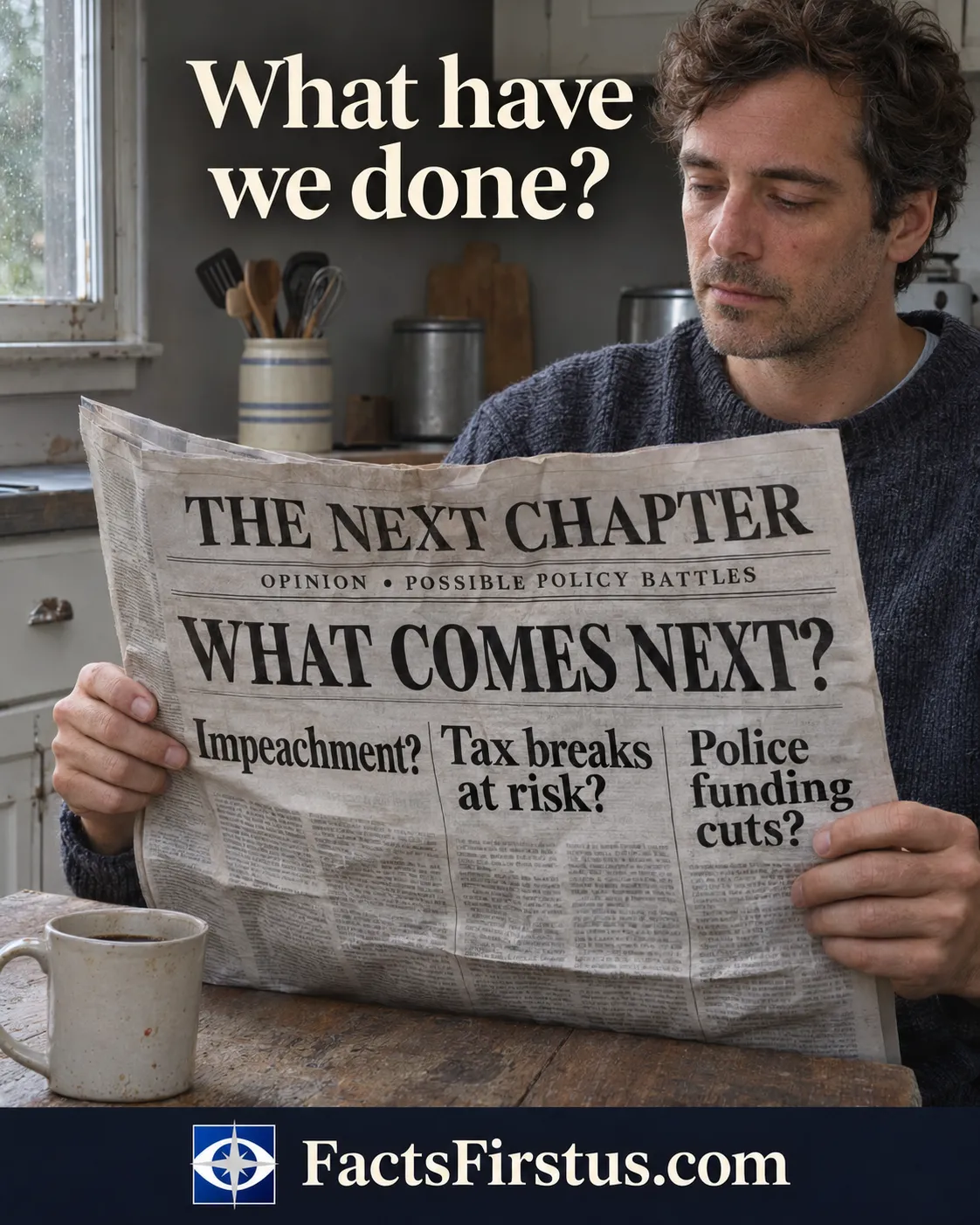
HE COULD HAVE WALKED AWAY. AMERICA WILL LIVE WITH WHAT HAPPENS NEXT.
HE COULD HAVE WALKED AWAY
The promise that brought Donald Trump into politics became a struggle stretching across investigations, courtrooms, his own administration and a Pennsylvania rally field. After the midterms, the fight enters another chapter, with consequences extending far beyond the president.
FactsFirstus Editor
November 7, 2026 | Opinion and Analysis
Before there was blood on his face in Pennsylvania, there was a golden escalator in Manhattan.
Donald Trump descended it on June 16, 2015, entering a presidential race that would consume the next decade of his life. He already possessed the things people spend their lives pursuing: wealth, recognition, a business carrying his name and a family whose future did not depend on winning an election.
He could have remained an observer, criticizing Washington from a comfortable distance. Instead, he offered to take responsibility for changing it.
Make America Great Again was a simple promise with enormous implications. It spoke to Americans who had watched factories disappear, communities weaken and politicians become fixtures in a government that seemed unable to solve problems everyone could see.
Trump told those Americans that decline could be reversed. When he later promised to “drain the swamp,” he gave their frustration a target.
Washington was about to discover what happened when someone campaigned against the way it worked and won.
Trump was about to discover how much of Washington a president could inherit without ever truly controlling.
The first struggle was over the legitimacy of his victory.
Russia became the story through which millions of Americans encountered his presidency. Allegations moved through television studios, congressional hearings and federal investigations. The public was invited to consider whether the man elected to lead the country had reached the White House through a conspiracy with a foreign government.
Some of the most sensational allegations came from the Steele dossier, opposition research financed through a law firm by the Clinton campaign and Democratic National Committee. Federal Election Commission proceedings later resulted in penalties over how those payments were reported.
The political origin of that material mattered. So did the conduct of the government officials exercising investigative power.
The Justice Department’s inspector general identified 17 significant inaccuracies and omissions in surveillance applications concerning former Trump campaign adviser Carter Page. Former FBI lawyer Kevin Clinesmith pleaded guilty to altering an email used in the surveillance process.
These were documented failures inside institutions whose authority depended on the public trusting them to get the facts right.
The Mueller report ultimately supplied a finding that deserved to travel as widely as the accusations.
“The investigation did not establish that members of the Trump Campaign conspired or coordinated with the Russian government in its election interference activities.”
Special counsel Robert Mueller’s report
By then, a substantial part of Trump’s presidency had unfolded beneath that suspicion.
A presidency has a clock. Every day spent answering another allegation is a day in which a promised reform competes for attention, staff and political capital. His Democratic opponents understood the political value of keeping him on defense. Hearings generated headlines, and headlines kept the administration responding while the next confrontation took shape.
An eventual finding could enter the historical record. It could not give the president back the time.
Nor could it restore the privacy his family had surrendered. In 2018, Vanessa Trump opened an envelope addressed to Donald Trump Jr. containing a threatening letter and white powder. Authorities determined the substance was nonhazardous, but that conclusion came after the envelope had been opened and the fear had become real.
The political fight had crossed the family’s doorstep.
Then came impeachment over Ukraine, followed by a second impeachment after January 6. The House impeached Trump twice. The Senate acquitted him twice.
Through those proceedings, the Americans who elected him watched the presidency become a continuous struggle over whether he would remain in a position to carry out their instructions.
Most people experienced that struggle through the news. That made the judgment exercised inside newsrooms part of the story itself.
Research documented how sharply Trump’s early coverage differed from that of his predecessors. Harvard Kennedy School’s Shorenstein Center found that, among reports with a clear positive or negative tone during his first 100 days in 2017, 80 percent were negative. Neutral reports were excluded from that calculation. At CNN and NBC, negative coverage outnumbered positive coverage by 13 to one.
Pew Research Center’s comparison of presidents’ first 60 days found that 62 percent of Trump stories carried a negative assessment and 5 percent a positive one. Obama’s comparable figures were 20 percent negative and 42 percent positive.
Those studies measured early first-term coverage. They did not establish that every negative report was unfair. They did establish the extraordinary imbalance in the account Americans were receiving.
Specific editorial failures made the problem more serious.
CNN retracted a Russia-related report concerning Trump associate Anthony Scaramucci the day after publishing it. The network apologized and subsequently accepted three journalists’ resignations. The allegation had already reached the public; its withdrawal could not guarantee that every reader would revise the impression it left.
Years later, the BBC acknowledged a misleading edit of Trump’s January 6 speech in a documentary broadcast before the 2024 election. Separate passages had been joined together, creating an impression the original sequence did not support.
Viewers had no access to the editing room. They received the finished account as something they could trust.
The BBC apologized in November 2025 after scrutiny of the edit and a legal demand from Trump’s lawyers. Roughly a year had passed since the documentary aired.
That is a profound failure of responsibility. People making an electoral decision should not discover afterward that a statement presented to them had been assembled misleadingly.
The press has the power to investigate officials, expose wrongdoing and help citizens understand their government. That power carries an obligation to scrutinize accusations as rigorously as the people accused. When political preference displaces that discipline, the audience loses the independent judgment it was promised.
This week, the language of election coverage again exposed that boundary.
As MS NOW projected a Democratic House majority, Rachel Maddow announced that “celebrations can absolutely begin.”
Celebration belonged to the winning candidates and their voters. From the host leading election coverage, the word made the reporting sound like participation.
The remark could not cause an election already held. It could remind viewers why they question whether the information presented before an election was selected to inform them or steer them.
Trump’s problems, however, could never be explained solely by Democrats or the media. He also needed the cooperation of people wearing his own party’s label.
A Republican majority gave him an opportunity. It did not guarantee that Republican senators would agree on how to use it.
Senate leader John Thune’s defense of the legislative filibuster captured that divide. Most legislation requires 60 votes to overcome a filibuster, allowing a Senate minority to block measures the majority wants to advance.
Preserving the rule protects a party when it returns to the minority. It can also prevent that party from fulfilling its promises while it holds power.
Sen. Ron Johnson pressed Republicans to confront that choice, particularly as influential Democrats and allied organizations advocated eliminating the filibuster for their own priorities.
Thune opposed holding a vote on eliminating it, warning that putting Republican senators on the record would expose divisions and damage the party.
“I don’t think that serves anybody’s interest,” he told the Washington Examiner in March.
A recorded vote would, however, have served accountability. Americans would have known precisely which senators supported changing the rule and which opposed it. Avoiding the vote spared colleagues that uncomfortable choice.
For people waiting for change, the distinction was practical. A president can issue executive orders, but a successor can often reverse them. Laws generally give policy greater durability. An agenda that never gets through Congress remains easier to dismantle after its author leaves office.
Trump was pressing for action. His Senate leader was weighing the political damage of making Republican colleagues declare their positions.
Meanwhile, policies the administration attempted to implement faced another route to delay: the courts.
Democratic-led states and advocacy organizations challenged Trump’s actions and sought injunctions reaching far beyond the people bringing the lawsuits. A single district judge could halt a policy across the country while litigation continued.
In June 2025, the Supreme Court curtailed that reach. In Trump v. CASA, the majority concluded that universal injunctions likely exceeded the authority Congress had given federal courts.
Put plainly, the lower courts had likely overstepped their authority in imposing restrictions that broad.
The decision did not settle the legality of Trump’s underlying citizenship order. It addressed the reach of judicial remedies. For an administration trying to govern, that distinction still carried enormous consequences: months could pass fighting an order before the limits on that order were established.
Winning an appeal could reopen the path. It could not recover the months.
Inside the administration, Trump faced a different version of the same problem. A president’s priorities still had to pass through the people controlling access, developing proposals and deciding what moved forward.
Calley Means brought that concern to Joe Rogan’s audience this week.
A health-policy advocate and former adviser to Health Secretary Robert F. Kennedy Jr., Means has challenged financial incentives surrounding food and medicine. His argument matters to families who wonder why a country spending so much on health care struggles so deeply with chronic illness.
On Rogan’s program, he alleged that industry influence and internal gatekeeping obstructed reform. Those allegations require investigation through documents, decisions and responses from the people involved.
They also reach the heart of Trump’s original promise. Replacing an elected administration does not automatically displace the relationships through which influence operates.
Susie Wiles’ replacement as chief of staff, announced Friday, added another upheaval after the election. It does not establish the truth of Means’ allegations. It does underscore how much a presidency depends on the people entrusted to execute its priorities.
Then there was Butler.
On July 13, 2024, a gunman opened fire at Trump’s campaign rally in Pennsylvania. Trump was wounded. Corey Comperatore was killed. Two other spectators were seriously injured.
The Secret Service’s own review documented failures in planning, communications and protective coordination. A rooftop with a line of sight to the stage remained unsecured. Information did not reach everyone who needed it.
The institution charged with protecting him failed. Director Kimberly Cheatle resigned.
The questions concern responsibility, decisions and whether the corrective measures are sufficient. The documented failures are grave enough without adding an unsupported conspiracy.
What Americans saw next required no interpretation: Trump rising, blood on his face, agents surrounding him, his fist lifted.
He continued the campaign.
Any account of his determination that leaves out that moment leaves out something essential.
Yet determination alone would not justify a presidency. Results matter, which is the argument Newsmax chief executive Christopher Ruddy has urged Americans to keep in view.
Trump’s record includes first-term tax legislation, deregulation and three Supreme Court appointments. His second term brought another major tax law, including deductions for eligible tips and qualifying overtime compensation and an additional deduction for qualifying seniors.
Those provisions have limits and eligibility requirements. For people who qualify, they concern the income left after work and the resources available in retirement.
Ruddy’s broader argument is that voters should assess the direction of the country across several measures, rather than allowing an immediate frustration to eclipse everything else. His September column pointed to tax policy, business conditions, border enforcement and public safety as reasons to maintain support while addressing the problems that remained.
“A rising Trump lifts all boats.”
Christopher Ruddy, Newsmax, September 13, 2026
Ruddy also argued that the administration needed to communicate its record more effectively. A result that people do not understand can be overwhelmed by a controversy they hear about every day.
His post-election column extended that argument to Iran, where the immediate political cost and the long-term security objective could pull in opposite directions.
Confronting Iran’s nuclear ambitions carried risks and economic consequences. Higher fuel costs reached Americans directly. The danger the policy sought to prevent was less tangible to a family filling its car.
Ruddy argued that judging the decision solely through the election result would confuse the president’s political fortunes with the country’s security interests.
“His decision to confront Iran’s nuclear ambitions was courageous, necessary, and, I believe, one that history will judge favorably.”
Christopher Ruddy, Newsmax, November 5, 2026
His column also made a practical case for what should follow defeat: stronger implementation, competent personnel, clearer communication and a willingness to negotiate where agreement could produce results.
Divided government, Ruddy observed, can still govern. It requires people willing to do so.
That is now the test facing Washington and the voters who changed its balance of power.
Sen. Ted Cruz offered a harsher warning. Speaking on Hannity, he argued that Americans who elected Democrats expecting affordability relief could find that restrictions on energy and other policies move costs in the opposite direction.
“Things are about to get much worse, because of the policies of the radicals they elected.”
Sen. Ted Cruz, speaking on Hannity, as reported by NewsBusters, November 6, 2026
That is a forecast. What happens will depend on the policies pursued, what becomes law and broader economic conditions. Trump retains his veto.
But Cruz’s warning exposes a weakness in the idea of voting simply to deliver a rebuke. The rebuke does not lower a bill. The people empowered by it must enact policies that do.
Their power reaches beyond prices. Congressional control affects nominations, investigations, legislation and the time a president must spend defending existing decisions instead of advancing new ones.
Chuck Schumer has already promised resistance to judicial nominees Democrats consider unacceptable. The consequences are taking shape before the next Congress has assembled.
For voters who believed in Trump’s mission but withdrew their support from Republicans, this is the moment to look beyond the satisfaction of sending a message.
They may still want a secure border, lower costs, a smaller bureaucracy and less influence for the interests entrenched in government. Their frustration did not erase those goals.
It changed who has the power to pursue them.
The presidency’s clock is still running. A stalled reform can remain unfinished. An appointment blocked today can affect the courts for years. A policy left dependent on executive action can disappear under a successor.
None of that requires guessing what Trump feels behind closed doors. The public consequences are serious enough.
He could have remained in the life he had before the escalator. He could have stopped after his first term. He could have decided that surviving Butler was enough.
Instead, he sought the authority to continue.
Now some of the Americans who asked him to take on Washington have made that task harder. They may believe they punished the people in power. They also entrusted power to the people who will decide what happens next.
Those officials should be judged by the results they deliver, as every elected official should.
If promised relief fails to arrive, if reforms stall and the influence voters wanted challenged remains secure, disappointment will not stay inside the White House. It will reach the households that were counting on change.
That is where the election will finally be measured, long after the television celebrations end.
The hardest reckoning may come for voters who discover that they still want the mission completed, but have helped close the path to completing it.
What have we done?
By the time that question becomes personal, the lost governing time will be beyond recovery.
Trump will still have to decide how to fight with the power he has left. Americans will have to live with how much of that power they gave away.
Official sources and primary research
Official congressional record: Mueller testimony and investigative findings.
United States Senate: Presidential impeachment proceedings and outcomes.
United States Supreme Court: Trump v. CASA, June 27, 2025.www.supremecourt.gov
United States Secret Service: Butler Mission Assurance Inquiry summary.
Harvard Kennedy School’s Shorenstein Center: News coverage of Trump’s first 100 days, May 2017.shorensteincenter.org
Pew Research Center: Comparison with early coverage of previous administrations, October 2017.www.pewresearch.org
Secondary sources and interviews
Associated Press: CNN retraction, apology and three resignations, June 2017.www.boston.com
Associated Press: BBC apology following Trump’s legal demand, November 13, 2025.apnews.com
RealClearPolitics: Maddow’s election-night statement, November 3, 2026.www.realclearpolitics.com
Washington Examiner: Thune’s opposition to a filibuster vote, March 19, 2026.www.washingtonexaminer.com
Clay Travis and Buck Sexton Show: Ron Johnson interview, November 5, 2026.
The Singju Post: Transcript of Calley Means on The Joe Rogan Experience, episode 2578.
Associated Press: Wiles’ replacement and Schumer’s statements concerning Trump’s nominees, November 6, 2026.apnews.com
Craig Bannister, NewsBusters: Cruz’s Hannity interview and affordability warning, November 6, 2026.
Christopher Ruddy: “Trump Is a Winner and Right on Iran,” Newsmax, November 5, 2026.
Christopher Ruddy: “A Rising Trump Lifts All Boats,” Newsmax, September 13, 2026.