
FROM PROMISES TO PRESCRIPTIONS: TRUMP DELIVERS THE BIGGEST DRUG PRICE CUTS IN U.S. HISTORY
AMERICA FIRST AT THE PHARMACY COUNTER
After Decades of Talk, Trump Forces a Breakthrough on Drug Prices Americans Can Finally Feel
What politicians debated for generations, patients paid for with their lives. On December 19, 2025, that changed.
By Staff Writer
December 19, 2025
For years, millions of Americans have stood at pharmacy counters staring at receipts that made no sense—choosing between insulin and rent, cancer medication and groceries, breathing treatments and heating bills. They were told reform was complicated. They were told change would take time. They were told help was coming.
It never did.
Until today.
On December 19, 2025, President Donald J. Trump announced what the White House described as the largest and most consequential prescription drug pricing reform in American history—a move that delivers immediate, enforceable price reductions and fundamentally alters how Americans pay for medicine.
This was not a speech.
Not a study.
Not another promise.
It was action.
DECADES OF TALK — AND NO DELIVERY
Lowering prescription drug prices has long been one of Washington’s most talked-about failures.
Across multiple administrations of both parties, the issue was acknowledged but never resolved. From Clinton to Bush, from Obama to Biden, bipartisan commissions were formed, hearings were held, and white papers were written—yet Americans continued to pay two to five times more than patients in other developed nations for the exact same drugs.
Progressive leaders like Senator Elizabeth Warren and Senator Bernie Sanders made drug pricing a moral cause, denouncing pharmaceutical excess and calling the system unjust. Republicans promised market-based fixes. Everyone agreed something was wrong.
But nothing changed.
Today, that record broke.
A DEAL THAT REWRITES THE SYSTEM
President Trump announced nine new agreements with major pharmaceutical manufacturers that will bring U.S. drug prices in line with the lowest prices paid by other developed nations, a policy known as Most-Favored-Nation (MFN) pricing.
The companies include:
Amgen
Bristol Myers Squibb
Boehringer Ingelheim
Genentech
Gilead Sciences
GSK
Merck
Novartis
Sanofi
These manufacturers produce medications used by tens of millions of Americans for chronic and life-threatening conditions, including:
Type 2 diabetes
HIV/AIDS
Hepatitis B and C
Multiple sclerosis
Rheumatoid arthritis
Asthma and COPD
Cancer
Cardiovascular disease
Under the agreements:
All State Medicaid programs gain access to MFN pricing, saving billions and strengthening care for the most vulnerable.
Foreign nations are prevented from using price controls to free-ride on American innovation.
Increased foreign revenue generated by these policies must be repatriated for the benefit of American patients.
New medicines introduced by these companies must also comply with MFN pricing.
“For the first time ever, Americans are no longer subsidizing the rest of the world’s healthcare system.”
— President Donald J. Trump
REAL NUMBERS. REAL RELIEF.
The scale of the reductions announced today is so dramatic that it challenges long-held assumptions about what drug pricing “has to be.”
Through TrumpRx, the federal government’s new direct-to-patient purchasing platform, Americans can now access deeply discounted medications without middlemen, pharmacy benefit managers, or inflated list prices.
Patients can learn more and purchase eligible medications directly at:
https://www.TrumpRx.gov
Select examples include:
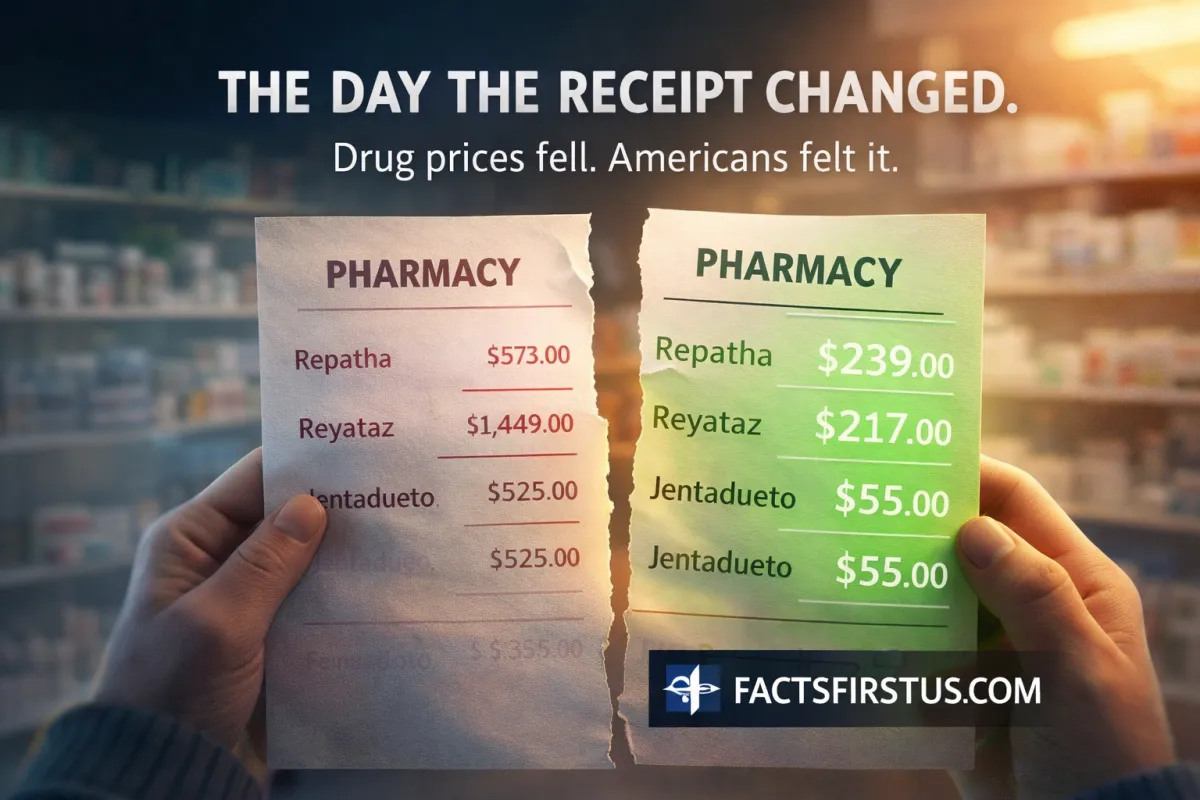
Repatha (Amgen): from $573 → $239
Reyataz (Bristol Myers Squibb): from $1,449 → $217
Jentadueto (Boehringer Ingelheim): from $525 → $55
Xofluza (Genentech): from $168 → $50
Epclusa (Gilead Sciences): from $24,920 → $2,425
Advair Diskus (GSK): from $265 → $89
Januvia (Merck): from $330 → $100
Mayzent (Novartis): from $9,987 → $1,137
Plavix (Sanofi): from $756 → $16
Sanofi insulin capped at $35 per month
For families managing chronic illness, these are not policy abstractions. They are life-altering realities.
STRENGTHENING MEDICAID AND NATIONAL SECURITY
Beyond immediate patient relief, the agreements require participating pharmaceutical companies to invest at least $150 billion collectively in U.S. manufacturing, reinforcing national health security and reducing reliance on foreign supply chains.
Several companies will also contribute active pharmaceutical ingredients to the Strategic Active Pharmaceutical Ingredients Reserve (SAPIR), including:
98.8 kilograms of albuterol (GSK)
6.5 tons of apixaban tablets (Bristol Myers Squibb)
3.5 tons of ertapenem (Merck)
These commitments ensure the United States is better prepared for public health emergencies while rebuilding domestic capacity.
“NOT LEFT OR RIGHT — BUT RIGHT FOR AMERICANS”
Health and Human Services Secretary Robert F. Kennedy Jr., long associated with progressive skepticism of corporate power, framed the announcement as a moral reckoning rather than a partisan win.
“This is about dignity, security, and fairness,” Kennedy said. “And it proves reform doesn’t belong to the left or the right. It belongs to the American people.”
During the announcement, Kennedy shared a moment that underscored the political significance of the day:
“I received a call this morning from a relative of mine—a far-left liberal—who said, ‘I never thought I’d say this, but this is extraordinary. Thank you for doing what no one else could.’”
YEARS OF ACTION, NOT WORDS
Today’s agreements build on a year-long campaign:
May 12, 2025 – President Trump signs the Executive Order “Delivering Most-Favored-Nation Prescription Drug Pricing to American Patients.”
July 31, 2025 – Letters sent to pharmaceutical manufacturers demanding price alignment.
September–December 2025 – 14 total manufacturer agreements announced.
December 1, 2025 – A U.S.–U.K. agreement increases drug prices abroad by 25%, ensuring foreign nations pay their fair share.
In the coming days, the administration is expected to bring major insurance companies to the White House or Mar-a-Lago, pressing for lower premiums—signaling that the reform effort is expanding beyond pharmaceuticals.
WHY ALL AMERICANS SHOULD CARE
This moment transcends party labels.
Progressives have demanded lower drug prices for decades.
Conservatives have demanded accountability and fairness.
Working families have demanded relief.
Today, those demands converged into action.
It is difficult to imagine that leaders like Elizabeth Warren or Bernie Sanders—who have made prescription drug affordability a defining cause—would oppose an outcome they have championed for years: real, enforceable price reductions for American patients.
Equally significant, the agreements now present a test for state leaders. Governors—including Illinois Governor J.B. Pritzker—face a clear choice: accept lower drug prices for their residents or explain why ideology matters more than affordability, particularly given past decisions to opt out of Trump-era policies such as eliminating taxes on tips and overtime pay.
For voters, the stakes are no longer theoretical.
Lower drug prices are not Republican.
They are not Democratic.
They are human.
What happens next will determine whether today becomes a lasting turning point or a missed opportunity. For millions of Americans still counting pills and dollars, the urgency is not political—it is deeply personal.
OFFICIAL SOURCES
The White House, President Donald J. Trump Announces Largest Developments to Date in Bringing Most-Favored-Nation Pricing to American Patients, December 19, 2025
Executive Order: Delivering Most-Favored-Nation Prescription Drug Pricing to American Patients, May 12, 2025
U.S. Department of Health and Human Services
Office of the United States Trade Representative