
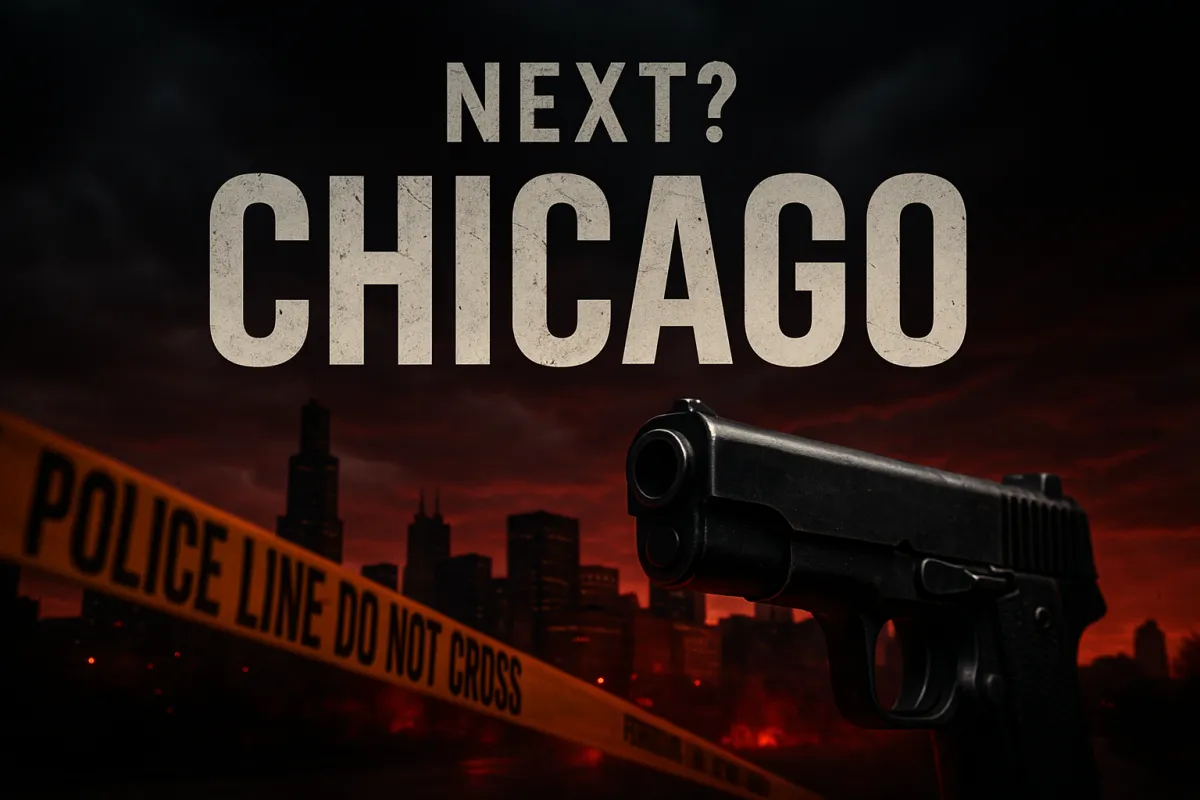
CLEANING UP CRIME
Trump Sets Sights on Chicago as Illinois’ Crime Policies Fail
D.C.’s turnaround under Trump’s crackdown highlights the cost of Springfield’s sanctuary stance and no-bail laws, leaving Illinois residents to wonder when help will arrive.
By STAFF WRITER | August 24, 2025
Introduction: A Tale of Two Cities
The numbers tell a story too stark to ignore. In Washington, D.C., a city long plagued by crime, President Donald Trump’s crackdown has produced a milestone no one thought possible: nine consecutive days without a single homicide.
In Chicago, the story could not be more different. Week after week, gunfire tears through neighborhoods. Families mourn. Businesses shutter. And instead of reversing course, Illinois leaders double down on policies that critics say embolden criminals and punish victims.
The contrast is so sharp it feels like two different countries. In Washington — a city where local leaders despise Trump — federal action has brought safety and prosperity. In Illinois, political resistance has left communities bleeding.
Illinois’ Experiment in Failure
When Gov. J.B. Pritzker signed the SAFE-T Act abolishing cash bail, he promised a fairer system. Instead, offenders arrested for violent crimes are often back on the streets within hours. Add to this Illinois’ sanctuary laws, which bar cooperation with ICE, and leniency measures that drag out prosecutions, and the result is predictable: chaos.
On the ground, police say they feel abandoned.
“We arrest them at night and see them back on the block by morning. It’s like fighting with one hand tied behind your back.” — Chicago Police Officer
“We’re risking our lives, but the politicians aren’t backing us. They’re backing the criminals. Every cop I know is asking the same thing: why are we even doing this if nothing changes?” — Veteran officer, Chicago
For families, the devastation is unbearable.
“The politicians protect criminals more than they protect us.” — Mother of slain Chicago teen
Chicago recorded over 600 homicides in 2024, and 2025 is tracking no better. Carjackings, robberies, and assaults are rising, while Springfield insists its reforms are working.
Washington, D.C.: Nine Days of Silence
Nearly two weeks into Trump’s executive order, Washington achieved what once seemed impossible: peace. The Metropolitan Police confirmed the city’s last homicide was August 13. Since then? Silence.
The Department of Justice reported more than 700 arrests in just two weeks, including 36 immigration-related arrests in a single day. Nearly 2,000 National Guard troops and federal agents now blanket the city, deterring criminals and reinforcing local police.
Trump wasted no time in celebrating:
“D.C. was a hellhole, and now it’s safe. There have been no murders in D.C. in the last week. That’s the first time anybody can remember.” — President Donald Trump
Even residents noticed the difference.
“I can see how violent crime would just go down off the strength of people not wanting to get caught up with unnecessary drama.” — D.C. Resident
Nine days without a murder may not sound long — but in a city that had become synonymous with violence, it’s historic.
The Economic Ripple Effect
The impact has been immediate. Washington businesses are booming. Restaurants that once sat half-empty are turning customers away at the door. Bars are packed. Tourists are coming back. Hotels downtown are filling up. Safety has become the catalyst for economic revival.
Chicago tells a grim opposite. Boarded-up storefronts line commercial corridors. Moving vans and U-Haul trucks carry families and businesses out of the state. The Illinois Policy Institute reported nearly 100,000 residents fled in 2024, many citing crime as the reason.
One longtime business owner on the West Side, preparing to close his bakery after 25 years, said it best:
“We had a bakery here for 25 years. I’m closing next month. Customers are scared. My employees have been robbed. I can’t keep asking them to risk their lives for a paycheck.” — David Martinez, Chicago
The contrast could not be sharper: in Washington, safety has created prosperity. In Illinois, violence has driven people out.
A Tale of Two Cities: Crime Compared
D.C. went 9 days without a homicide under Trump’s crackdown, while Chicago continues to average 60 shootings per week under Illinois’ current policies.
Trump’s Next Target: Chicago
President Trump has made his intentions clear.
“I think Chicago will be our next. And then we’ll help with New York.” — President Donald Trump
He even claimed residents were asking him directly:
“African American ladies, beautiful ladies, are saying, ‘Please, President Trump, come to Chicago, please.’”
For many Chicagoans, those words are not politics — they are hope. Yet Springfield leaders, like D.C.’s before them, are prepared to resist. Washington resisted, too, but Trump pushed forward. Today, the city is safer for it. In Illinois, resistance means more funerals.
Why All of Illinois Should Care
Some outside Chicago dismiss the violence as a city problem. But crime does not respect boundaries.
Carjackings and retail theft are rising in the suburbs.
Gang networks stretch into Rockford, Peoria, Springfield, and towns along I-55.
Sanctuary laws apply statewide, tying the hands of sheriffs from southern Illinois to the Quad Cities.
A downstate sheriff put it bluntly:
“We’re dealing with Chicago’s crime, whether Springfield admits it or not. Gangs and drugs don’t stop at city limits. The state’s policies make it harder for us to do our job, too.”
This is why many Illinois residents hope Trump’s crackdown will extend beyond Chicago — to the entire state.
Lessons from the Past
History offers a warning Illinois has ignored. In the 1990s, New York City embraced what became known as “broken windows” policing. The theory, developed in the 1980s, held that ignoring small crimes — vandalism, graffiti, turnstile-jumping — signaled disorder and invited more serious crime. By enforcing laws against these minor offenses, police sent the message that lawlessness would not be tolerated.
The result was historic. Murders dropped from more than 2,000 a year to fewer than 600 within a decade. Streets once considered unwalkable became safe again.
New York turned the corner while those policies were in place. Chicago, by contrast, resisted adopting the model — and remains stuck in crisis.
Sanctuary Policies: Compassion or Negligence?
Illinois’ sanctuary status has been praised as compassionate. But law enforcement officials see it differently.
“We’ve seen cases where individuals wanted for violent crimes in their home countries are allowed to stay here and commit more crimes. Local politicians call it equity. We call it negligence.” — ICE Officer
For victims’ families, the result is betrayal. Sanctuary may sound noble, but in practice, it too often protects predators instead of communities.
Grassroots Voices
Behind the numbers are people whose lives are unraveling. Their voices reveal a city in crisis:
“I don’t let my grandkids play outside anymore… every weekend, somebody dies. And Springfield acts like it’s normal.” — Angela White, Englewood grandmother
“We had a bakery here for 25 years. I’m closing next month. Customers are scared. My employees have been robbed. I can’t keep asking them to risk their lives for a paycheck.” — David Martinez, West Side business owner
“We prayed for Springfield to act. They didn’t. At this point, we need outside intervention. If President Trump wants to send in the Guard, I say send them.” — Rev. James Carter, South Side pastor
A State’s Defining Choice
Trump summed up his approach with characteristic bluntness:
“The big question is how long do we stay? Because if we stay, we want to make sure it doesn’t come back. So we have to take care of these criminals and get them out.”
Illinois now faces that same big question.
This is not just a Chicago problem. From Rockford to Peoria to small towns across southern Illinois, crime is spreading. Families are fleeing. Businesses are closing. Investment is vanishing.
The choice Illinois faces is stark: continue down the path of ideology and watch the state unravel, or accept what D.C. has already proven — that decisive action works.
In Washington, leaders despised Trump’s presence. They resisted his tactics. But when he acted, crime fell, businesses thrived, and residents felt safe again. Restaurants are full. Hotels are busy. The city is alive.
Illinois tells the opposite story: shuttered windows, U-Haul caravans, empty storefronts, tax dollars bleeding away.
The reality is unavoidable: when leaders resist solutions, they choose violence over safety, collapse over prosperity.
Illinoisans now wonder: how many more funerals, how many more empty storefronts, how many more families leaving will it take before their leaders allow the very policies that have already restored safety and prosperity elsewhere?
History may one day record that Illinois was not destroyed by crime alone, but by leaders who refused to stop it.
Sources:
Fox News, “National Guard mobilizing in 19 states amid immigration, crime crackdown”, Aug. 22, 2025.
Associated Press, “Trump says Chicago is the likely next target of his efforts to crack down on crime”, Aug. 22, 2025.
DC News Now, “D.C. goes 9 days without a homicide under Trump executive order”, Aug. 23, 2025.
Chicago Police Department Annual Crime Report, 2024.
Historical Data: NYPD Crime Statistics, 1990–2000.
Illinois Policy Institute, State Outmigration Report, 2024.
Community Interviews, South & West Side of Chicago, Aug. 2025.