
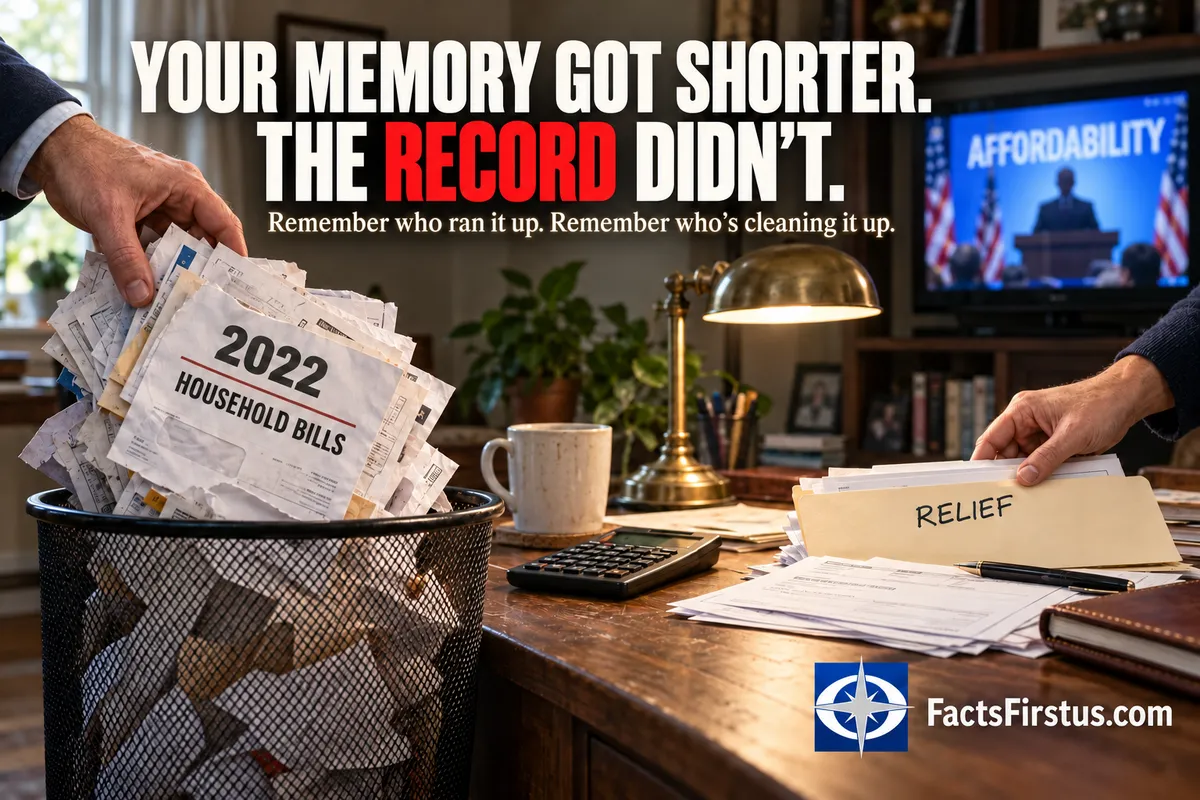
THEY WANT YOUR VOTE. THEY’RE COUNTING ON YOUR SHORT MEMORY.
TRUMP IS CUTTING TAXES. VANCE IS CHASING FRAUDSTERS. DEMOCRATS WANT TO TALK ABOUT AFFORDABILITY.
With the midterms approaching, the administration is making a powerful argument: helping Americans afford a better life includes protecting the money government already takes from them.
By FactsFirstus.com Staff Writer
October 31, 2026
You have heard the pundits. You have heard the campaign speeches. You have heard the chant.
Affordability. Affordability. Affordability.
Groceries cost too much. Gasoline is expensive. Buying a house feels like an ambitious retirement plan for people who have not yet turned 30.
The frustration is real.
The political memory loss is something else.
Democrats have made affordability a weapon against President Donald Trump, hoping voters will concentrate on today’s expenses without spending much time remembering how the country reached this point.
Apparently, the grocery receipt is admissible evidence. The previous administration’s record has been misplaced.
During Joe Biden’s presidency, annual inflation reached 9.1 percent in June 2022. Grocery inflation reached 12.2 percent. Those increases became embedded in household budgets.
Families did not receive a refund when the inflation rate slowed.
Now, less than two years into his second term, Trump is pursuing tax relief, prescription savings, investment, and economic growth while assigning Vice President JD Vance a task with enormous implications for affordability.
Go after the people stealing Americans’ money.
A RECORD THAT DESERVES MORE THAN A CAMPAIGN CHANT
The administration’s supporters have concrete results to point to.
Economic growth accelerated. Manufacturing employment increased from its recent low. Major stock indexes reached records earlier this month. Federal tax deductions are helping eligible workers keep more of their tips and qualified overtime compensation.
Those developments deserve attention alongside the complaints.
Here is part of the record:
Economic growth accelerated. Real GDP grew at a 3.4 percent annualized rate in the third quarter, up from 2.2 percent in the second.
Quarterly inflation slowed. The annualized quarterly PCE inflation rate declined to 2.1 percent, from 5.0 percent in the previous quarter.
Manufacturing employment improved. BLS reported manufacturing employment 72,000 above its December 2025 low, including an estimated September increase of 9,000.
Payrolls increased. September added an estimated 29,000 jobs, following an average monthly gain of 45,000 over the preceding year.
Markets delivered gains. The S&P 500 and Nasdaq reached record closing highs on October 6. Despite subsequent declines, the S&P 500 remained 10.7 percent higher for the year through October 30.
Prescription savings advanced. The White House reports $700 million in savings through TrumpRx, attributing lower prices to its drug pricing initiatives.
Workers received new federal tax relief. Eligible taxpayers can deduct qualifying tips and the qualifying premium portion of overtime pay.
Seniors received additional relief. Eligible Americans age 65 and older can claim an additional $6,000 federal deduction per person, subject to income limits.
Children received a financial head start. Trump Accounts created investment accounts for eligible children, with a one-time $1,000 federal contribution available to qualifying U.S. citizens born from 2025 through 2028. Families and employers can contribute additional money, subject to program rules, helping children begin building wealth before adulthood.
These are specific developments Americans can examine. They do not require pretending every problem has disappeared.
They require remembering that progress takes place over time, while campaign slogans can be manufactured before lunch.
Gasoline also illustrates why dates matter. EIA’s national all-grades average declined from approximately $4.60 on September 28 to $4.41 on October 26, below the $5.03 monthly average recorded in June 2022 during Biden’s presidency.
The recovery argument is straightforward: judge the work underway, the direction of specific measures, and the policies being implemented.
Demanding that every accumulated problem vanish immediately resembles dismissing the fire department because the furniture still smells like smoke.
WASHINGTON CUTS TAXES. ILLINOIS KEEPS ITS HAND OUT.
For workers, affordability can mean something as practical as keeping more of the money they earned during a busy shift.
The federal tips deduction allows eligible workers to deduct up to $25,000 in qualified tips annually. The overtime deduction covers qualifying overtime premiums, up to $12,500, or $25,000 for joint filers. Both have eligibility rules and income limits.
The senior deduction provides additional relief rather than repealing federal taxation of Social Security benefits.
Those distinctions explain how the benefits work. The underlying accomplishment remains: eligible households can reduce their federal taxable income.
State policy is a separate decision.
The Illinois Restaurant Association reports that Illinois has not adopted the federal tips and overtime deductions for state income taxes. Workers can receive federal relief while those earnings remain subject to Illinois income tax.
Under Governor JB Pritzker and the Democratic legislative majority, matching that relief has not become Illinois law. A Republican-sponsored proposal to create state deductions for tips and overtime remained in the House Rules Committee in the legislative record reviewed for this story.
That is a concrete affordability issue for servers, bartenders, and eligible overtime workers.
Washington provides a federal deduction. Springfield continues collecting its share.
Pritzker’s affordability message should be judged against those choices.
VANCE IS FOLLOWING THE MONEY
Tax relief addresses what Americans keep.
Fraud enforcement addresses what happens to the money government collects.
At his October 29 town hall with Jesse Watters, Vance connected the two:
“The fraud is actually, to me, very closely connected to the affordability problem in the United States of America.”
Vice President JD Vance
The argument makes sense because the money came from somewhere.
A worker earned it. A business owner accounted for it. A family surrendered it through taxes, expecting public services and legitimate benefits in return.
When fraudsters steal those dollars, the public loses what it paid for.
Vance argued that those resources could otherwise support legitimate benefits or potentially become tax relief.
A dollar stolen through fraud is a dollar taken from the public without delivering what the public paid for.
The Government Accountability Office estimated annual federal fraud losses of $233 billion to $521 billion, based on fiscal 2018 through 2022 data.
President Trump is tackling that problem head-on.
His March 16 executive order established the Task Force to Eliminate Fraud, with Vance as chairman, to coordinate enforcement and prevention across federal benefit programs.
This year’s National Health Care Fraud Takedown charged 455 defendants, including 90 doctors and other licensed medical professionals, in alleged schemes involving more than $6.5 billion in false claims.
The nationwide problem includes Illinois.
ILLINOIS: $136 MILLION PAID FOR TEST KITS NEVER PROVIDED
On October 30, DOJ announced that Syed Murtuza Kablazada, 36, of Des Plaines, pleaded guilty to two counts of health care fraud involving three Chicago-area laboratories.
According to prosecutors, the scheme used purchased Medicare beneficiary information to submit claims for COVID-19 test kits that beneficiaries neither requested nor received.
Fraudulent claims totaled approximately $227 million.
Medicare paid approximately $136 million.
Prosecutors said proceeds moved through overseas transfers and unlicensed money transmitters, with some used to purchase luxury vehicles.
Kablazada agreed to forfeit more than $46 million in proceeds seized from ten bank accounts.
Taxpayers paid. The test kits never arrived. Someone else enjoyed the proceeds.
DOJ identifies the prosecuting Fraud Division’s work as supporting the task force chaired by Vance.
That is an Illinois example of enforcement producing a guilty plea and an agreement to surrender seized money.
ILLINOIS MEDICAID: COUNSELING CLAIMS AND AN ALLEGED YACHT PURCHASE
Federal prosecutors separately charged Daniel Robinson, of Palos Park, with health care fraud and money laundering involving ODA Solutions Inc.
They alleged that the company billed Illinois Medicaid more than $92 million and received approximately $75 million, while Robinson directed the creation of false records for counseling and therapy services never provided.
Some claims allegedly involved beneficiaries who had died.
Prosecutors further alleged that more than $7 million in proceeds financed real estate, vehicles, jewelry, and a yacht.
Those charges remain allegations.
The public interest is immediate. Money intended to support behavioral health care allegedly became personal spending money.
Families trying to afford a reliable car have every reason to care when their public health dollars allegedly help purchase someone else’s boat.
Illinois officials should welcome aggressive scrutiny of those payments. Pritzker should be expected to explain what his administration is doing to prevent similar losses and support the federal effort.
Illinois taxpayers deserve visible cooperation and measurable results. Pritzker should make that commitment unmistakable.
TIM WALZ HAS AN AUDITOR’S REPORT TO ANSWER FOR
In Minnesota, criticism of Governor Tim Walz’s administration rests on more than partisan accusations.
The state’s Office of the Legislative Auditor examined oversight of Feeding Our Future and found that the Department of Education’s inadequate oversight created opportunities for fraud.
The review found that the department failed to act on warning signs, approved applications despite unresolved concerns, and conducted inadequate complaint investigations.
Among its findings: the department inappropriately asked Feeding Our Future to investigate complaints about itself.
That is a remarkable approach to accountability.
Most taxpayers would prefer the subject of an investigation not also serve as its investigative committee.
The department disputed the auditor’s characterization and pointed to law enforcement referrals and reforms. The independent findings nevertheless provide a documented basis for holding the administration accountable.
Federal prosecutors subsequently secured convictions against nonprofit founder Aimee Bock and Safari Restaurant co-owner Salim Said in the roughly $250 million scheme.
Prosecutors described fabricated claims involving 91 million meals, with proceeds financing property, luxury vehicles, and international travel.
Bock received a 500-month prison sentence.
Walz owes taxpayers an explanation of how an agency under his administration handled those warnings and why its safeguards failed.
GAVIN NEWSOM AND THE FIGHT OVER SCRUTINY
California Governor Gavin Newsom faces a different accountability dispute.
He signed Assembly Bill 2624 in August, expanding privacy protections for qualifying immigration support services providers, employees, and volunteers.
Republican critics dubbed it the “Stop Nick Shirley Act,” arguing that its provisions could intimidate people investigating organizations receiving public money.
Shirley, whose videos have alleged fraud in publicly funded operations, is challenging the law through litigation brought by America First Legal.
His attorneys argue that its disclosure and removal provisions could expose lawful reporting to liability. The law’s supporters say it protects people facing threats and does not shield organizations from legitimate investigation.
The statute is not a blanket prohibition on investigative journalism, and the constitutional claims remain contested.
The political question is still serious.
Newsom should have to demonstrate that protecting personal safety will not become a mechanism for suppressing scrutiny of public spending.
Public money carries a public obligation to answer questions. Privacy protections should not become an escape hatch from accountability.
California’s fraud cases make that scrutiny essential.
On October 22, federal prosecutors in Los Angeles announced charges against 15 defendants in cases involving approximately $2 billion in alleged fraudulent claims, including sham addiction treatment, unnecessary artery procedures, and hospice fraud.
In one hospice case, prosecutors alleged that nonterminal Medicare beneficiaries generated approximately $9.8 million in claims and more than $8.3 million in payments.
Those cases will be decided in court. The public’s right to examine how the money moved should remain firmly protected.
THE MIDTERMS ARE ALSO ABOUT WHO WILL HELP
Vance has made the electoral argument explicit.
At his July 8 anti-fraud speech in Milwaukee, he urged voters to give greater authority to the party pursuing fraud and asked them to return Republican representatives to Washington.
“The people’s government exists to fight for the people and not the fraudsters.”
Vice President JD Vance, July 8, 2026
The Trump administration is asking voters to support its agenda. Vance is making taxpayer protection part of that choice.
On June 10, the House passed the Fraud Prevention and Accountability Act by 240 votes to 181. All 211 Republicans who voted supported it. Among Democrats, 28 supported passage and 181 opposed it; one independent voted yes.
Voters can examine that record alongside specific enforcement results, oversight failures, and candidates’ proposals.
The choice deserves more substance than another affordability slogan.
Americans should support officials who pursue theft, protect legitimate recipients, recover public money, and strengthen safeguards. Officials whose records show ignored warnings and failed oversight deserve hard scrutiny.
The standard is action.
AFFORDABILITY DESERVES A LONGER MEMORY
Affordability. Affordability. Affordability.
You have heard the chant. Before accepting the campaign pitch, remember the record.
Remember the inflation surge during Biden’s presidency. Remember the grocery increases that became lasting fixtures in the family budget. Remember that an expensive problem does not become someone else’s creation simply because an election changes who is responsible for fixing it.
Then examine the work underway.
Tax relief for eligible workers. Additional deductions for seniors. Trump Accounts for children. Prescription savings. Manufacturing gains. Economic growth.
And a vice president pursuing the people stealing public money.
Those efforts belong in the affordability discussion, even when they complicate a convenient campaign slogan.
Short-term political memory can be expensive. It lets officials escape their records, repackage themselves as the solution, and ask voters for another chance to manage the money.
The fraud cases show what is at stake. Public dollars became luxury vehicles, property purchases, and payments for services never delivered. Meanwhile, the families who supplied that money kept working and paying their bills.
Trump and Vance are asking voters to support their effort to stop it. Their results deserve scrutiny, and their work deserves recognition.
Affordability starts with respecting the value of a dollar. Accountability starts with remembering whose dollar it was.
Before rewarding another politician for saying “affordability,” remember who paid, who failed to protect the money, and who is fighting to get it back.
The fraudsters counted on government looking away. Politicians with failed records are counting on voters forgetting. Americans cannot afford either.
Official sources
Bureau of Economic Analysis: Third-quarter 2026 GDP growth and quarterly inflation measures.www.bea.gov
Bureau of Labor Statistics: September 2026 employment report, manufacturing employment, payroll gains, and June 2022 inflation figures.www.bls.gov
Energy Information Administration: National weekly gasoline prices and historical monthly prices.www.eia.gov
Internal Revenue Service: Qualified tips, overtime, and additional senior deductions, including eligibility requirements, limits, and phaseouts.www.irs.gov
Internal Revenue Service: Trump Accounts, eligibility requirements, and the $1,000 federal contribution program.www.irs.gov
Illinois Department of Revenue: State income calculations. Illinois General Assembly: HB 4877 status and proposed tips and overtime deductions.tax.illinois.gov
White House: Prescription drug pricing claims and March 16 establishment of the task force chaired by Vance.www.whitehouse.gov
Government Accountability Office: Estimated annual federal fraud losses.www.gao.gov
Justice Department: National health care fraud takedown, Illinois Medicare guilty plea, and Illinois Medicaid charges.www.justice.gov
Minnesota Office of the Legislative Auditor: Feeding Our Future oversight review, findings, and agency response.www.auditor.leg.state.mn.us
Justice Department: Feeding Our Future convictions and Bock’s sentence; Los Angeles health care fraud allegations.www.justice.gov
House Clerk: June 10 vote on the Fraud Prevention and Accountability Act.clerk.house.gov
Secondary sources, transcript services, and litigation positions
Reuters: October 6 record closing highs. Associated Press: October 30 market performance and year-to-date gains.www.marketscreener.com
Illinois Restaurant Association: Illinois treatment of federal tips and overtime deductions.www.illinoisrestaurants.org
CalMatters: AB 2624, its protections, and the dispute over its effect on reporting. America First Legal: Shirley’s constitutional challenge and the plaintiffs’ arguments.calmatters.org
Roll Call/Factba.se: Vance’s October 29 town hall and July 8 Milwaukee anti-fraud speech.