
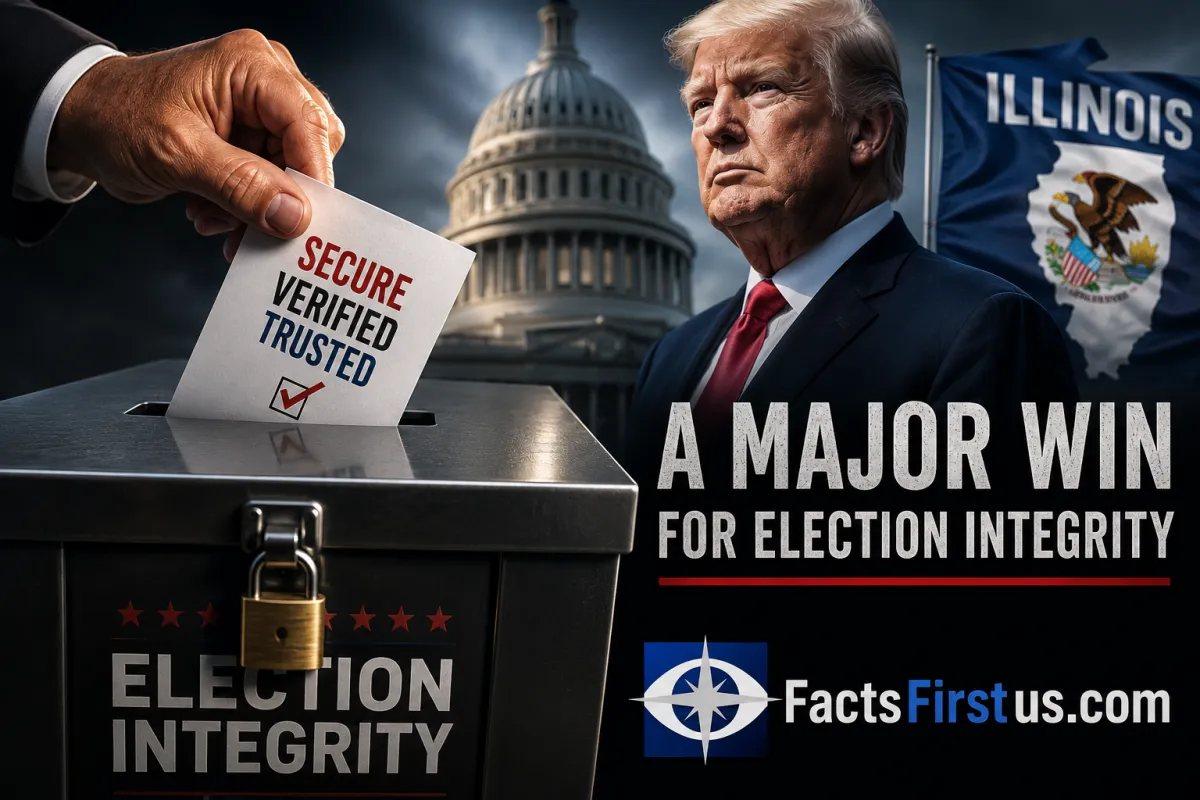
TRUMP SCORES MAJOR ELECTION INTEGRITY WIN AS ILLINOIS COMES UNDER NATIONAL SPOTLIGHT
TRUMP SCORES MAJOR ELECTION INTEGRITY WIN AS ILLINOIS COMES UNDER NATIONAL SPOTLIGHT
Federal judge clears the way for tougher voter verification efforts, dealing a major blow to Democratic challenges and intensifying pressure on Illinois Democrats defending expanded mail in voting policies.
By Staff Writer
May 28, 2026
For years, millions of Illinois voters have watched the national fight over election trust grow more bitter, more divisive, and more personal. On Thursday morning, many of those voters woke up believing the tide may finally be turning.
For voters who believe elections should be trusted and protected, a federal court ruling in favor of President Donald Trump’s voter verification efforts felt like a political earthquake that could reshape the national debate heading into November.
In a decision already sending shockwaves through the political landscape, U.S. District Judge Carl Nichols cleared the way for the Trump administration to move forward, at least for now, with aggressive efforts aimed at tightening voter verification, reviewing voter rolls, and increasing scrutiny of mail in voting systems.
To Trump supporters and election accountability advocates, the ruling was validation after years of heated national debate over mail in voting, voter roll accuracy, and ballot security.
And for Illinois Governor JB Pritzker, the timing could hardly be worse.
While the Trump administration pushes for citizenship checks, voter roll maintenance, and stronger ballot verification measures, Pritzker and Illinois Democrats have spent years expanding mail in voting and opposing Republican backed election security proposals.
Now those two visions are colliding head on.
And Illinois may soon become one of the most fiercely contested battlegrounds in America over how elections are conducted, verified, and trusted.
“Given that the Executive Order does not command Plaintiffs to do anything, and that no agency has yet acted pursuant to the Order in a way that could harm Plaintiffs, they have not suffered any harm at present.”
— U.S. District Judge Carl Nichols
The ruling delivered a major setback to Democrats who argued Trump’s executive order could disenfranchise voters and create inaccuracies in citizenship databases.
Judge Nichols rejected those arguments, ruling that the alleged harms were speculative at this stage of the case.
He also dismissed claims that sharing voter related information between government agencies automatically violated privacy protections.
“Plaintiffs fail to demonstrate that such action would cause a harm sufficient to establish Article III standing.”
— U.S. District Judge Carl Nichols
The political impact was immediate.
Conservatives across the country celebrated the decision as a major victory for ballot security and voter confidence. Republican strategists are expected to use the ruling as momentum for pushing additional voter verification laws, voter roll audits, and tighter absentee ballot oversight before the November elections.
And nowhere may that pressure intensify more than Illinois.
Under Pritzker’s leadership, Illinois dramatically expanded vote by mail access and created a permanent vote by mail program that automatically sends applications to voters who choose to remain on the list. Critics have repeatedly argued those policies weakened public confidence and increased concerns surrounding outdated voter rolls and election accountability.
That divide is now becoming one of the defining political fault lines of the 2026 election cycle.
Because this fight is no longer simply about Republicans versus Democrats.
It is about whether voters still trust the system itself.
Across Illinois, frustration over election procedures has simmered for years. From suburban neighborhoods to working class communities throughout the state, many voters say they want something simple: confidence that every legal vote counts and that election systems are protected against errors, outdated records, and abuse.
Even many voters who do not support Trump say they want greater confidence that elections are accurate, transparent, and secure.
And at the center of that frustration is one question Democrats are increasingly struggling to answer.
In a world where Americans are required to show identification for nearly everything, boarding a plane, cashing a check, opening a bank account, picking up prescriptions, entering government buildings, or even purchasing certain everyday products, why should voting require less verification than almost any other major responsibility in American life?
For years, Illinois voters have been told that asking citizens to verify identity before casting a ballot is somehow controversial. Yet those same voters cannot board a plane, open a bank account, or access countless services without proving who they are.
To millions of Americans, the contradiction no longer makes sense.
Illinois does not generally require photo identification to vote outside limited circumstances, while Democrats in Springfield continue expanding mail in voting and permanent vote by mail programs.
Democrats argue stricter voting requirements could discourage participation among legitimate voters, particularly seniors, low-income residents, and communities with limited access to identification documents.
But for critics of Illinois’ current system, that argument is losing political ground.
They argue that verifying voter identity is no different than the countless identity checks Americans already encounter throughout daily life. To many ordinary voters, this debate is no longer about party politics. It is about whether the system treats voting with the seriousness Americans believe it deserves.
That is what makes Thursday’s ruling so politically significant.
Trump’s courtroom victory did not simply preserve an executive order. It gave fresh momentum to a national movement demanding cleaner voter rolls, tighter verification standards, and stronger election accountability.
For Illinois Democrats, that creates a dangerous political reality heading into November. The more voters compare election rules to the verification standards they encounter throughout everyday life, the harder it becomes to convince skeptical Americans that stronger ballot security measures are unreasonable.
That is the fault line now opening beneath Illinois.
If inaccurate voter rolls exist, voters pay the price. If confidence in elections collapses, democracy pays the price. And if Americans stop believing elections are fair, the country itself pays the price.
An election system people no longer trust eventually becomes a democracy people no longer trust.
That is why this ruling matters far beyond Washington.
It may ultimately be remembered as the moment the national election security debate shifted from political rhetoric to legal enforcement, and Illinois now finds itself directly in the center of it.
Public trust in government is already fractured. Confidence in major institutions has been battered for years. Inflation, crime, border security, and economic anxiety have left voters demanding accountability from leaders at every level.
Against that backdrop, any perception that Illinois leaders are resisting stronger election accountability measures could become politically devastating, especially among suburban swing voters and independents already frustrated with government institutions.
Trump allies are framing the ruling as proof that election verification efforts can withstand legal scrutiny. Democrats continue warning that aggressive verification policies could discourage participation and create unnecessary barriers for legitimate voters.
That clash is only beginning.
Whether voters view this moment as a long overdue defense of democracy or as government overreach, one reality is becoming impossible to ignore:
Millions of Americans no longer want to simply be told elections are secure.
They want to know they are secure.
They want confidence that voter rolls are accurate, that ballots are protected, and that every legal vote carries the weight and integrity it deserves.
Across Illinois, that frustration has been building quietly for years. Not just among Republicans, but among independents, suburban voters, and ordinary citizens who increasingly believe public trust in elections cannot survive without stronger accountability and verification.
Because in a country where Americans are asked to verify their identity for nearly every major responsibility in life, more voters are beginning to ask a question that cuts deeper than politics:
If Americans deserve protection when it comes to their money, their identity, and their freedoms, why should their vote deserve anything less?
And if the people themselves are not worth protecting at the ballot box, then what exactly is democracy supposed to protect?
That question is no longer confined to courtrooms or campaign rallies.
It is echoing across Illinois.
And before November arrives, voters themselves may decide whether election security is merely another political argument, or one of the defining battles over trust, power, and democracy in modern America.
Official Sources
• U.S. District Court ruling by Judge Carl Nichols regarding challenges to President Trump’s executive order on voter verification and mail in voting procedures.
• Statements and reporting published May 28, 2026, regarding litigation involving the Democratic National Committee and allied plaintiffs.
• Illinois election law, including permanent vote by mail provisions enacted under Governor JB Pritzker’s administration.
• Public records and legislative materials regarding Illinois voter registration procedures, vote by mail policies, and voter identification debates.