
WHEN CORRUPTION STOPS SHOCKING PEOPLE
THE PRICE OF ACCEPTANCE
Illinois families say corruption is no longer shocking and that may be the state’s biggest crisis
By Staff Writer | May 12, 2026
Illinois is not just losing residents.
It is losing the belief that the people running the state still fear the consequences of failure.
After decades of corruption scandals, rising taxes, failing infrastructure, crime headlines, and one party political control, many Illinois families no longer see dysfunction as political dysfunction.
They see it as the culture of the system itself.
That feeling sat silently at a kitchen table this week beside an unopened property tax bill.
Because everyone in the house already knew what was inside.
Another property tax increase.
Another corruption headline.
Another reminder that, in Illinois, ordinary people always seem to pay first.
Across the state, this scene keeps repeating itself.
Families running numbers.
Businesses questioning whether to stay.
Young couples quietly looking at homes across state lines.
People are tired.
Not normal tired.
Illinois tired.
The kind of exhaustion that comes from watching taxes rise while trust in government collapses at the exact same time.
And this week Illinois received another reminder of just how far the state’s reputation has fallen.
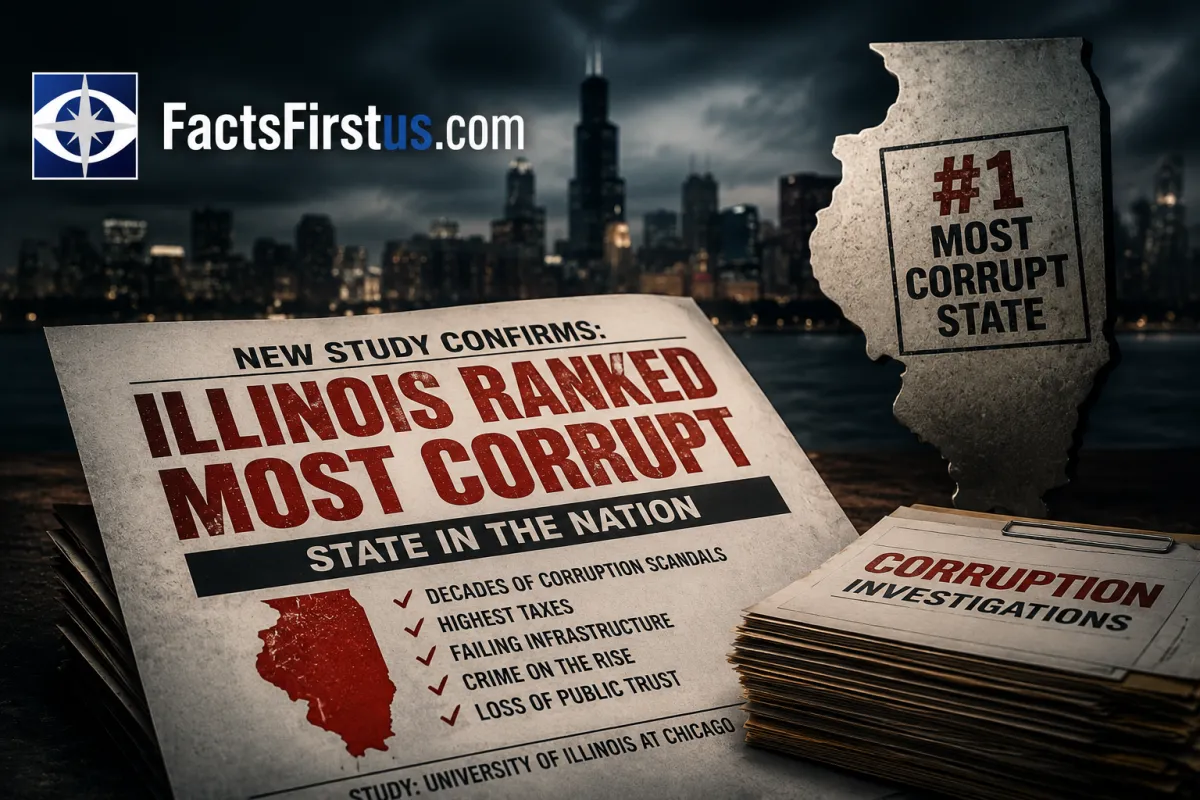
Chicago was once again named America’s most corrupt metropolitan area for the fourth consecutive year while Illinois continued ranking among the nation’s most corruption plagued states.
Not once.
Not twice.
Four consecutive years.
At some point a headline stops feeling temporary.
At some point it stops feeling embarrassing.
And starts feeling permanent.
Because by the fourth time something happens it is no longer a surprise.
It is a warning.
And what may disturb many Illinois residents most is how little shock remains.
“When corruption stops shocking people, the system has already won.”
According to the University of Illinois at Chicago political science department, Chicago recorded 1,824 federal public corruption convictions since 1976. Statewide, Illinois recorded 2,224 convictions during that same period, placing Illinois among the nation’s most corrupt states on a per capita basis. Researchers estimate corruption costs Illinois as much as $550 million every year in lost economic activity, investment, and public trust.
Half a billion dollars.
Gone.
And yet somehow families are still told there is never enough money.
Enough money for lower property taxes.
Enough money for safer communities.
Enough money for stronger schools.
Enough money for roads and infrastructure that no longer feel like they are falling apart.
“Political and government related bribery, extortion, fraud, conflicts of interest, theft of campaign funds, and tax cheating continue to undermine the public’s trust in government.”
— Marco Rosaire Rossi, co-author of the UIC corruption report
The frustration now stretches far beyond Chicago politics.
It reaches suburban homeowners opening tax bills with anxiety.
It reaches small business owners drowning in regulations and rising costs.
It reaches parents questioning public schools while paying some of the highest property taxes in America.
It reaches families packing moving trucks for Indiana, Tennessee, Texas, or Florida because they no longer believe Illinois is moving in the right direction.
For generations Illinois was a place families-built lives they expected their children to continue.
Increasingly it has become a place parents quietly encourage those children to leave.
Illinois is not just losing residents.
It is losing belief.
Illinois voters keep hearing the same promises from Democratic leaders about progress, investment, and opportunity.
But many residents say the reality outside their front door tells a very different story.
Schools continue struggling.
Infrastructure keeps deteriorating.
Crime dominates headlines.
Taxes keep climbing.
And corruption scandals never seem to end.
After decades of Democratic control, many Illinois families are no longer listening to what politicians promise.
They are judging what they see.
The corruption cases themselves have become almost routine.
Former Illinois House Speaker Michael Madigan, once considered the most powerful politician in Illinois, became the face of a sweeping federal corruption investigation. Longtime Chicago Alderman Ed Burke was convicted in a separate federal corruption case. Red light camera bribery scandals spread through suburban political networks.
The headlines change.
The culture does not.
Then came one of the strangest stories of all.
In Whiteside County, jury summonses reportedly went out to at least 60 deceased individuals, including one person who had reportedly been dead for more than 30 years. The names came from databases tied to voter registration systems, fueling new concerns about oversight, voter roll maintenance, and election integrity.
At the same time, Governor J. B. Pritzker’s administration resisted turning over broader voter roll access requested by federal authorities seeking to verify accuracy and maintenance of the rolls, according to reporting surrounding the dispute. That resistance sparked lawsuits and intensified skepticism among residents already questioning transparency and accountability inside Illinois government.
For many Illinois residents, stories like this land differently now.
Not because they are unbelievable.
Because they feel believable.
In almost any other state, stories like this would dominate headlines for months.
In Illinois, they barely survive a news cycle.
That may be what alarms people most.
The sense that dysfunction is no longer the exception in Illinois government.
It is becoming the expectation.
In Illinois, outrage now has an expiration date.
A corruption indictment dominates headlines for a week. A tax increase angers homeowners for a month. Another scandal sparks outrage online for a few days before disappearing beneath the next crisis.
Then life moves on.
Bills still arrive.
Families still leave.
And the people running the system remain exactly where they were before.
At the same time, federal investigators reviewed Illinois Medicaid funding practices in a multistate investigation that could reportedly require nearly $30 million in repayments tied to improper reimbursements.
Meanwhile, families continue paying some of the highest taxes in America while politicians promise reforms that never seem to arrive.
“It isn’t enough to change the face at the top.”
— Longtime government watchdog quoted in the report
“The question is whether Illinois has the will to break the culture that keeps producing the same headlines.”
— Longtime government watchdog quoted in the report
Republican lawmakers, including State Representative Patrick Windhorst, have pushed for stronger ethics reforms, tougher enforcement, expanded transparency, and real oversight powers. Critics argue Democratic leaders in Springfield have repeatedly weakened, delayed, or watered-down meaningful reform efforts while maintaining centralized political control over Illinois government.
For a growing number of Illinois residents, the problem no longer feels tied to one politician or one scandal.
They believe the problem is the system itself.
After decades of Democratic supermajority control, many voters openly question whether meaningful accountability can ever exist while one party continues controlling nearly every lever of power in Springfield.
That frustration is no longer being whispered quietly.
It is becoming a broader belief that Illinois cannot change until voters break the political stranglehold that has dominated state government for generations.
Because, to many residents, the pattern now feels painfully familiar.
The scandals come.
The outrage fades.
The promises return.
And the system protects itself.
And that is where frustration across Illinois keeps returning.
Power.
Who has it.
Who protects it.
And who pays for it.
Because while politicians hold press conferences, families are making decisions.
Whether to stay.
Whether to leave.
Whether they still believe Illinois can recover.
The most expensive thing in Illinois is no longer taxes.
It is trust.
The danger for Illinois is no longer the corruption everyone sees.
It is the normalization of it.
Because once people stop believing accountability is possible, those in power no longer need to earn public trust.
They only need to survive the next news cycle.
And slowly, almost without noticing, a state begins adjusting itself around lowered expectations.
Families expect taxes to rise.
Residents expect scandals.
Voters expect disappointment.
What once would have outraged the public becomes background noise.
And that may be the most expensive loss of all.
Because roads can be repaired.
Budgets can be rewritten.
Even governments can change.
But once people lose faith that honesty still matters inside the system, rebuilding that trust becomes far harder than rebuilding anything made of concrete or steel.
Official Sources
• University of Illinois at Chicago Political Science Department Anti Corruption Report
• U.S. Department of Justice Public Corruption Conviction Data
• Illinois Policy Institute analysis
• FactsFirstUS reporting on jury pool and Medicaid investigations
• Public statements from Marco Rosaire Rossi and Illinois lawmakers