
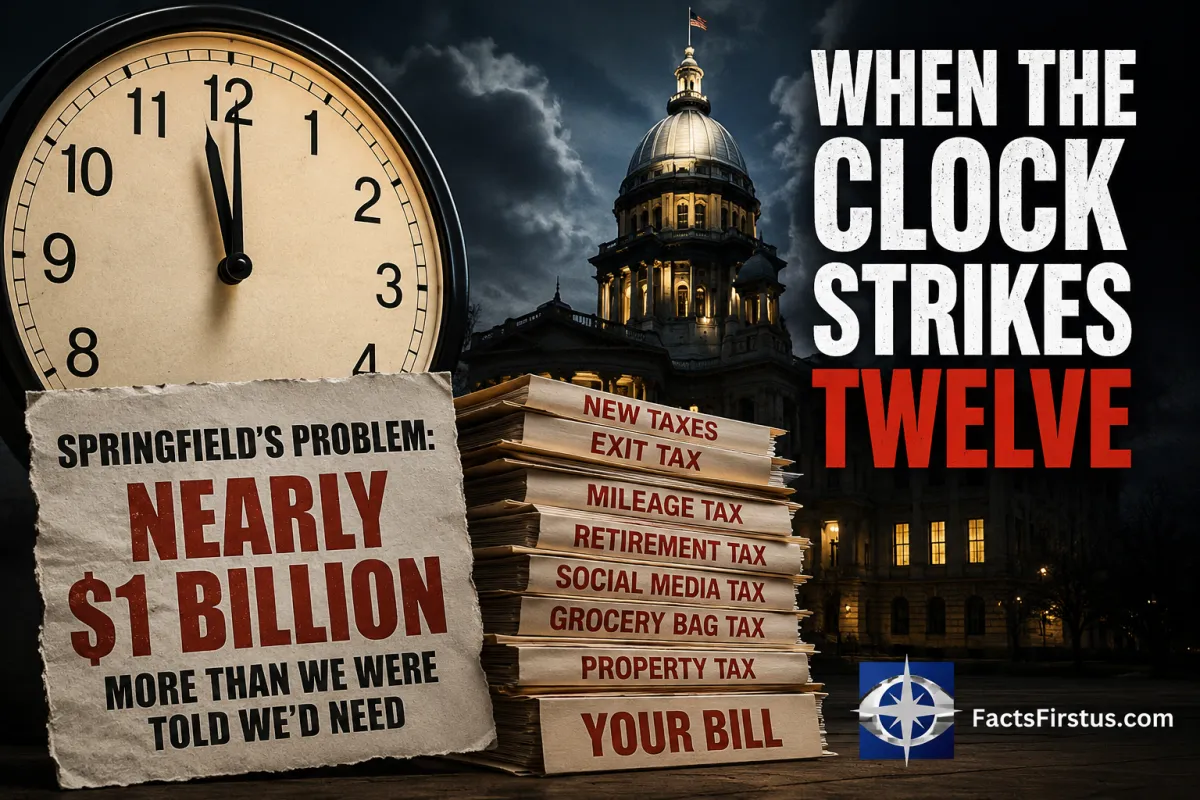
WHEN THE CLOCK STRIKES TWELVE
WHEN THE CLOCK STRIKES TWELVE
At 11:59 p.m. on May 31, lawmakers must finish the budget. At 12:00 a.m., Illinois taxpayers will learn the cost of another night in Springfield.
By Staff Writer
May 30, 2026
Somewhere in Illinois, a father is helping his daughter finish her homework.
A retiree is watching the evening news.
A small business owner is closing the books for the day.
A family is gathered around the dinner table.
Across Illinois, millions of taxpayers are winding down for the night.
Meanwhile, in Springfield, the lights are still on.
The clock is ticking toward midnight.
And if history is any guide, that is when things start getting expensive.
There is a reason Illinois taxpayers get nervous when lawmakers start talking about midnight.
Not because midnight is late.
Because in Illinois, midnight has become a strategy.
It is a scene that has played out so many times that veteran Capitol observers can practically set their watches by it.
The public goes to bed.
The cameras begin to disappear.
The hallways inside the State Capitol fill with lawmakers, lobbyists, staffers, and political insiders.
Then it happens.
A bill appears.
An amendment is filed.
A vote is called.
And by sunrise, Illinois families discover that something expensive happened while they were sleeping.
Critics have long argued that some of the most controversial legislation in Illinois is passed in the dark of night, when public scrutiny is weakest and public opposition is least likely to disrupt the outcome.
Republican lawmakers have repeatedly objected to the practice, arguing that taxpayers deserve time to review legislation before major spending plans, tax increases, and sweeping legislation are rushed through during the final hours of session.
Now, as lawmakers race toward 11:59 p.m. on May 31, 2026, many believe Springfield is preparing to follow the same script once again.
Only this time, Springfield's problem is measured in a number so large it is difficult to ignore.
Nearly $1 BILLION.
Let that sink in.
Not one billion dollars for a once in a generation emergency.
Not one billion dollars because of a natural disaster.
Not one billion dollars because Illinois residents were told the state suddenly faced an unexpected crisis.
Nearly one billion dollars more than Illinois taxpayers were previously told would be needed.
According to revenue estimates, Illinois could come up between $720 million and $900 million short of the money needed to pay for Governor J.B. Pritzker's budget.
The spending plan is already on the table.
The money to pay for it is not.
In other words, Springfield has already decided what it wants to spend.
Now it is searching for ways to make taxpayers cover the difference.
And there are only two ways to close a gap that large.
Cut spending.
Or take more money from taxpayers.
Critics fear Springfield has already made its choice.
State Senators Li Arellano Jr. and Chapin Rose issued warnings this week that taxpayers should brace themselves for surprise tax proposals that could emerge just hours before lawmakers adjourn.
"We're looking at pretty massive tax hikes by this time next week."
State Senator Li Arellano Jr.
For taxpayers already burdened by soaring property taxes, rising utility bills, inflation, insurance costs, and some of the highest overall tax burdens in America, the warning landed like a thunderclap.
Then came the list.
And for many Illinois residents, it sounds almost unbelievable.
Until they remember this is Illinois.
Among the tax proposals and revenue ideas critics say are being discussed:
• Package Delivery Taxes
• Social Media Taxes
• Exit Taxes
• Grocery Bag Taxes
• Campfire and Firepit Taxes
• Casino Taxes
• Mileage Taxes
• Retirement Taxes
The proposal drawing perhaps the strongest reaction is the idea of an Exit Tax.
Illinois has spent years watching residents leave.
Families leave.
Retirees leave.
Businesses leave.
Young professionals leave.
According to census data, Illinois has consistently ranked among the nation's leaders in population loss as residents seek lower taxes, lower living costs, safer communities, and stronger economic opportunities elsewhere.
Most states would view that trend as a warning sign.
Critics fear Illinois may view it as a revenue opportunity.
Opponents argue an Exit Tax would amount to government standing at the border with one hand extended.
Moving truck packed?
That may cost you.
Leaving because property taxes became unaffordable?
That may cost you.
Taking a new job in another state?
That may cost you too.
To critics, the message seems clear.
Illinois is not asking why people are leaving.
It is asking how much money can be collected before they go.
It sounds unbelievable.
But then again, this is Illinois.
Then there is the Mileage Tax.
For generations, Americans have associated driving with freedom.
The freedom to go where they want.
When they want.
Without government tracking every mile traveled.
A Mileage Tax would fundamentally change that relationship.
Every commute.
Every trip to the grocery store.
Every drive to church.
Every visit to grandparents.
Every mile.
Taxed.
Critics argue suburban and rural residents would bear the heaviest burden because they often drive farther and have fewer alternatives.
For many working families, driving is not optional.
It is necessary.
And opponents warn a Mileage Tax could become one more expense piled onto motorists already paying fuel taxes, registration fees, tolls, vehicle taxes, and some of the highest transportation costs in the Midwest.
It sounds unbelievable.
But then again, this is Illinois.
Then comes the Retirement Tax.
Perhaps no proposal has generated more anxiety among seniors.
For decades, Illinois has been known as one of the few states that broadly exempts retirement income from state taxation.
Retirees built financial plans around that policy.
Many chose to remain in Illinois because of it.
Now some fear Springfield may be eyeing retirement income as its next source of revenue.
Pensions.
Retirement account distributions.
Income earned after decades of work.
For retirees living on fixed incomes, the prospect is deeply concerning.
Many seniors already face rising healthcare costs, housing costs, insurance costs, and property taxes.
A Retirement Tax could represent yet another financial burden placed on those who spent a lifetime contributing to the state's economy.
To many retirees, the question is becoming increasingly simple.
If Illinois starts taxing retirement income, what reason remains to stay?
Then comes the proposal that causes many taxpayers to stop and read it twice.
The Campfire Tax.
Imagine a warm summer evening.
A backyard firepit.
Marshmallows.
Children laughing.
Neighbors gathered around the fire.
A scene repeated across America for generations.
Yet critics warn that permit requirements and regulatory oversight surrounding backyard fires could become another example of government reaching deeper into ordinary daily life.
To many Illinois residents, the issue has become symbolic of a larger frustration.
The feeling that no corner of life remains untouched.
The feeling that every activity eventually becomes another opportunity for government to collect revenue.
Your income.
Your home.
Your purchases.
Your retirement.
Your miles.
Even your backyard firepit.
It sounds unbelievable.
But then again, this is Illinois.
The list continues.
Package Delivery Taxes that could increase the cost of online shopping.
Social Media Taxes and fees.
Higher Casino Taxes.
Digital Advertising Taxes.
Corporate Tax Increases.
New Fees.
New Assessments.
New Revenue Streams.
All driven by the same reality.
Springfield needs more money.
And taxpayers remain the easiest source.
Yet perhaps the most explosive issue still looming over the debate is something known as the Mega Project legislation.
First reported by FactsFirstUS.com and later discussed more broadly as lawmakers searched for financing solutions and economic development incentives, critics argue the proposal could become one of the most controversial taxpayer backed development initiatives in recent Illinois history.
Supporters call it economic development.
Opponents call it corporate welfare.
At the center of the debate are discussions surrounding efforts to keep the Chicago Bears in Chicago and support other major development projects.
Critics argue taxpayers could ultimately be asked to shoulder significant financial risk while billionaire owned organizations and politically connected corporations receive incentives, subsidies, and tax advantages.
For many homeowners already struggling beneath crushing property tax burdens, the optics are difficult to ignore.
The homeowner pays more.
The billionaire pays less.
The taxpayer assumes the risk.
The corporation receives the reward.
And once again, the bill arrives in the mailbox.
As Sunday night, May 31, 2026, approaches, Illinois taxpayers find themselves in a familiar position.
Waiting.
Waiting to see what emerges from behind closed doors.
Waiting to see what deals are struck.
Waiting to see what legislation appears at the last possible moment.
Waiting to learn what surprises may be waiting when the clock strikes twelve.
Because if history has taught Illinois taxpayers anything, it is this.
The biggest votes often happen when the fewest people are watching.
The most controversial bills often arrive when the public has the least time to react.
And the people paying for them usually find out last.
At 12:00 a.m. on June 1, 2026, lawmakers will know exactly what they passed.
The question is whether Illinois taxpayers will.
The votes will be recorded.
The speeches will end.
The negotiations will end.
The lawmakers will begin heading home.
But they will not take the bill with them.
They will leave it behind for everyone else.
Because in Springfield, midnight marks the end of the legislative session.
For taxpayers, it may mark the beginning of the invoice.
When the clock strikes twelve, Springfield's work may be finished.
The consequences may just be getting started.
Sources
• Illinois Policy Institute, Tax Hike Threat Looms as Illinois Budget Deadline Nears, May 27, 2026
• Public statements from State Senator Li Arellano Jr.
• Public statements from State Senator Chapin Rose
• Governor's Office of Management and Budget revenue projections
• Commission on Government Forecasting and Accountability revenue estimates
• FactsFirstUS.com reporting regarding Mega Project legislation and related development proposals
• Illinois General Assembly budget discussions and public legislative proceedings