
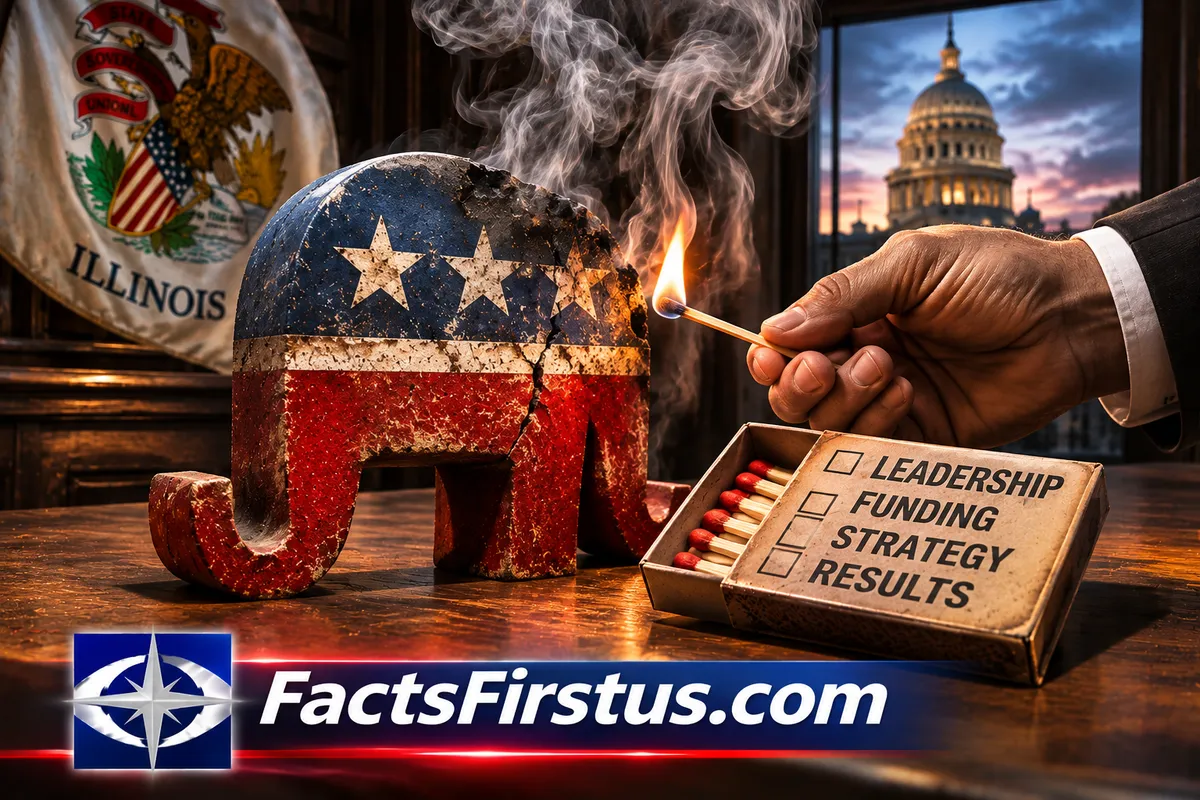
THE HOUSE IS BURNING, AND THE PEOPLE IN CHARGE ARE STILL HOLDING THE MATCHES
THE SMELL OF SMOKE, THE SOUND OF SILENCE
Illinois Republicans were promised a rebuilding. Instead, another election left their political house in ruins. Now, as Chairman Bob Grogan calls the devastation a “controlled burn,” an investigation into the money, the leadership, the internal fighting and the candidates left struggling reveals a party confronting something more dangerous than defeat: the possibility that its own voters are losing faith in the people entrusted to lead it.
By Staff Writer | FactsFirstus.com Investigation | November 9, 2026
There is something haunting about walking through the remains of a house after a fire. The walls that once stood strong are gone. The rooms that held generations of memories are reduced to ashes. What remains is a foundation, a few recognizable pieces and the unsettling realization that something valuable was lost.
Now imagine standing in those ruins while the person responsible for maintaining the property tells you the fire might actually be good for the soil.
Welcome to the Illinois Republican Party.
Following another devastating election, Illinois Republican Party Chairman Bob Grogan offered an extraordinary description of what happened to the political organization he was elected to lead just six months earlier.
Speaking with the Daily Herald on November 7, Grogan compared the Republican losses to a controlled burn, suggesting that the destruction might eventually create the conditions for new growth.
“Sometimes you have to have a controlled burn — this was less controlled — to put nutrients back into the soil, so that we can grow again.”
Bob Grogan, Illinois Republican Party Chairman, Daily Herald, November 7, 2026.
It was an interesting metaphor. It was also a remarkable description of an election that left Republicans with fewer elected officials, a weakened suburban presence, an enormous financial disadvantage and serious questions about the competence of their statewide political organization.
The problem with Grogan's comparison is that a controlled burn is supposed to be planned. It requires preparation, supervision and a strategy for preventing the flames from destroying everything around them.
Illinois Republicans have now experienced years of political destruction. The people responsible for preventing the next fire keep promising that rebuilding is just around the corner.
For voters who have donated money, knocked on doors, distributed campaign literature, attended rallies and defended Republican candidates through one disappointing election after another, the chairman's metaphor raises a much larger concern.
The party may be learning to live with losing.
The November 3 election did not simply deliver another disappointing result. It exposed how far Republican influence has deteriorated in parts of Illinois that once provided the foundation for statewide victories.
Democrats retained every statewide elected executive office and expanded their legislative supermajorities. Republican candidates lost ground in suburban and downstate districts, while county-level Republican representation continued shrinking across the Chicago metropolitan region.
According to the Daily Herald, the incoming county boards will leave Republicans with only one member in DuPage County, two in Lake County and three in Kane County.
Think about those numbers.
DuPage County was once synonymous with Republican political strength. For generations, its voters, donors and elected officials helped sustain the party's statewide organization.
Today, Republicans are approaching political extinction on its county board.
This is not simply the loss of a governor's race or an unsuccessful statewide campaign. It is the erosion of the local political structure that produces future candidates, develops volunteers, raises money and builds relationships with voters.
When a political party loses its foundation, winning back the governor's mansion becomes considerably more difficult.
And that brings us to one of the most troubling discoveries in examining the Illinois Republican Party's condition.
The party did not arrive here overnight. Its decline unfolded over multiple election cycles, under multiple chairmen, with warning signs that were impossible to miss.
Republicans last won an Illinois statewide election in 2014, when Bruce Rauner defeated Democratic Governor Pat Quinn. Since then, the party has failed to recapture a statewide executive office.
The last Republican elected to the United States Senate from Illinois was Mark Kirk, who won in 2010 and lost his reelection bid in 2016.
For more than a decade, Republican leaders have watched their party's statewide influence diminish.
The explanations have changed. The results have not.
Some blame Chicago. Others blame the state's Democratic political machine, unfavorable legislative maps, wealthy donors, Donald Trump's unpopularity among suburban voters or Republican candidates who fail to appeal beyond their conservative base.
Those factors deserve examination. Several have unquestionably shaped the political environment.
But they do not relieve Republican leadership of responsibility for developing a strategy to compete within that environment.
A political organization cannot control every voter, every opponent or every outside contribution.
It can control how aggressively it raises money, recruits candidates, organizes volunteers, identifies voters and supports the people running under its banner.
That is where the investigation becomes particularly uncomfortable.
In July, Grogan spoke with Capitol News Illinois about his plans for rebuilding the Republican Party. The former DuPage County auditor acknowledged the organization's weaknesses and emphasized the importance of developing stronger teams, better processes and more consistent fundraising.
He also offered an assurance.
“We're going to show that we're putting together strong teams with strong processes, and then I believe the funding will follow.”
Bob Grogan, Capitol News Illinois, July 1, 2026.
Four months later, the election results provided little evidence of a successful statewide turnaround.
Grogan inherited a deeply troubled organization. He cannot reasonably be assigned responsibility for every defeat that preceded his chairmanship.
But the election presented an opportunity to demonstrate that new leadership could produce measurable improvements.
Instead, the party entered November struggling with many of the same problems Grogan had identified during the summer.
The fundraising picture was especially alarming.
Axios Chicago reported that Republican gubernatorial nominee Darren Bailey entered the final month of his campaign with approximately $432,000 available.
Governor JB Pritzker entered that same period with approximately $44.4 million.
That is a financial advantage of more than 100 to 1.
Pritzker could purchase television advertising, develop digital messaging, fund extensive campaign operations and reach voters repeatedly while his Republican opponent struggled with a comparatively tiny treasury.
The contrast was extraordinary.
But the financial imbalance tells only part of the story.
Conservative billionaire Richard Uihlein, who had invested more than $50 million in Bailey's 2022 campaign and an allied political action committee, contributed only $6,900 directly to Bailey's 2026 campaign, according to Axios.
One of the Republican Party's most significant previous financial supporters had dramatically reduced his direct investment.
That development should have triggered serious concern long before Election Day.
“The donor class of the Republican Party decided some time ago that Illinois was a lost cause.”
Rod McCulloch, Republican pollster, quoted by Axios Chicago, November 5, 2026.
Those words deserve particular attention.
When donors begin treating an entire state as a lost cause, the problem extends far beyond a single candidate.
Political donors are not charitable institutions. They expect campaigns to demonstrate organization, competitiveness and a reasonable strategy for turning financial contributions into votes.
Repeated losses make that argument increasingly difficult.
But withdrawing financial support also creates a destructive cycle. Candidates cannot compete effectively without resources, and donors become even more reluctant to contribute when poorly funded campaigns lose.
Eventually, the organization becomes trapped in a pattern where everyone waits for someone else to make the first investment.
Grogan himself acknowledged the party's excessive dependence on wealthy contributors during his July interview.
That recognition was important.
A successful political party cannot depend indefinitely on a handful of billionaires arriving every four years to rescue a struggling statewide ticket.
It needs recurring contributions, organized county committees, dependable voter-contact programs, effective communications and the ability to raise money from people who believe their contributions will make a difference.
Yet the question remains whether Illinois Republican leadership has demonstrated that it knows how to build those systems.
The Illinois State Board of Elections maintains campaign finance disclosures for the state Republican Party and other political committees. Those filings provide a record of contributions, expenditures, available cash and financial transfers.
They also create an opportunity for a far more demanding examination of leadership performance.
The important measure is not simply how much money the organization collected. It is how much reached competitive campaigns, how effectively it was spent and whether the party invested early enough to influence election outcomes.
Those questions became especially important during the controversy surrounding Bailey's campaign and his running mate, Aaron Del Mar.
In September, The Illinoize reported that Del Mar publicly criticized the state Republican Party's financial support for the statewide ticket.
Del Mar argued that party resources should be directed toward candidates competing in the general election.
His criticism went directly to the purpose of a statewide political organization.
“Every single time we should be giving it 100% effort.”
Aaron Del Mar, Republican lieutenant governor nominee, quoted by The Illinoize, September 1, 2026.
Del Mar's complaint was not simply that his campaign needed more money.
He challenged whether the party's leadership was using its available resources to support the candidates Republican primary voters had selected.
The controversy also raised questions about internal party loyalties.
Grogan had been associated with the campaign of Ted Dabrowski, who lost the Republican gubernatorial primary to Bailey.
Attorney Thomas DeVore, the party's 2022 nominee for attorney general, publicly accused Grogan of favoring Bailey's defeat because of those earlier political relationships.
That allegation has not been established as fact. Grogan's prior political association does not, by itself, demonstrate that he worked against the Republican nominee.
Nevertheless, the accusation exposed a serious breakdown in trust between prominent Republicans and the organization responsible for supporting their statewide ticket.
DeVore was considerably less restrained in his criticism.
“The Party sucks. I'm not going to work with Bob Grogan. He's useless.”
Thomas DeVore, quoted by The Illinoize, September 1, 2026.
The language was harsh, personal and unmistakable.
But dismissing DeVore's criticism solely because of its confrontational tone would overlook the larger argument he has been making about Republican politics in Illinois.
DeVore contends that the party's fundamental weakness is not an inability to find acceptable candidates. It is an inability to build the political infrastructure necessary to elect them.
In a June 2026 commentary published by Illinois Review, he challenged the recurring argument that Republicans could solve their statewide problems simply by nominating more moderate candidates.
His analysis compared the geographic voting patterns of former Governor Bruce Rauner and Darren Bailey, arguing that gains among suburban voters could be offset by losses elsewhere.
The comparison is not a complete electoral model. Different elections involve different turnout levels, candidates and political conditions.
But DeVore's central argument deserves serious consideration.
Changing the candidate without changing the organization may produce little more than another expensive defeat.
A political party needs more than an appealing name at the top of the ballot.
It needs the machinery to identify supporters, register voters, contact households, distribute campaign materials, organize early voting, encourage absentee participation and turn political enthusiasm into actual ballots.
That machinery must operate long before Election Day.
Illinois Republicans have repeatedly demonstrated that they can attract enthusiastic supporters to rallies and political events.
The more difficult challenge is turning that enthusiasm into a disciplined statewide operation.
DeVore has also raised concerns about Republican voter participation and the party's ability to mobilize people who share its political priorities but do not consistently vote.
Those concerns point toward an uncomfortable possibility.
The party may be spending too much time arguing about which Republicans are acceptable and too little time identifying how to bring additional voters into elections.
There is another troubling dimension to the dispute.
In August, FactsFirstus.com examined DeVore's allegations concerning internal State Central Committee decisions and an email attributed to State Central Committeeman Jeff Castle.
That reporting raised questions about internal votes, candidate support and the transparency of decisions involving party resources.
The existence of internal disagreement is not evidence of misconduct. Political committees routinely debate expenditures, campaign priorities and strategic investments.
But decisions about whether to financially support statewide nominees deserve public accountability, especially when those nominees are asking Republican voters to contribute money and volunteer their time.
Reports that Del Mar sought approximately $150,000 for turnout operations and that the request was rejected also warrant further examination. The precise request, committee vote and reasons for any rejection have not yet been independently established.
The distinction matters because a responsible investigation must determine what happened rather than simply repeat accusations.
The underlying question, however, is unavoidable.
When Republican voters select their nominees, what obligation does the Illinois Republican Party have to help those nominees compete?
A party committee is not required to spend every dollar in its treasury on a single campaign. It must balance immediate needs against future organizational responsibilities.
But preserving resources for the future becomes difficult to justify if the organization repeatedly fails to build a competitive future.
A campaign that needs help is a test of leadership.
The response reveals whether the organization exists primarily to administer itself or to win elections.
There is an important difference between the volunteers who sustain Republican campaigns and the officials responsible for directing the party.
Across Illinois, volunteers have spent countless hours supporting candidates who faced enormous financial and organizational disadvantages.
They attended community events, worked election precincts, distributed signs, made telephone calls and encouraged neighbors to vote.
Some campaign supporters have described difficulty obtaining even basic materials, including candidate signs.
Those experiences should be examined systematically rather than dismissed as isolated complaints.
For a volunteer standing along a busy highway with a campaign sign, the state party's internal disputes may seem distant.
But when campaign materials are unavailable, voter-contact operations are poorly coordinated and candidates struggle to obtain support, the consequences become personal.
The volunteer sees the difference.
The candidate feels the difference.
And the voter notices when one political party appears organized, visible and confident while the other struggles simply to be heard.
It is particularly troubling when those volunteers are later told that Republican candidates lost because they were not sufficiently appealing to the electorate.
Candidates certainly bear responsibility for their campaigns, messages and public conduct.
But candidates cannot reasonably be expected to replace an entire statewide political organization.
Nor should volunteers be expected to compensate indefinitely for institutional failures through personal sacrifice.
There is a limit to how many times committed supporters can be asked to give more while the people responsible for the organization's strategy produce less.
Meanwhile, the political consequences continue accumulating.
Republican losses in the Chicago suburbs are especially significant because those communities once supplied the party with elected officials, financial contributors and a reliable organizational base.
The transformation did not happen in one election.
Demographic changes, evolving suburban political preferences, the national political environment and changing attitudes toward Donald Trump have all contributed.
Democrats also developed effective local organizations and successfully recruited candidates in communities where Republicans once dominated.
That reality deserves acknowledgment because a party cannot solve a problem it refuses to understand.
Grogan has argued that Republicans need to communicate more effectively with suburban voters.
In his November interview, he offered another memorable description.
“What we need to be competitive on a statewide level is someone who can actually speak suburban cocktail party language.”
Bob Grogan, Daily Herald, November 7, 2026.
His larger point was that Republican candidates must communicate with voters who do not already agree with them.
That is a legitimate political concern.
But the phrase also illustrates the danger of reducing an organizational collapse to a messaging problem.
The Republican Party's difficulties cannot be solved merely by teaching candidates to speak differently at suburban gatherings.
Communication matters. So do candidates, public policies and political temperament.
But voters must first encounter a functioning political organization capable of reaching them.
A polished message cannot replace an absent ground operation.
A memorable slogan cannot substitute for fundraising.
And a new chairman cannot rebuild trust simply by promising that better days are coming.
There is also a leadership question that extends beyond Grogan.
Don Tracy, Kathy Salvi and other party officials served during different stages of the organization's prolonged decline.
Grogan inherited the chairmanship in May 2026, after years of internal disagreement and electoral setbacks.
The history matters because assigning every failure to the newest chairman would obscure the institutional problems that preceded him.
Yet inherited problems do not excuse a failure to address them.
The Illinois Republican State Central Committee is responsible for important organizational decisions, including leadership selection and party governance.
Its members should be prepared to explain how they evaluate success, determine financial priorities and hold party officers accountable.
A serious rebuilding effort requires measurable goals.
How many new donors were recruited? How many previously inactive voters were contacted? How many precincts were organized? How many competitive candidates received meaningful assistance? How much money was invested in voter turnout rather than administrative expenses?
These are not complicated concepts.
They are basic measures of whether a political organization is functioning.
And they should be available to the people whose contributions, volunteer hours and votes keep the organization alive.
The party also needs to confront a difficult reality about its own internal culture.
Political disagreement is inevitable. Republicans represent different regions, generations, economic interests and ideological perspectives.
A Republican candidate from rural southern Illinois may emphasize different issues from a Republican seeking office in suburban DuPage County.
That diversity does not automatically make the party dysfunctional.
The failure comes when internal disagreements become more important than defeating political opponents.
Grogan has spoken about building a broader coalition of conservatives and moderates.
That objective makes sense if it produces a party capable of competing across Illinois.
But a broader coalition cannot be created simply by asking one faction to surrender its priorities or another to abandon its concerns.
It requires leadership that can earn trust across those divisions.
That trust is difficult to establish when candidates and party officials publicly question one another's motives.
And the consequences extend beyond the Republican Party itself.
Illinois has a Democratic governor, Democratic control of both legislative chambers and Democratic occupants of every statewide elected executive office.
Voters who disagree with the state's direction need an effective opposition capable of challenging legislation, scrutinizing spending, offering alternative policies and presenting credible candidates.
Even voters who support Democratic leadership benefit when elections are competitive and public officials face meaningful scrutiny.
A weakened opposition diminishes that competition.
The Illinois Republican Party's condition is therefore more than an internal Republican problem.
It is a problem for political accountability in Illinois.
Still, declaring the party permanently defeated would ignore history.
Republicans have won statewide elections in Illinois. They have elected governors, United States senators, constitutional officers and legislative majorities.
Bruce Rauner's 2014 victory demonstrated that a Republican could still win the governor's office in a state with a substantial Democratic advantage.
But history does not guarantee a comeback.
The Republican Party cannot simply wait for voters to become dissatisfied with Democrats and assume those voters will automatically return.
Discontent does not always produce political change.
Voters must believe that an alternative organization is capable of governing effectively.
That requires credibility.
It requires candidates who understand their communities, leaders who can raise money, local organizations that remain active between elections and a willingness to measure performance rather than reward longevity.
It also requires something that may be especially difficult for the current Illinois GOP.
A willingness to change the people in charge when the results demonstrate that change is necessary.
Leadership positions are not lifetime appointments. Committee membership should not become a substitute for achievement. And political loyalty should never outweigh an organization's responsibility to the voters it claims to represent.
There is a practical path forward.
It begins locally.
Springfield's municipal elections in April 2027 provide one example of how Republicans and other voters dissatisfied with existing leadership can begin rebuilding political influence from the ground up.
Municipal contests are often nonpartisan, and they should not be treated simply as miniature statewide party battles.
But they provide opportunities to identify capable candidates, build neighborhood relationships, recruit volunteers and demonstrate that organized citizens can influence local government.
The same principle applies in communities across Illinois.
A successful county board campaign can develop future legislative candidates. A strong precinct organization can improve voter participation. A dependable small-donor program can reduce dependence on wealthy contributors.
Those achievements may appear modest compared with winning the governor's office.
But political organizations are not rebuilt by press releases.
They are rebuilt through repeated, measurable victories.
Grogan's own description of the election as a controlled burn contains an unintended lesson.
Fire can clear damaged vegetation and create conditions for new growth.
But only when someone understands what must be protected, what needs to be removed and what must be planted afterward.
The Illinois Republican Party has already experienced more than enough destruction.
It does not need another chairman explaining why losing might eventually prove beneficial.
It needs leaders willing to confront the reasons it keeps happening.
That means examining financial records, explaining committee decisions, rebuilding donor confidence, supporting candidates, restoring local organizations and establishing standards by which leadership can be judged.
It also means accepting that some of the people who presided over the party's decline may not be the people best equipped to reverse it.
That is not a demand for endless internal warfare.
It is a demand for accountability.
And accountability begins when an organization stops treating failure as an unfortunate political season and starts treating it as evidence that something fundamental must change.
For years, Illinois Republicans have been told that the next election would be different.
There would be a new strategy. A stronger organization. Better candidates. Improved fundraising. Greater unity.
Then Election Day would arrive.
The results would be disappointing.
The explanations would begin.
And the rebuilding would be postponed until another election cycle.
That cycle cannot continue indefinitely without consequences.
Eventually, donors stop contributing. Volunteers stop volunteering. Potential candidates decide the sacrifice is not worthwhile. Younger voters conclude that the party has nothing meaningful to offer.
At that point, the organization faces something more dangerous than an election defeat.
It faces irrelevance.
Yet there remains a reason for hope.
The Illinois Republican Party still has voters who care deeply about the state's future. It still has volunteers willing to work, communities seeking political alternatives and individuals capable of building effective local organizations.
What it has not demonstrated is that its statewide leadership can consistently convert those assets into victories.
The distinction is critical.
The party's greatest remaining resource may not be its treasury, its headquarters or its State Central Committee.
It may be the ordinary Republican voter who has endured years of disappointment and still believes Illinois deserves a competitive political alternative.
Those voters have already given their time, their money and their trust.
They should not have to spend another decade waiting for their leaders to figure out how to win.
The Illinois Republican Party is not beyond saving.
But saving it will require more than changing the chairman's vocabulary, issuing another fundraising appeal or promising that the next election will be different.
It will require a fundamental change in how the organization operates, how its leaders are evaluated and how its candidates and volunteers are treated.
The people responsible for the party's direction must either demonstrate that they can deliver meaningful results or make room for those who can.
And the members responsible for choosing those leaders must be willing to act.
There is one final difference between a controlled burn and what Illinois Republicans have experienced.
A controlled burn is supposed to leave the land healthier than it was before.
After years of defeat, Illinois Republicans are still waiting for the first signs of growth.
The question is no longer whether the Illinois Republican Party can survive another election loss. It probably can.
The question is how many more losses its voters are willing to survive before they stop waiting for someone else to rebuild it.
Because the most devastating outcome would not be watching the Illinois Republican Party burn to the ground.
It would be discovering that the people who could have saved it finally walked away.
OFFICIAL SOURCES
Illinois State Board of Elections. Illinois Republican Party political committee, Committee ID 292. Campaign finance disclosures, quarterly reports, contributions and expenditures. https://www.elections.il.gov/campaigndisclosure/CommitteeDetail.aspx?ID=mA6QxNRuQwE%3D
Illinois State Board of Elections. Election Results Information, statewide, legislative and county-by-county election records. https://www.elections.il.gov/electionoperations/ElectionResults.aspx
Illinois State Board of Elections. Republican State Senate Campaign Committee, Committee ID 17589, campaign finance disclosures. https://www.elections.il.gov/CampaignDisclosure/CommitteeDetail.aspx?id=17589
SECONDARY SOURCES
Daily Herald, Christopher Placek, November 7, 2026. “Suburban cocktail party language”: Illinois GOP chair says better messaging needed to win back voters. https://www.dailyherald.com/20261107/news/suburban-cocktail-party-language-illinois-gop-chair-says-better-messaging-needed-to-win-back-vote/
Axios Chicago, Justin Kaufmann, November 5, 2026. Illinois Republicans face fundraising crisis after 2026 midterm losses. https://www.axios.com/local/chicago/2026/11/05/illinois-republicans-gop-donors-fundraising-2028
Capitol News Illinois, Ben Szalinski, July 1, 2026. New Illinois Republican Party chair hopes for “JB fatigue” in tough midterm. https://capitolnewsillinois.com/news/new-illinois-republican-party-chair-hopes-for-jb-fatigue-in-tough-midterm/
The Illinoize, Patrick Pfingsten, September 1, 2026. Del Mar Accuses Illinois GOP of Withholding Funding from Bailey. https://illinoize.squarespace.com/articles/delmar-accuses-illinois-gop-withholding
Chicago Sun-Times, Mitchell Armentrout, July 20, 2026. Illinois Republican Party chair Bob Grogan aims to shake off “Stockholm syndrome” of struggling state GOP. https://chicago.suntimes.com/politics/2026/07/20/bob-grogan-illinois-republican-party-new-chairperson-dupage-county-auditor
Illinois Review, Thomas DeVore, June 2, 2026. Illinois Republicans Don't Have a Candidate Problem. They Have an Infrastructure Problem. https://www.illinoisreview.com/illinoisreview/2026/06/illinois-republicans-dont-have-a-candidate-problem-they-have-an-infrastructure-problem.html
Illinois Review, December 8, 2025. New Data Exposes Illinois GOP Crisis: Millions of Republicans Aren't Voting, Party Leaders to Blame. https://www.illinoisreview.com/illinoisreview/2025/12/new-data-exposes-illinois-gop-crisis-millions-of-republicans-arent-voting-party-leaders-to-blame.html
FactsFirstus.com, August 30, 2026. Eleven Votes. One Locked Door. A Party Turning on Its Own Ticket. https://factsfirstus.com/post/illinois-gop-secret-vote-abandon-candidates-devore-leaked-email
Chicago Tribune, September 7, 2026. Illinois' fall campaign kicks off overshadowed by distractions. Reporting on Republican campaign divisions and criticism involving DeVore, Del Mar and Grogan.
Daily Herald, Marni Pyke, November 4, 2026. Last Republicans standing: How the Trump effect grew Democrats' suburban footprint, devastated GOP.