
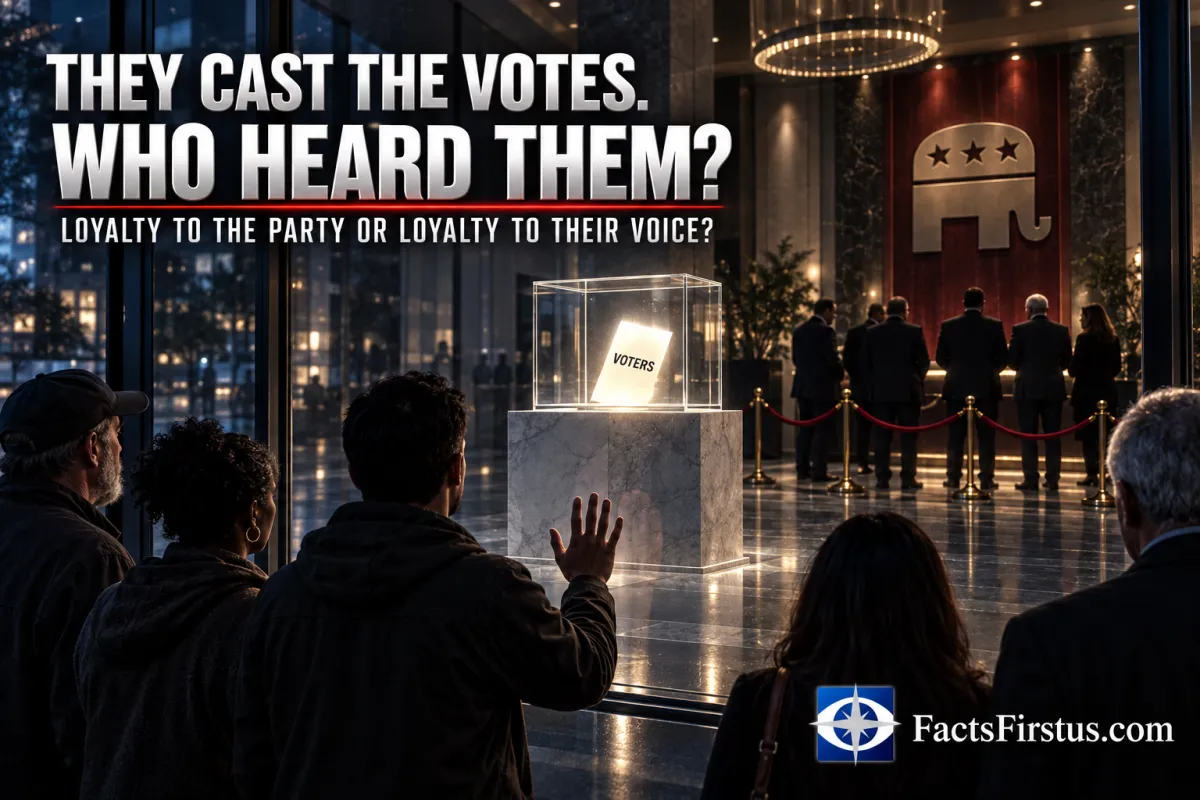
THE VOTERS CHOSE THEIR CANDIDATE. BEHIND A LOCKED DOOR, THE ILLINOIS GOP CHOSE SOMETHING ELSE.
THE VOTERS CHOSE THEIR CANDIDATE. BEHIND A LOCKED DOOR, THE ILLINOIS GOP CHOSE SOMETHING ELSE.
Darren Bailey won the primary. The party reportedly rejected financial support for his ticket. Ted Dabrowski is already promoting what comes next. Now Republican voters must decide whether the party they have supported still represents them.
Staff Writer | September 19, 2026
The door was closed.
The voters were outside.
And inside that room, leaders of the Illinois Republican Party were deciding whether to support the candidates Republican voters had already chosen.
The money was available.
The election was approaching.
Governor J.B. Pritzker had tens of millions of dollars behind him, and the Republican ticket needed help.
The answer was no.
According to published reports and people familiar with the meeting, the Illinois Republican State Central Committee rejected a proposal to provide financial support to Darren Bailey and the other statewide Republican candidates.
That decision did not nominate Bailey.
Republican voters had already done that.
They had studied the candidates, listened to the promises and delivered an unmistakable verdict in the March primary.
Bailey received approximately 53.5 percent of the vote. Ted Dabrowski received approximately 28.8 percent.
Bailey did not survive a contested convention. He did not emerge through a compromise negotiated by party leaders. He did not win because powerful insiders cleared the field for him.
He won because Republican voters chose him.
Six months later, those voters are confronting a possibility far more serious than ordinary disagreement inside a political party.
Their votes may have selected the nominee.
But party leaders may have decided their choice did not matter.
“The whole point of the party, the whole point of working together as an organization, is to try to win elections.”
Aaron Del Mar, Republican candidate for lieutenant governor and State Central Committee member
Del Mar brought the request for assistance before the State Central Committee during Republican Day at the Illinois State Fair.
The discussion took place in executive session. Republican voters were not allowed to hear the debate. They were not told how their representatives argued. They were not shown how each committee member voted.
Sources cited by The Illinoize said the request ultimately involved approximately $150,000 for the statewide ticket. The proposal reportedly failed by a weighted vote of approximately 65 percent to 35 percent.
Some committee members reportedly objected because the request did not contain a completed plan explaining how the money would be divided and spent.
That explanation might justify postponing a decision.
It does not explain abandoning one.
If the plan was inadequate, where was the counterproposal?
If $150,000 was too much, what amount was acceptable?
If the committee wanted financial accountability, why did it not demand a revised budget and reconvene?
If cash assistance was not the best option, where were the organizers, voter data, advertising resources and campaign staff?
The committee had choices.
It could have revised the proposal.
It could have reduced the amount.
It could have attached conditions.
It could have demanded accountability.
It could have developed another plan.
Instead, the reported answer was no.
The party kept the money.
The candidates kept fighting without it.
Attorney and conservative advocate Thomas DeVore described the meaning of that decision in six words.
“The Illinois GOP just voted to lose.”
Thomas DeVore, attorney and conservative advocate
That accusation changes the entire story.
This is no longer only about whether one funding request was properly prepared. It is about whether people with power inside the Illinois Republican Party are willing to watch their own ticket fail because Republican voters nominated someone they did not want.
Del Mar acknowledged that the proposal needed more detail. He also made clear that he was willing to discuss virtually any level of support.
The message was not that the party should surrender its treasury without a plan.
The message was that it should do something.
Republican voters selected the ticket.
Party leaders appear to have selected the sidelines.
That would be difficult enough to explain if the party were broke.
It was not.
Public campaign records showed that the Illinois Republican Party had hundreds of thousands of dollars available between its state and federal operations.
That money would never place Bailey on equal financial footing with Pritzker. No responsible observer expects the Illinois GOP to match a billionaire governor dollar for dollar.
But this was never about matching Pritzker.
It was about showing Republican voters that their party intended to fight him.
Political parties ask for money by warning supporters that everything is at stake. They ask people to attend fundraisers, knock on doors, make telephone calls, display signs and remain loyal during difficult years.
They insist that every contribution matters.
They insist that every volunteer matters.
They insist that every vote matters.
Then Republican voters cast those votes, selected Bailey and watched the party reportedly reject financial support for his ticket behind a closed door.
The contradiction is impossible to ignore.
The money came from Republicans.
The nominee was chosen by Republicans.
The decision to withhold the requested support was made by a small group of Republicans in private.
And the person most likely to benefit from Republican division is not Bailey.
It is Pritzker.
The controversy becomes even more troubling when placed beside the political history of Illinois Republican Chairman Bob Grogan.
Before becoming chairman, Grogan supported Dabrowski in the Republican primary. He did more than offer an endorsement. He served as treasurer of Dabrowski’s campaign committee.
There is nothing improper about that relationship. Primaries exist so candidates, activists and party officials can compete over ideas and direction.
But elections are supposed to settle those competitions.
A primary is not an opinion survey for party leaders to consider and disregard.
It is not a public suggestion box.
The winner becomes the nominee, even when insiders wanted someone else.
Once voters rejected Dabrowski and nominated Bailey, the responsibility of party leadership changed. Grogan was no longer being asked to choose between two primary candidates.
The voters had already chosen.
He was being asked to lead their party.
Grogan has spoken about unity. He has invoked former President Ronald Reagan’s principle that someone who agrees with you most of the time should be treated as an ally, not an enemy.
But unity cannot be demanded only from the voters.
It cannot mean that the grassroots must support candidates selected by party leaders while party leaders remain free to withhold support from candidates selected by the grassroots.
It cannot mean that voters must surrender after losing an internal party contest while insiders may continue resisting after losing a statewide primary.
That is not unity.
That is obedience.
The conflict is not limited to the State Central Committee.
Former Illinois House Republican Leader Jim Durkin publicly dismissed Bailey’s campaign by declaring that there was effectively no election in November.
Former Illinois Republican Chairman Pat Brady warned that Republicans who embrace President Donald Trump and the movement associated with him could become little more than a downstate party.
They have every right to hold those opinions.
But the most recent statewide election results tell a story the party cannot afford to ignore.
In 2024, Trump received 2,449,079 votes in Illinois.
His share of the statewide vote increased from 40.55 percent in 2020 to 43.47 percent in 2024. He carried 88 of Illinois’ 102 counties.
Trump did not win Illinois. Kamala Harris carried the state with 54.37 percent.
But more than 2.4 million Illinois residents voted for the Republican presidential nominee.
Those voters are not a theory.
They exist.
Their names appear in voter files. Their precincts can be identified. Their communities can be reached. Their concerns can be studied. Their support can be organized.
The Illinois Republican Party has spent years complaining about its inability to compete statewide.
In 2024, more than 2.4 million Illinois residents showed the party exactly where a potential Republican coalition could begin.
Some party figures responded by treating that coalition as a problem.
A party that has not elected an Illinois governor since Bruce Rauner’s victory in 2014 should not be looking for Republican voters it can afford to reject.
It should be looking for every voter it can reach.
President Trump has reaffirmed his support for Bailey.
“I’ve already endorsed him. I’m all for Bailey.”
President Donald Trump
Bailey has the nomination of Illinois Republican voters.
He has the endorsement of the Republican president.
He has access to a potential Republican base of more than 2.4 million Illinois voters.
What he does not appear to have is the full force of the Illinois Republican Party.
And one number shows what that failure could cost.
709,984.
That is the approximate difference between Trump’s 2024 Illinois vote and Bailey’s vote in the 2022 gubernatorial election.
Trump received 2,449,079 votes.
Bailey received approximately 1,739,095.
The two elections involved different opponents, different issues and different levels of turnout. The comparison does not prove that every Trump voter would support Bailey.
It proves that the opportunity exists.
Nearly 710,000 more Illinois residents voted for the Republican presidential nominee in 2024 than voted for Bailey in 2022.
A party determined to win would be studying that difference.
Where were those voters?
Why did they turn out?
What messages reached them?
How many live in communities where Republican participation has traditionally fallen?
How many could be persuaded to vote in a gubernatorial election?
How many could be reached through targeted mail, telephone calls, digital advertising and door-to-door organizing?
Those are the questions a party asks when it wants to win.
Instead, Illinois Republicans are being forced to ask whether their party has already decided to lose.
That question becomes harder to avoid as Dabrowski returns to the political stage.
On September 22, the candidate who lost the primary is scheduled to host an event in Bolingbrook called “Ted Dabrowski Shares What’s Next.”
Its promotional message declares that it is time to fight for Illinois, advance reform, unite people and give Illinoisans the tools to become involved.
One name is conspicuously absent.
Darren Bailey.
Illinois is not between elections.
Bailey is not a former nominee.
Pritzker has not already won.
The Republican candidate for governor is fighting the election that will decide who controls Illinois for the next four years.
Dabrowski, meanwhile, is promoting his organization and asking supporters to consider what comes next.
His campaign website remains active. Its language invites supporters to join his movement and build a political opposition in Illinois.
There is nothing inherently wrong with a former candidate remaining politically active. There is nothing improper about maintaining a website, promoting reform or preparing for the future.
But timing reveals priorities.
The fight party leaders say they want is happening now.
Not in 2030.
Now.
DeVore has argued that the possibility of defeat is not merely being predicted by people inside the party.
He believes it is being arranged.
“That is not a prediction of failure. That is the arrangement of it for their own self-serving reasons.”
Thomas DeVore, attorney and conservative advocate
Sources familiar with internal Republican political discussions have described the same fear to FactsFirstus.com.
According to those sources, some party leaders and political insiders would rather endure another four years of Pritzker than fully support Bailey and risk allowing the faction preferred by Republican voters to gain control of the party.
The sources allege that a Bailey loss would preserve an opening for Dabrowski, or another establishment-backed candidate, to seek the Republican nomination in 2030.
Under that reported theory, Bailey loses in 2026.
Pritzker gets four more years.
The people who opposed Bailey blame him for the defeat.
Dabrowski spends the intervening years building his organization, strengthening political relationships and preparing for another campaign.
Republican voters are then told that the candidate they chose failed and that the party must return to the leadership of the people who never wanted him.
DeVore has been blunt about what he believes such a defeat would accomplish.
“We are going to lose in November. The people who just took control of this party are prepared to lose, they want to lose, because a loss is the cleanest argument for keeping their grip on the apparatus that produced it.”
Thomas DeVore, attorney and conservative advocate
FactsFirstus.com has not obtained a written strategy document proving that such an agreement exists.
That must be stated clearly.
The allegation comes from DeVore’s public comments and sources describing internal conversations and the motivations they believe are driving decisions inside the party.
But the absence of a written plan does not erase the public record.
Grogan served as treasurer for Dabrowski.
Republican voters rejected Dabrowski and nominated Bailey.
The State Central Committee reportedly rejected the requested financial support for the statewide ticket.
Prominent former Republican leaders have publicly dismissed Bailey’s prospects.
Dabrowski is promoting his political organization during the general election.
None of those facts independently proves a coordinated plan to sacrifice 2026 for a preferred candidate in 2030.
Together, they make the allegation impossible to dismiss without answers.
FactsFirstus.com contacted Illinois Republican Party leaders and requested responses regarding the committee vote, the party’s support for its statewide candidates and the allegations involving the 2026 and 2030 elections.
To date, they have not responded.
Their silence leaves Republican voters with questions that should have simple answers.
Does Grogan support Bailey without qualification?
How much money, staff assistance, voter data and organizational support has the party provided to its statewide ticket?
Why was no alternative funding proposal adopted?
Will the party disclose how State Central Committee members voted?
What is its plan for reaching the 2,449,079 Illinois residents who voted for Trump?
Does Dabrowski support Bailey?
Will his September event encourage Republicans to help elect the current nominee?
Is he considering another campaign for governor in 2030?
If the allegations are false, party leaders should want to answer.
If the committee’s decision was responsible, they should be willing to defend it.
If a better strategy exists, they should be eager to show it.
Silence does none of those things.
Silence leaves voters staring at a locked door.
This is no longer simply a fight over campaign money.
It is a fight over ownership.
Does the Illinois Republican Party belong to the citizens who vote in its primaries, or to the insiders who control what happens after those votes are counted?
The party has not elected a governor since 2014.
It now has a Republican presidential vote exceeding 2.4 million people, a gubernatorial nominee chosen decisively in the primary and an endorsement from the president those voters supported.
Yet its State Central Committee reportedly rejected financial assistance for the statewide ticket while influential Republicans publicly questioned whether the nominee could win.
That record leaves voters facing a decision no party organization can make for them.
Do they continue waiting for the Illinois GOP to organize the constituency that already exists?
Do they direct their money, volunteer work and political energy toward individual candidates?
Do they organize independently of a party structure they believe has disregarded their choice?
Or will party leaders finally demonstrate, through money, organization and measurable action, that the primary result matters?
No political party is automatically entitled to anyone’s money.
It is not entitled to anyone’s work.
And it is not entitled to anyone’s loyalty.
Those things must be earned through results, accountability and respect for the people whose ballots give the organization its purpose.
For years, Illinois Republicans have been told to remain loyal, wait their turn and trust the people running the party.
They waited.
They voted.
They chose.
Now they are watching party leaders do everything except follow.
Pritzker does not need every Republican to support him.
He does not need the Illinois GOP to endorse him.
He needs Republican leaders to waste time, withhold resources, fracture their voters and prepare for the next election before this one is finished.
He needs a Republican Party more interested in controlling defeat than risking victory with a nominee its insiders did not choose.
If that is what is happening, the greatest obstacle confronting Illinois Republicans is not Pritzker’s fortune.
It is not Chicago.
It is not the Democratic machine.
It is the party standing between Republican voters and the candidate they selected.
The voters spoke in March.
Party leaders answered behind a locked door.
Now those voters must decide whether to keep knocking or go around the party and carry their choice directly to November.
Because if the Illinois GOP will not fight for the candidate its voters chose, those voters must confront one final question.
What, exactly, is the party for?
Official sources
Illinois State Board of Elections, campaign disclosure database
Illinois State Board of Elections, Illinois Republican Party disclosure filing
Illinois Secretary of State, Illinois General Election Results for 2024
Secondary sources
FactsFirstus.com, Eleven Votes. One Locked Door. A Party Turning on Its Own Ticket.
FactsFirstus.com, Illinois Republican Party Statewide Election Struggles
The Illinoize, Del Mar Accuses Illinois GOP of Withholding Funding from Bailey
The Daily Northwestern, Rauner Defeats Quinn to Become State Governor
Mark Vargas, “Illinois GOP’s Real Problem Isn’t Money. It Doesn’t Want Trump’s Candidate to Win,” published September 17, 2026.
Sources familiar with internal Republican political discussions who spoke with FactsFirstus.com. Their allegation concerning the 2026 election and a possible 2030 Dabrowski candidacy has not been independently established through documentary evidence.