
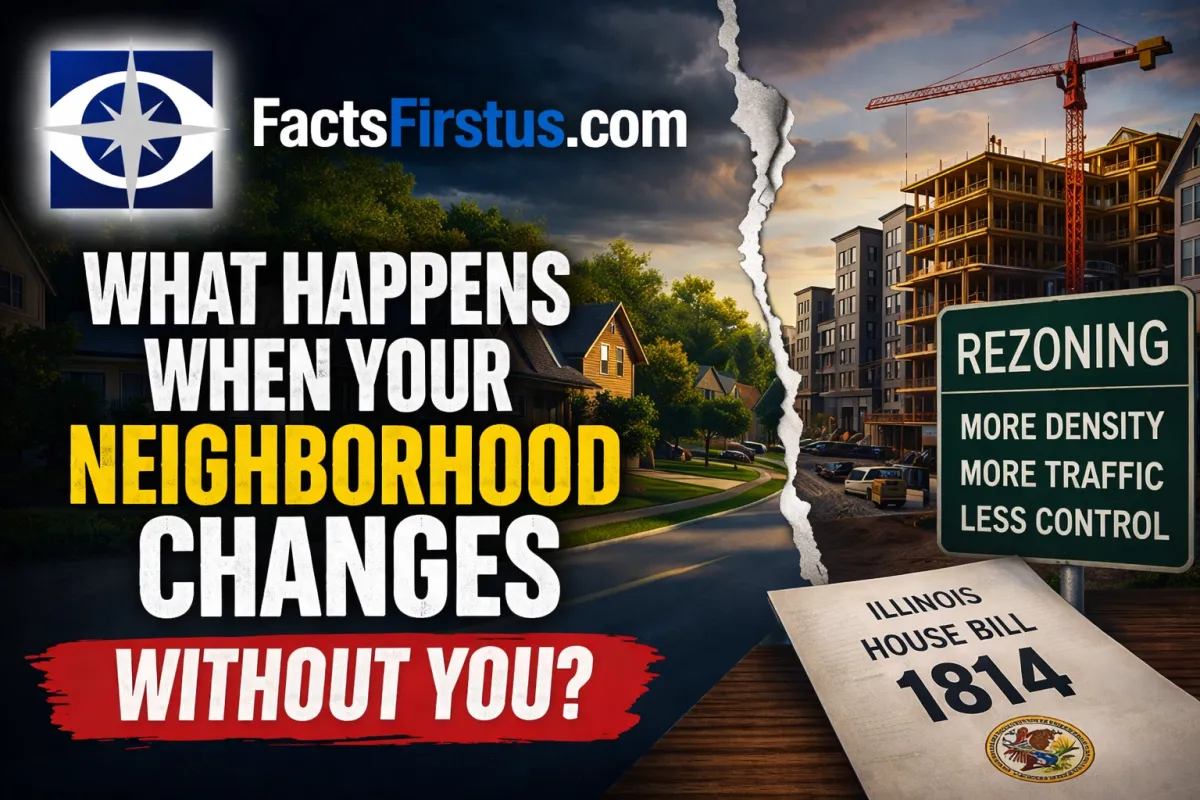
WHAT HAPPENS WHEN YOUR NEIGHBORHOOD CHANGES WITHOUT YOU?
WHAT HAPPENS WHEN YOUR NEIGHBORHOOD CHANGES WITHOUT YOU?
How Illinois House Bill 1814 could redefine homeownership, local control, and the future of where you live
By Staff Writer
April 19, 2026
A quiet street. A familiar view. The kind of place people work years to afford.
And then, one day, it starts to change.
Not all at once. It rarely does.
At first, it is subtle. A few more cars than usual. A little less space. A feeling that something is shifting, even if you cannot quite explain it yet.
Then you notice it.
And once you do, it is hard to unsee.
If you read “The Law That Could Change Your Neighborhood Forever,” you have already seen how that kind of change can begin.
Read the full story here: https://factsfirstus.com/post/illinois-house-bill-1429
That conversation focused on public spaces. Parks. Walking paths. Shared areas. It raised the question of what happens when policies begin to allow homeless encampments in places families once relied on without hesitation.
This is something different.
This is about where you live.
There was a reason you chose your home.
It might have been the quiet of a neighborhood in places like Chatham, Normal, or the outer edges of Springfield. The space between houses. The predictability of a street that felt settled.
You do not arrive there by accident.
You work for it. You save for it. You build your life around it.
Now picture something else.
A home near Lake Springfield. A view of the water. Something beautiful. Something earned through years of hard work and careful investment, not just in a house, but in the community around it.
Now picture that view changing.
Construction begins. Traffic increases. More units appear where there was once one.
And the realization that it is not temporary.
Illinois House Bill 1814 has the potential to make changes like that possible in ways many communities have never had to consider before.
The proposal, sponsored by State Representative Bob Rita and co-sponsored by State Representative Jay Hoffman, is part of a broader push tied to Governor J.B. Pritzker’s “Building Up Illinois” plan.
On paper, it is about housing.
In practice, it is about how neighborhoods are allowed to evolve.
Under the proposal, towns with populations between 10,000 and 25,000 would be required to allow duplexes on lots that are currently zoned for single family homes. In larger cities, multi-unit housing would be permitted on residential lots as small as 5,000 square feet.
Other legislation moves in the same direction.
Taken together, they point toward something larger.
A future where single-family zoning, as people have known it, could become far less common across Illinois.
Supporters argue the need is real.
Housing supply is limited. Prices are rising. Many families are struggling to find something they can afford.
More housing, in more places, is one way to respond.
Housing advocates also point out that without changes like this, younger families and first-time buyers may never be able to enter the very neighborhoods others are trying to preserve.
That argument carries weight.
But policy is not measured by how it sounds when it is introduced.
It is measured by what it changes.
Because this is not just about building somewhere new.
It is about what happens next door.
A single-family home becomes two units. Then four. Then something larger.
More people on streets that were never designed for that level of density. More cars. More congestion. More pressure on infrastructure that was built for something else.
It does not happen all at once.
It builds.
And then it stays.
If growth comes at the cost of stability, what exactly are communities being asked to trade?
Schools are often where that change shows up first.
Districts like Ball Chatham or Springfield Public Schools plan years in advance. They look at enrollment trends, staffing needs, and classroom capacity with precision.
When density increases faster than expected, those plans can be strained.
Classrooms fill more quickly. Resources stretch thinner. Adjustments that should take years are compressed into months.
A central Illinois school administrator, speaking generally about these shifts, put it simply. “We build around projections. When those projections change quickly, the pressure shows up in the classroom almost immediately.”
That pressure does not stay contained.
It spreads.
Safety becomes part of the conversation.
In lower density neighborhoods, people tend to know each other. They recognize routines. They notice when something feels off.
That familiarity is part of what makes a place feel secure.
When density increases quickly, that begins to change.
A resident in a Springfield neighborhood described it this way. “You start to feel like you do not recognize your own street anymore. That changes how comfortable people feel, even if nothing specific has happened.”
Crime statistics may take time to reflect change, but perception often moves faster.
And perception alone can influence whether families stay or begin to look elsewhere.
For homeowners, another question follows closely behind.
What happens to value?
A home is not just a place to live. For most families, it is their largest investment.
Illinois already ranks among the highest states in the nation for property taxes, which adds pressure long before questions about zoning and density enter the picture.
When the structure of a neighborhood begins to change, the housing market can shift with it.
Buyers who are looking for space and stability may begin to look elsewhere. What once felt predictable becomes uncertain.
Demand softens. Expectations change.
Even that uncertainty alone can slow what was once steady.
And once that shift begins, it is not easily reversed, especially for the people who are already invested in it.
There is another part of this conversation that is harder to ignore.
Control.
For generations, decisions about zoning have been made at the local level. Communities decided what fit their infrastructure, their schools, and their long term plans.
This proposal does not just change zoning.
It changes who decides.
It places that authority at the state level, with Governor J.B. Pritzker and Democratic supermajorities in the Illinois General Assembly.
The goal, according to state leaders and supporting reports, is to increase housing supply by standardizing what can be built across Illinois.
But that raises a deeper question.
If the character of a neighborhood can be rewritten from the outside, then ownership begins to mean something different.
Governor J.B. Pritzker addressed the broader goal during a budget address, saying, “If we are going to build on this state’s record of growth and prosperity, lower costs for Illinois’ working families and be a state that everyone can call home, we must build more housing in every Illinois community from Cairo to Chicago.”
There is no question the challenge is real.
Housing is expensive. Supply is limited. Families feel it every day.
The goal may be more housing.
The question is what happens to everything built around it.
There is also a more direct and increasingly unavoidable question being raised about what is driving the urgency behind these proposals.
Critics argue that recent policy decisions in Illinois have significantly increased demand on housing and public resources across the state. They point to the state’s long standing sanctuary policies and the continued arrival of migrants, including those who entered or remain in the country without legal authorization, as factors that have added pressure to systems that were already strained.
In that view, the demand is not theoretical. It is immediate, and it is already being felt across communities that were never designed to absorb it at this pace.
Some lawmakers, policy analysts, and local officials have raised concerns that proposals like House Bill 1814 are not just about long-term housing affordability, but about creating the ability to build housing more quickly and at a larger scale in response to that growing demand.
That perspective frames the issue differently. Not simply as a housing shortage, but as a question of how rapidly the state is trying to respond to pressures that have changed in a relatively short period of time.
State leaders, however, have consistently pointed to broader trends, including years of limited housing supply and rising costs, as the primary drivers behind the legislation.
There are other ways to approach the same problem.
Lowering property taxes could make homeownership more attainable without changing the structure of existing neighborhoods.
Making Illinois more attractive to businesses could bring jobs, increase wages, and give families more stability.
Encouraging development in areas already designed for growth could expand supply without forcing rapid change into established communities.
These approaches are not simple.
But they focus on the root of the issue, not just the outcome.
At some point, this stops being about policy.
It becomes personal.
These are not changes people vote on street by street. They happen at a distance and then arrive in ways that feel sudden.
But in real life, the shift is quieter. It builds slowly, and then it stays.
It becomes about the place you chose.
The place you invested in.
The place you believed would remain, at its core, what it was when you said yes to it.
And once that changes, it does not change back.
At some point, this stops being about policy and starts being about ownership.
You chose where you live. You invested in it. You trusted that the character of your neighborhood meant something.
If that can be changed from the outside, without your community having a say, then the question is no longer just about housing.
It is about whether the place you call home is still yours.
Official Sources and References
Illinois General Assembly, House Bill 1814
Illinois General Assembly, House Bill 4795
Office of Governor J.B. Pritzker, Budget Address Remarks
Crain’s Chicago Business, reporting on Illinois zoning reform proposals
Illinois Ad Hoc Missing Middle Housing Solutions Advisory Committee